


Recent Posts
Categories
Tags
Years
Self-Employed 18 Months and Turned Down: How a Second Home Still Closed
A composite of files like this one. Details are combined and changed so no one is identifiable.
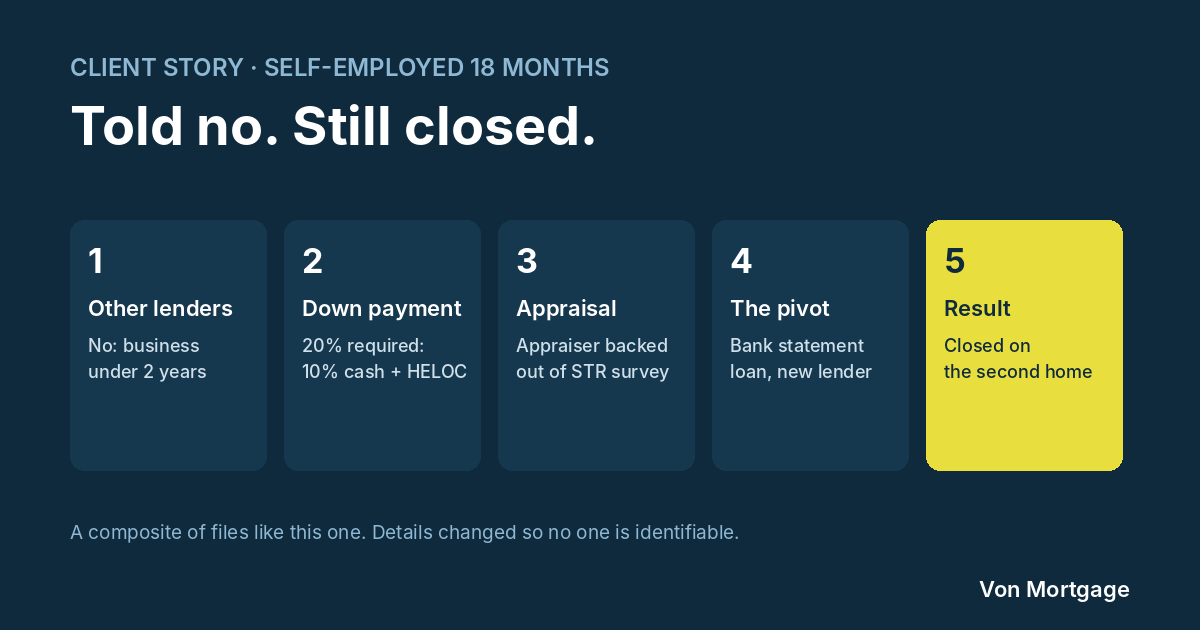
The buyers had already heard "no" before they called me. Other lenders told them the same thing: the business has only been open 18 months. Come back when it's been two years.
It didn't matter which loan they asked about. For a regular loan, those lenders wanted two years of tax returns. For a bank statement loan, which skips the tax returns, they still wanted proof the business had been established for at least two years.
They'd already found the house: a second home they planned to use themselves and rent out when they weren't there.
Why did the other lenders say no?
Most lenders set a two-year minimum for self-employed borrowers, and they apply it to more than tax returns. On a conventional loan, the two years shows up as two years of returns. On a bank statement loan, which qualifies you on 12 or 24 months of deposits, many lenders still require the business itself to have existed for two years. These buyers had 18 months, in a new field with no prior W-2 work in the same line. Every door they tried had the same lock.
But two years isn't a law. It's a common lender rule. A bank only offers its own programs. A broker can shop the file to the smaller set of lenders that will accept a newer business.
How do you cover a 20% down payment without 20% in cash?
This type of loan required 20% down. What most buyers don't realize is that the down payment doesn't have to come only from cash in the bank. If you own other property with equity, you can borrow against it to cover part of the down payment, or sometimes all of it.
That's where real planning comes in. These buyers had the cash for the full 20%. We laid out the options side by side:
- Use cash for the full 20%. No new debt, but a big chunk of savings goes into the house.
- Put 10% in cash and borrow the other 10% with a home equity line of credit (HELOC) on their primary residence. They keep more cash on hand, in exchange for a second payment.
Neither is right for everyone. The question is what you'd rather hold onto: cash in the bank, or less monthly debt. Seeing the real payment on each option made the choice easy. They kept their cash and used the HELOC.
A HELOC counts as debt when the lender calculates what you can afford, and HELOC rates are usually variable. So the numbers have to work with that payment included, and you should plan for it to move.
What went wrong in escrow?
We started with a DSCR loan, which qualifies a property on its rental income instead of the borrower's income. For a newer business, that sidesteps the two-year problem entirely.
Because the plan included short-term rental income, the appraisal needed a short-term rental income survey. The appraiser accepted the order, then backed out before delivering the report. They'd decided they didn't want to do the short-term rental survey. We'd lost valuable time with no appraisal, and the escrow deadline was still running.
How did we save it?
We pivoted to a bank statement loan, which qualifies the buyers on 12 months of business deposits instead of tax returns.
This is where the file had died before. The other lenders offered bank statement loans too, but only for businesses open two years or more. So we went looking for a lender that would accept a business open less than two years, and found one. That was the key move, and it's only possible when you can shop more than one lender.
New loan, new lender, new appraisal, with the escrow clock still running. It was close, but it closed.
What did it cost?
Less than most people expect. The bank statement loan came in at a competitive rate, close to what the buyers would have paid on a standard second-home or investment purchase. A newer business didn't mean a punishing rate. It meant finding the right lender.
What's the lesson if you're self-employed?
"No" from one lender usually means "not with our programs." The two-year business history rule is common, but it isn't universal. Some lenders will look at a newer business.
Your down payment can come from more than your savings account. Equity in a home you already own can cover part of it, or sometimes all of it. Look at both options with real payments before you decide.
Ask early whether the appraisal needs anything unusual. Short-term rental surveys, rural properties and unique homes all narrow the list of appraisers who'll take the job. A cancellation late in escrow can cost you weeks.
Have a backup plan before you need one. The DSCR loan was the right first choice. Knowing a bank statement option existed kept the deal alive when the appraiser walked.
I'm Pete Metz, a mortgage broker at Von Mortgage in Redding, California (NMLS #260571). If you've been told no because your business hasn't been open long enough, send me your situation and I'll tell you honestly whether there's a path and what it costs. You can also see how self-employed borrowers qualify, read what you can do without a 2025 tax return, or learn how DSCR investor loans work.
Disclaimer: This information is educational and is not a commitment to lend, a loan approval, or an offer of credit. Any rates, payments, down payments or other figures shown are illustrative examples only — not quoted terms and not an offer to extend credit. Actual rates and terms depend on credit, income, property, occupancy and market conditions, and change daily. For current pricing see vonmortgage.com/rates.
Pete Metz, Mortgage Broker · NMLS #260571
Dream Big Ownership LLC dba Von Mortgage · NMLS #2592815
2777 Bechelli Lane, Redding, CA 96002 · Pete@VonMortgage.com
Equal Housing Opportunity.
 Equal Housing Lender
Join the conversation
Comments are reviewed before they appear. Have a question about your own situation? Ask Pete directly — that stays private.
No comments yet