


Recent Posts
Categories
Tags
Years
No 2025 Tax Return Yet? How Self-Employed Borrowers Still Buy
Every fall I get the same call. A self-employed borrower has found the house, their 2025 return isn't done, and they assume that means waiting until spring. Most of the time it doesn't. I've closed plenty of buyers who were sure they had to wait.
The answer depends on two things: when your loan funds, and how much you're putting down.
Can you get a mortgage before your 2025 tax return is filed?
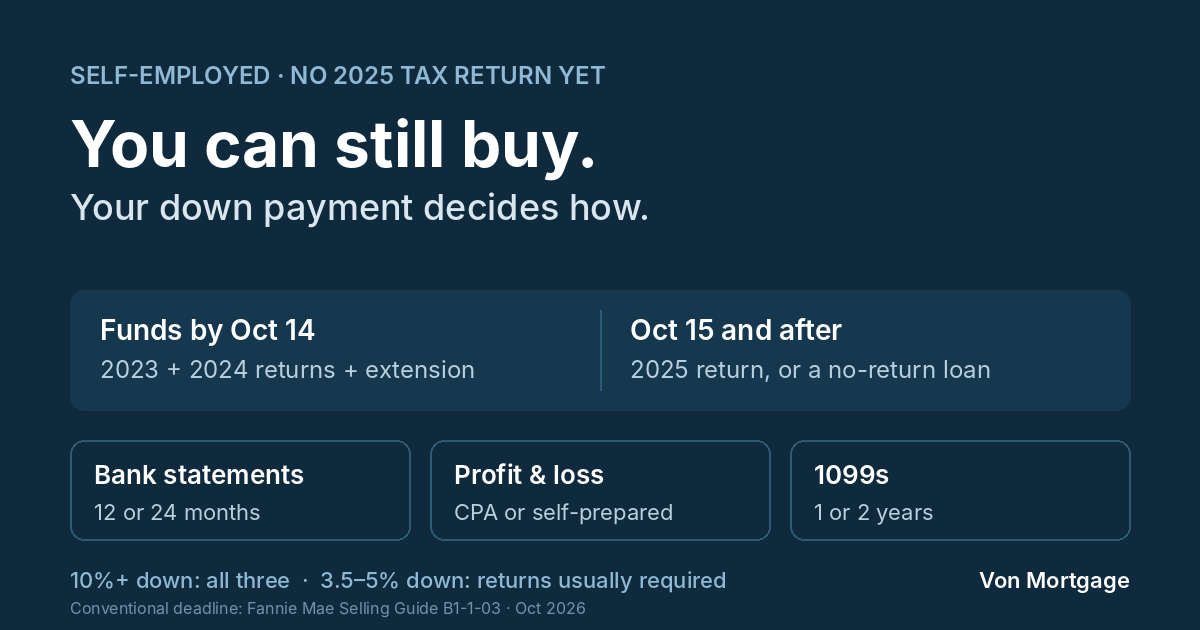
Yes. If you filed an extension, a conventional loan can still close on your 2023 and 2024 returns, as long as it funds by October 14. After that, you need either the 2025 return or a loan that doesn't use tax returns at all. Those exist, and they're how most of my self-employed buyers close in the fall.
Can you use your last two returns plus an extension?
Yes, until October 14. Fannie Mae's Selling Guide (section B1-1-03, as of October 2026) lets a conventional loan use your two prior returns if you filed IRS Form 4868 and the loan disburses by October 14, 2026. The lender will want proof you filed the extension and confirmation from the IRS that no 2025 return is on file yet. They'll also compare the tax you estimated on the extension to prior years. A big swing can trigger a request for the new return anyway.
From October 15 on, the 2025 return is required for a conventional loan. The IRS doesn't grant a second extension past October 15, except in narrow cases like disaster relief.
What are your options after October 15?
There are three ways to qualify without a filed return:
- Bank statements. Your income is calculated from 12 or 24 months of deposits. Twenty-four months can help if the last year was slow.
- Profit and loss statement. Some lenders accept one you prepare. Others want it from a CPA or tax preparer.
- 1099s. If you're paid as a contractor, one or two years of 1099s can stand in for the return, depending on the lender.
Why does your down payment change which options you get?
With 10% or more down, all three options are on the table. With 3.5% or 5% down, there's a good chance the lender will require tax returns.
There's one exception I use. One lender we work with offers an FHA loan that qualifies you on a profit and loss statement with 3.5% down. The rate and costs are higher than a standard FHA loan. But because it's an FHA loan, you can later do an FHA streamline refinance to the market rate without qualifying on income again. HUD Handbook 4000.1 allows that once 210 days have passed since closing and you've made six payments.
What if you're buying an investment property?
Then your tax returns may not matter at all. A DSCR loan qualifies the property on its rent, not on your income. It's built for exactly this borrower. See how DSCR investor loans work.
What do these loans cost compared to a regular mortgage?
More, and you should know how much before you choose one. In Von Mortgage's pricing for October 2026, a borrower buying a primary residence with a credit score of 740 or higher is seeing rates about half a percent above conventional. Below 740, the gap can run 1% to 1.5%.
On a $400,000 loan, half a percent is real money. At 6.5%, principal and interest on a 30-year loan run about $2,528 a month. At 7%, about $2,661. That's roughly $133 a month for skipping the tax return.
The FHA streamline only helps if rates are lower when you're eligible to use it. Nobody can promise that.
For investment properties, a DSCR loan with a prepayment penalty can bring the rate down by 0.75% to 1%. That option exists only on investment properties, not primary residences or second homes.
What should you do if you're self-employed and buying soon?
Talk to a broker before you talk to your tax preparer about timing. Some buyers are better off filing fast and using a conventional loan. Others are better off with a bank statement loan and a refinance later. Your down payment decides more of this than people expect, so know that number first.
I'm Pete Metz, a mortgage broker at Von Mortgage in Redding, California (NMLS #260571). I'd rather you know all of these options before you write an offer than find out in escrow. If your return isn't done and you've found the house, send me your situation and I'll tell you which of these fits and what it costs. You can also see how self-employed borrowers qualify or check today's rates.
Disclaimer: This information is educational and is not a commitment to lend, a loan approval, or an offer of credit. Any rates, payments, down payments or other figures shown are illustrative examples only — not quoted terms and not an offer to extend credit. Actual rates and terms depend on credit, income, property, occupancy and market conditions, and change daily. For current pricing see vonmortgage.com/rates.
Pete Metz, Mortgage Broker · NMLS #260571
Dream Big Ownership LLC dba Von Mortgage · NMLS #2592815
2777 Bechelli Lane, Redding, CA 96002 · Pete@VonMortgage.com
Equal Housing Opportunity.
 Equal Housing Lender
Join the conversation
Comments are reviewed before they appear. Have a question about your own situation? Ask Pete directly — that stays private.
No comments yet