




Recent Posts
Categories
Tags
Years
Portable Mortgage: Can You Take Your Mortgage Rate With You?
Clients have asked me about portable mortgages all year. They heard you'd be able to sell your house, keep your 3% rate, and use it on the next one. I couldn't answer them well, because I didn't understand how it would work with the way mortgages are actually funded. So I read the bill.
It's two sections and less than a page long. It tells Fannie Mae and Freddie Mac to buy portable loans. It doesn't say how a loan gets from one house to another, what happens to it in between, or who pays for it. Either Rep. Tom Kean Jr. (R-NJ), the congressman who introduced it, doesn't know how the mortgage business works, or he knew how hard the answer is and chose not to explain how Fannie and Freddie would pull it off.
I'm Pete Metz, a mortgage broker at Von Mortgage in Redding, California (NMLS #260571). This is what the bill says, what it leaves out, and what you can actually do today if you're sitting on a low rate and want to move. Written October 2026.
What is a portable mortgage?
A portable mortgage is a home loan you can move from the house you sell to the house you buy, keeping the same interest rate, balance and terms. Instead of paying off your loan at closing and taking out a new one at today's rate, the loan comes with you.
Portable mortgages are common in Canada and the UK. They are not available on standard 30-year fixed loans in the U.S. today. A portable mortgage is also different from an assumable mortgage. With an assumable loan, the buyer of your house takes over your loan. With a portable loan, you keep it and take it to your next house.
What is the MOVE Act?
The MOVE Act is a House bill that would require Fannie Mae and Freddie Mac to buy and securitize portable conventional mortgages. Its full name is the Making Ownership Viable for Everyone Act, H.R. 10028. Rep. Tom Kean Jr. (R-NJ) introduced it on August 3, 2026, and it was referred to the House Financial Services Committee. Kean said he introduced it after hearing from New Jersey residents who feel stuck in homes that no longer fit them because moving would mean giving up their rate (Kean press release, Aug. 3, 2026). That problem is real. My issue is with how the bill tries to solve it.
The core of the bill is one sentence. Within 180 days of the law passing, Fannie and Freddie would have to start buying conventional loans where the lender lets the borrower move the "interest rate, terms and balance" to a new property within 90 days of selling the old one.
That's the whole mechanism. The bill has no other definitions, no rules on requalifying, and nothing about borrowing more for a bigger house. (Bill text, GovInfo)
Has the MOVE Act passed?
No. As of mid-October 2026, the only recorded action is its referral to committee on August 3 (official bill status record, GovInfo). It has no cosponsors, no hearing, no committee vote, and no Senate version. This Congress ends January 3, 2027. A bill that hasn't moved by then dies and has to be introduced again.
A separate bill, the Take Your Rate Act (H.R. 7754, introduced March 3, 2026), would only order HUD and the FHFA to study portability. FHFA Director Bill Pulte said in November 2025 that the agency was evaluating portable and assumable mortgages. As of this writing, no study, pilot or program has been announced.
Would the MOVE Act let me keep my 3% rate?
Almost certainly not. The bill doesn't say whether existing loans are covered. It only tells Fannie and Freddie to buy loans whose terms already allow porting.
Your 2021 loan doesn't have those terms. Your note says the loan is due when you sell, and the loan was sold to investors years ago on exactly that promise. Nothing in the bill tells anyone to rewrite existing notes or change the investment pools they sit in. As written, it only affects loans made after it passes.
How would a portable mortgage actually move to a new house?
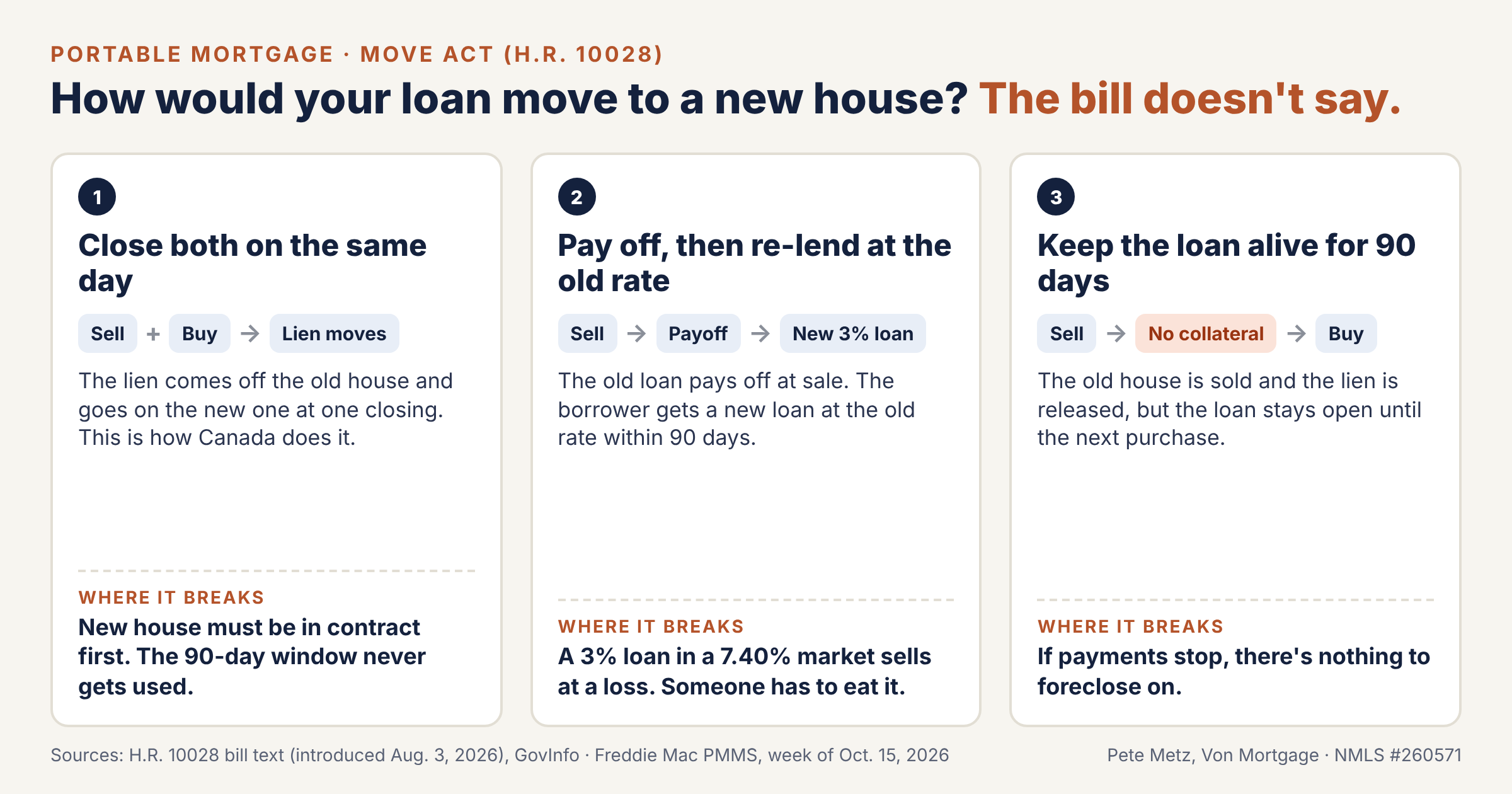
The bill doesn't say, and that's the problem. When I walked through it, I could only see three ways it could work.
Close both on the same day. The lien comes off the old house and goes on the new one at the same closing. This is how RBC, one of Canada's largest banks, handles porting. It works, but it means you have to have the new house in contract before the old one closes. The 90-day window in the bill would never get used.
Pay the loan off at the sale, then make a new loan at the old rate. The UK works closer to this. Nationwide, for example, refunds the early payoff penalty if the new purchase closes within 180 days. Here, the new loan would be a 3% loan in a 7.40% market. Nobody can sell that loan at full value, so somebody eats the difference. The bill doesn't say who.
Keep the old loan alive with no house behind it for up to 90 days. This is the one the bill's wording seems to describe, and it's the one that worries me most. The house is sold, the buyer's lender wants clear title, so the old lien has to come off. Now Fannie or Freddie holds a loan with nothing securing it. If the borrower stops paying during those 90 days, there's nothing to foreclose on.
The bill also doesn't answer the questions I'd have on any file. Does the borrower requalify? Does the new house need an appraisal that supports the old balance? What if the new house costs more, which it usually does?
Why doesn't this work like it does in Canada?
Because Canadian and British mortgages aren't 30-year fixed loans. In Canada, fixed terms are typically five years or shorter. In the UK, two to five years is common. The rate resets when the term ends anyway.
Porting there mostly exists to avoid a penalty for paying off early. Americans don't pay that penalty. You can pay off a U.S. conforming loan when you sell at no cost. So in Canada, porting protects a rate for a few years. In the U.S., it would protect a rate for up to 30.
Who pays for a portable mortgage?
Everyone who borrows after it exists, most likely. Investors who buy mortgage bonds price them on the assumption that people move and pay off. Before the low-rate years, a typical 30-year loan lasted about seven years. If borrowers can carry a cheap rate from house to house, investors get stuck holding below-market loans much longer, and they charge for that risk up front.
The Urban Institute estimated portable loans could carry rates up to 0.40 percentage points higher (Urban Institute, Dec. 10, 2025). MSCI argued in January 2026 that a porting fee paid to investors could offset that. Both can be true. It depends entirely on a fee the bill never mentions.
How big is the lock-in problem?
Big enough that the idea keeps coming back. In the second quarter of 2026, 49.1% of outstanding U.S. mortgages had rates under 4%, and 22.5% were at 6% or higher (FHFA National Mortgage Database, Q2 2026, via Calculated Risk, Oct. 1, 2026). Freddie Mac's 30-year average was 7.40% for the week of October 15, 2026 (Freddie Mac PMMS).
In dollars, a $400,000 loan at 3% runs about $1,686 a month in principal and interest. The same loan at 7.40% runs about $2,770. That's roughly $1,080 a month to move into the same price house.
The FHFA found each percentage point between a homeowner's rate and the market rate lowered the chance they'd sell by 18.1%, and estimated the lock-in prevented about 1.33 million home sales from mid-2022 through 2023 (FHFA Working Paper 24-03, March 2024). The same research found California metros among the most locked-in in the country.
What can a locked-in homeowner do right now?
The closest thing that exists today is an assumable loan. FHA, VA and USDA loans can be assumed, meaning a buyer takes over the seller's loan and rate on the same house. That helps you when you sell, not when you buy.
Assumptions are rare. About 6,400 were completed in 2023 (Scotsman Guide). The buyer has to cover the gap between the loan balance and the price, servicers are slow, and on a VA loan the seller's entitlement can stay tied up if the buyer isn't a veteran. Since August 2024, VA has allowed a second loan to cover the gap (VA Circular 26-24-17).
Is it worth giving up a low rate to move?
When someone asks me whether it's worth moving and taking a higher rate, it really comes down to two things: lifestyle and budget. I wouldn't move for no good reason.
But I'm in that spot myself. Since 2021, I've gotten married, and we now have three amazing kids. The home we have now isn't right for our family. We need more space. The memories we share and the time we spend together in our home matter more to me than the financial picture of my house and my mortgage.
My income has also gone up about 15% since 2021. So for me, it comes down to two questions. Can I comfortably afford the new payment at the higher rate? And will this new home be a place my kids enjoy, where we can make great memories as a family? For me, the answer to both is yes, and the move is worth it.
That won't be the case for everyone, because both have to be true. The payment has to be comfortable, and the new home has to make life better for your family. If you're on the fence, let us give you accurate numbers with your real payment. Once you know the real numbers, the decision gets a lot easier, one way or the other.
What this means for you
If you have a low rate today, the MOVE Act won't change your situation, even if it passes. Don't put off a move your family needs while you wait for it. If portability ever arrives, it will most likely be for new loans, and it may cost a little more up front.
If you want to see your real numbers, I'm happy to run your move side by side: your current payment, the new payment, and what it takes to get there. You can also check today's rates yourself. For more on why rates move, see how the CPI report affects your rate lock.
Disclaimer: This information is educational and is not a commitment to lend, a loan approval, or an offer of credit. Any rates, payments, down payments or other figures shown are illustrative examples only — not quoted terms and not an offer to extend credit. Actual rates and terms depend on credit, income, property, occupancy and market conditions, and change daily. For current pricing see vonmortgage.com/rates.
Pete Metz, Mortgage Broker · NMLS #260571
Dream Big Ownership LLC dba Von Mortgage · NMLS #2592815
2777 Bechelli Lane, Redding, CA 96002 · Pete@VonMortgage.com
Equal Housing Opportunity.
 Equal Housing Lender
Join the conversation
Comments are reviewed before they appear. Have a question about your own situation? Ask Pete directly — that stays private.
No comments yet