




Recent Posts
Categories
Tags
Years
Can a retired person get a mortgage?
Yes. A lender generally can't turn you down because of your age, and you don't need a paycheck. Social Security, pensions, retirement withdrawals and dividends can count as income, and many retired families also qualify on savings through asset depletion, where the lender divides eligible savings by a set number of months to create monthly income.
By Pete Metz, mortgage broker at Von Mortgage in Redding, California, NMLS #260571. Updated November 2026.
In the last 12 to 24 months, multiple retired families with savings but no paycheck have come to me after another lender told them they couldn't qualify. Those loans closed.
Federal law backs this up. Under the Equal Credit Opportunity Act and Regulation B (12 CFR 1002.6, eCFR, current as of November 19, 2026), a lender can't discount your income because it comes from a pension, an annuity or another retirement benefit. See what counts as income for a mortgage beyond a paycheck.
How do retirees qualify for a mortgage without a paycheck?
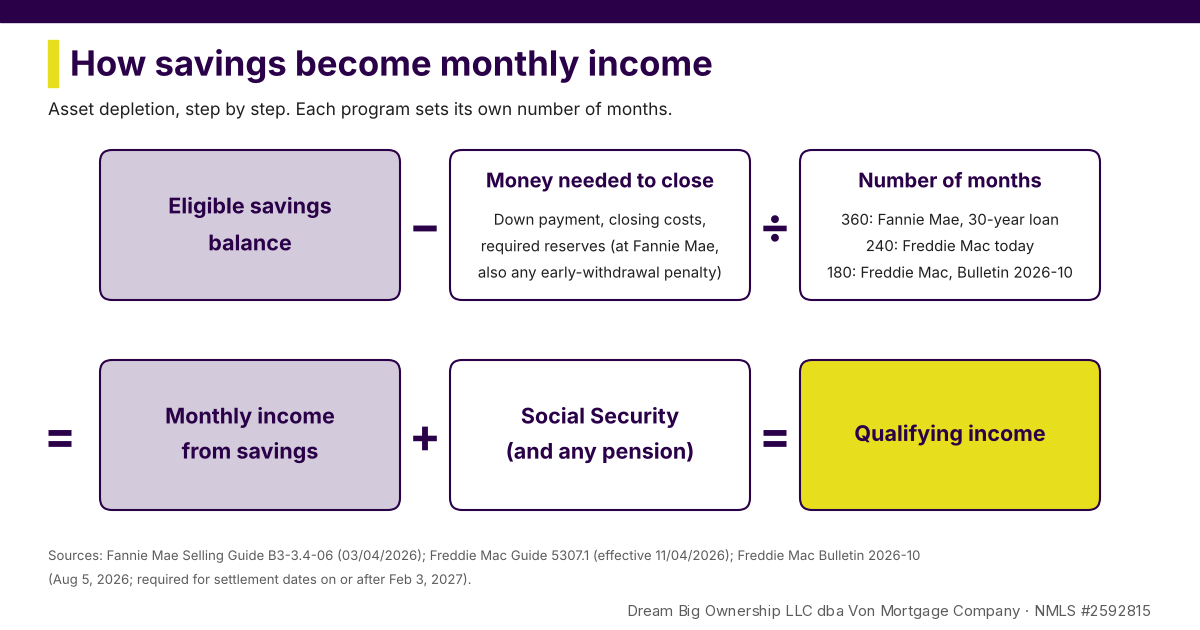
They qualify on what they've saved, added to the income they already get. Asset depletion is a lending rule that lets a lender count savings as monthly income. The lender starts with your eligible balance, subtracts the down payment, closing costs and required reserves, and divides what's left by a set number of months.
You can add your Social Security income to your asset depletion income and use both together to qualify. That's how I build these files.
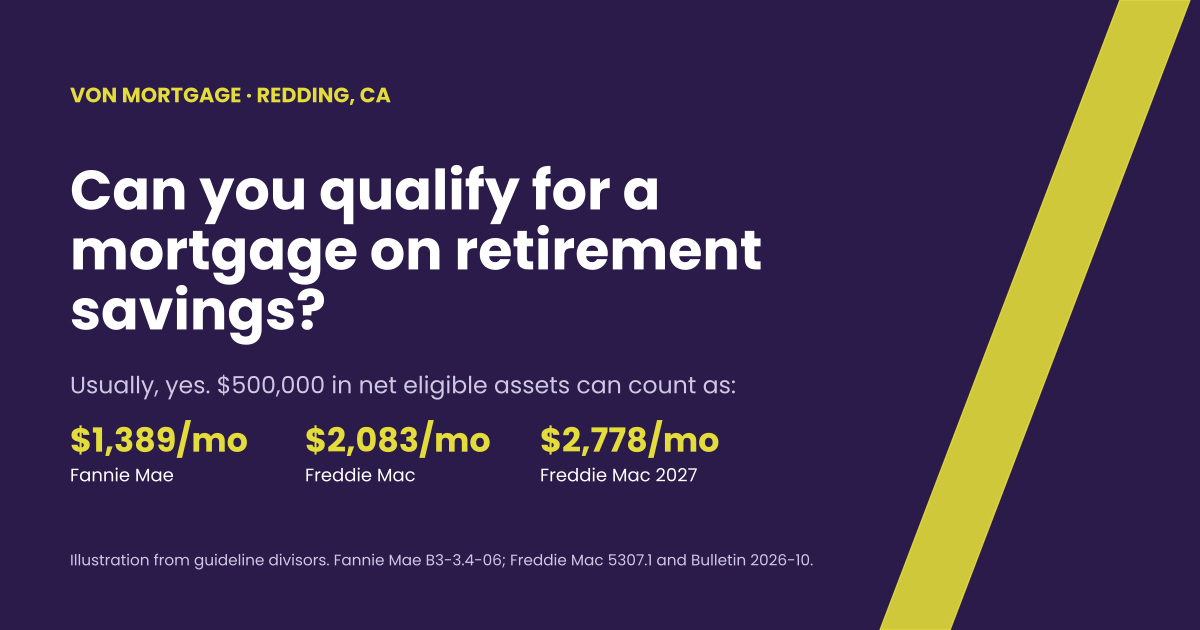
Example, round numbers, not a quote. After the down payment, closing costs and reserves, a family has $600,000 of eligible savings left. Divided by 360 months, that's about $1,667 a month. Divided by 240 months, it's $2,500. Divided by 180 months, it's about $3,333. Add an example $3,000 a month of Social Security, and qualifying income is about $4,667, $5,500 or $6,333. I left out the Social Security gross-up below to keep the math simple.
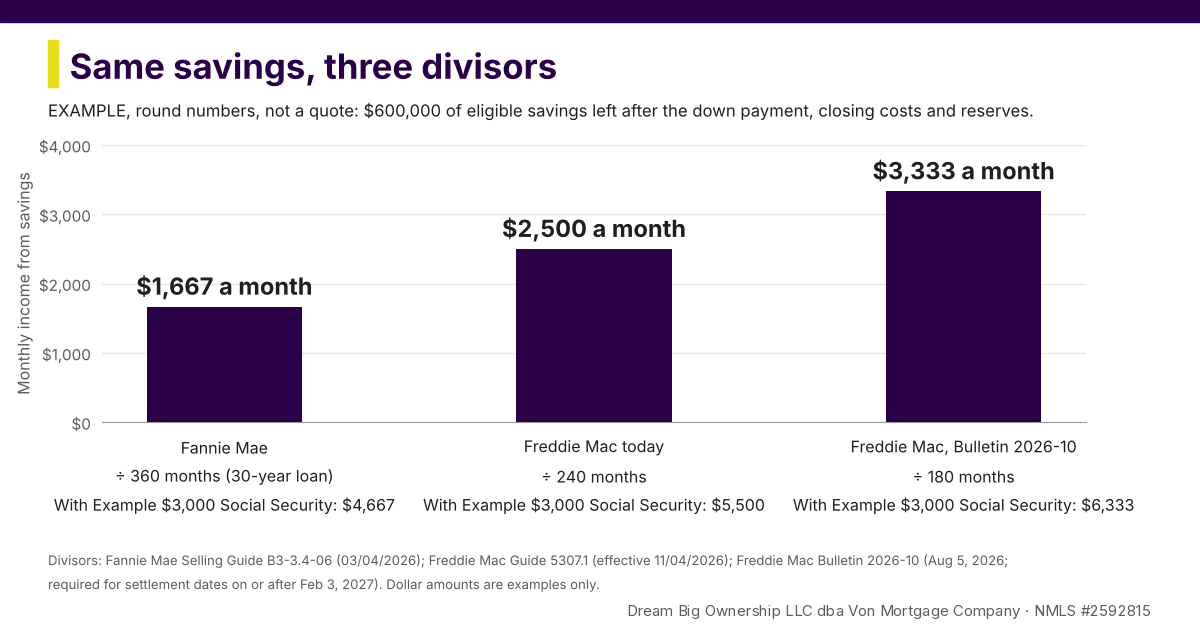
The 360 comes from Fannie Mae on a 30-year loan (Selling Guide B3-3.4-06, dated March 4, 2026). The 240 is Freddie Mac's current rule (Guide Section 5307.1, effective November 4, 2026). The 180 is Freddie Mac's new rule under Bulletin 2026-10 (August 5, 2026). For the full rules, read how asset depletion works.
Why would a lender say no to a retired family with savings?
Usually because that lender didn't know the rule, or didn't know how to use it. The families who came to me had been told no by lenders who didn't realize they could use their assets, through asset depletion, to help them qualify for the purchase.
The rules also change from one program to the next: the number of months, the down payment and the accounts that count. A file that falls short under one set of rules can work under another.
As a broker, I can run the same file under Fannie Mae rules, Freddie Mac rules or a non-QM asset-based program, which is a loan built outside those two sets of rules. Every family gets a total cost analysis so you can see each option side by side.
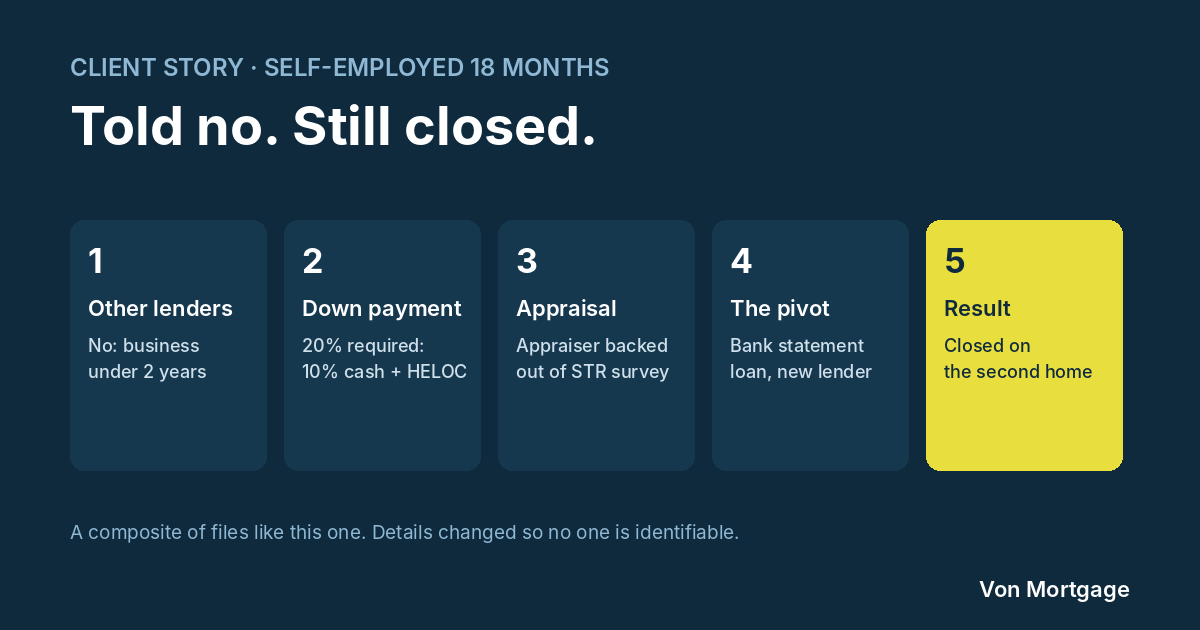
Sometimes the other lender misses income, too. Right now I'm working on a loan for a family who came to me after another lender told them they had to use asset depletion. That lender didn't look at their IRA income. They also have a few million dollars in money market accounts, and the dividend income shows on their tax returns.
So I didn't have to use asset depletion. I used their Social Security, their dividend income and their IRA income. They hadn't been taking draws from the IRA, so I had them take one withdrawal and got a letter from the custodian, the company that holds the IRA. That let me count it as income on this loan.
They didn't qualify for asset depletion under conventional rules. They did qualify for it on a non-QM loan. But the conventional loan is a much better deal for them, and I got there by paying attention to how they filed their tax returns.
Asset depletion isn't the only way to qualify on what you've saved. If your tax returns show dividends or interest, that income may count on its own, usually with a two-year history. IRA withdrawals can count too, without a long history of draws, if the account can keep paying them for at least three years without a penalty. Send me your last two years of tax returns, and I'll check every kind of income before we pick a program.
Can you get a mortgage on Social Security?
Yes. Social Security counts as qualifying income, and Fannie Mae sets no minimum history of receiving it (Selling Guide B3-3.4-15, dated October 7, 2026). The same section lets a lender treat 15% of the benefit as nontaxable and count that part at 125%. Example: $3,000 a month of Social Security counts as about $3,113.
If Social Security alone doesn't carry the payment, savings can fill the gap.
Can you get a 30-year mortgage at 70?
Yes. Your age can't be the reason a lender says no. Regulation B bars a lender from taking age into account once you're old enough to sign a contract, with narrow exceptions (12 CFR 1002.6), and the Consumer Financial Protection Bureau says a lender generally can't use your age to make a credit decision (CFPB, last reviewed December 11, 2024).
A lender can still ask whether your income will keep coming. The CFPB's official commentary on Regulation B says an older applicant who doesn't fit a 30-year loan with 5% down might qualify with a larger down payment or a shorter loan. If you were turned down and age came up, reach out so we can look at your situation.
What changes for retirees in 2027?
Freddie Mac's rule for qualifying on savings gets easier. Bulletin 2026-10, issued August 5, 2026, changes the divisor from 240 months to 180 and drops the age 62 rule on bank and brokerage accounts.
Lenders may use the new rule now. It's required for loans with settlement dates on or after February 3, 2027. Until then, the answer you get can depend on which lender you ask.
What's the catch with qualifying on savings?
The money you need to close comes off the top, and some programs want a bigger down payment. At Fannie Mae, any early-withdrawal penalty comes off too.
When you qualify on savings, Fannie Mae caps the loan at 70% of the home's value, or 80% if the account owner is 62 or older at closing (B3-3.4-06). That means 20% to 30% down. It works for a purchase or a refinance that doesn't take cash out.
This is also a different tool from a reverse mortgage, which is for staying in a home you already own and drawing on its equity.
How do you find out if your savings qualify?
Send me your account types and rough balances. I'll run them through each program and show you what each one counts as income and what each one costs. You can start with a quote request.
What else do retired families ask about qualifying on savings?
They ask about turning 62, their house, their dividends and their retirement accounts.
Do you have to be 62 to use asset depletion?
No. Fannie Mae has no minimum age, but it caps the loan at 70% of the home's value unless the account owner is 62 or older at closing. Then the cap is 80%. Freddie Mac's current age 62 rule applies only to bank and brokerage accounts, and Bulletin 2026-10 removes it.
Does my house count as an asset for qualifying?
Not the house itself. A home isn't on the list of eligible assets. Fannie Mae lists money from the sale of real estate as ineligible, while Freddie Mac's new rules list real estate sale proceeds as an eligible source of money in those accounts. If you have a home to sell, reach out so we can look at your situation.
Do dividends count as income for a mortgage?
Yes, if you can show a two-year history. Fannie Mae and Freddie Mac both accept your last two years of tax returns or account statements, and the lender averages the income. Freddie Mac also wants proof that enough money stays in the accounts after closing to keep paying that income for at least three years. Interest income works the same way.
Will I have to drain my retirement accounts?
No. Asset depletion uses the balance in the account to calculate income. No withdrawals are required to qualify. If you do plan to take money out, withdrawals can have tax effects that depend on the account, so talk with your CPA or tax pro first.
Sources
- Fannie Mae Selling Guide B3-3.4-06, Employment Related Assets as Qualifying Income, dated March 4, 2026. Read Nov 22, 2026. selling-guide.fanniemae.com/sel/b3-3.4-06/employment-related-assets-qualifying-income
- Fannie Mae Selling Guide B3-3.4-15, Social Security Income, dated October 7, 2026. Read Nov 22, 2026. selling-guide.fanniemae.com/sel/b3-3.4-15/social-security-income
- Freddie Mac Single-Family Seller/Servicer Guide, Section 5307.1, effective November 4, 2026. Read Nov 22, 2026. guide.freddiemac.com/app/guide/section/5307.1
- Freddie Mac Bulletin 2026-10, August 5, 2026 (required for settlement dates on or after February 3, 2027). guide.freddiemac.com/app/guide/bulletin/2026-10
- Equal Credit Opportunity Act, Regulation B, 12 CFR 1002.6(b)(2) and (b)(5). eCFR, current as of November 19, 2026. ecfr.gov/current/title-12/chapter-X/part-1002/section-1002.6
- CFPB Official Interpretation of Regulation B, comment 6(b)(2)-3. Read Nov 22, 2026. consumerfinance.gov/rules-policy/regulations/1002/interp-6/
- Consumer Financial Protection Bureau, "Can a lender consider your age when deciding whether to give you a mortgage or home equity loan?" Last reviewed December 11, 2024. consumerfinance.gov/ask-cfpb/can-a-lender-consider-your-age-when-deciding-whether-to-give-you-a-mortgage-or-home-equity-loan-en-346/
- Fannie Mae Selling Guide B3-3.4-03, Annuity, Pension, or Retirement Income, dated October 7, 2026. Read Nov 22, 2026. selling-guide.fanniemae.com/sel/b3-3.4-03/annuity-pension-or-retirement-income
- Fannie Mae Selling Guide B3-3.4-08, Interest and Dividend Income, dated March 4, 2026. Read Nov 22, 2026. selling-guide.fanniemae.com/sel/b3-3.4-08/interest-and-dividend-income
- Freddie Mac Single-Family Seller/Servicer Guide, Section 5305.1(d) and (l), dividend and interest income and retirement account distributions, effective August 5, 2026. Read Nov 22, 2026. guide.freddiemac.com/app/guide/section/5305.1
Disclaimer: This information is educational and is not a commitment to lend, a loan approval, or an offer of credit. Any rates, payments, down payments or other figures shown are illustrative examples only, not quoted terms and not an offer to extend credit. Actual rates and terms depend on credit, income, property, occupancy and market conditions, and change daily. For current pricing see vonmortgage.com/rates.
Pete Metz, Mortgage Broker · NMLS #260571
Dream Big Ownership LLC dba Von Mortgage Company · NMLS #2592815
Loans made or arranged pursuant to a California Financing Law license, #60DBO-195824.
2777 Bechelli Lane, Redding, CA 96002 · (530) 221-7700 · Pete@VonMortgage.com
Equal Housing Opportunity.

 Equal Housing Opportunity
Join the conversation
Comments are reviewed before they appear. Have a question about your own situation? Ask Pete directly — that stays private.
No comments yet