




Recent Posts
Categories
Tags
Years
Why did my mortgage go up if I have a fixed rate?
Your mortgage payment most likely went up because your escrow changed, not your loan. Your property taxes or homeowners insurance went up, so your servicer raised the part of your payment that pays those bills. A fixed rate only locks principal and interest.
Escrow is the account your servicer uses to pay your property taxes and homeowners insurance for you. Your servicer is the company you send your payment to.
By Pete Metz, mortgage broker at Von Mortgage in Redding, California, NMLS #260571. Updated November 2026.
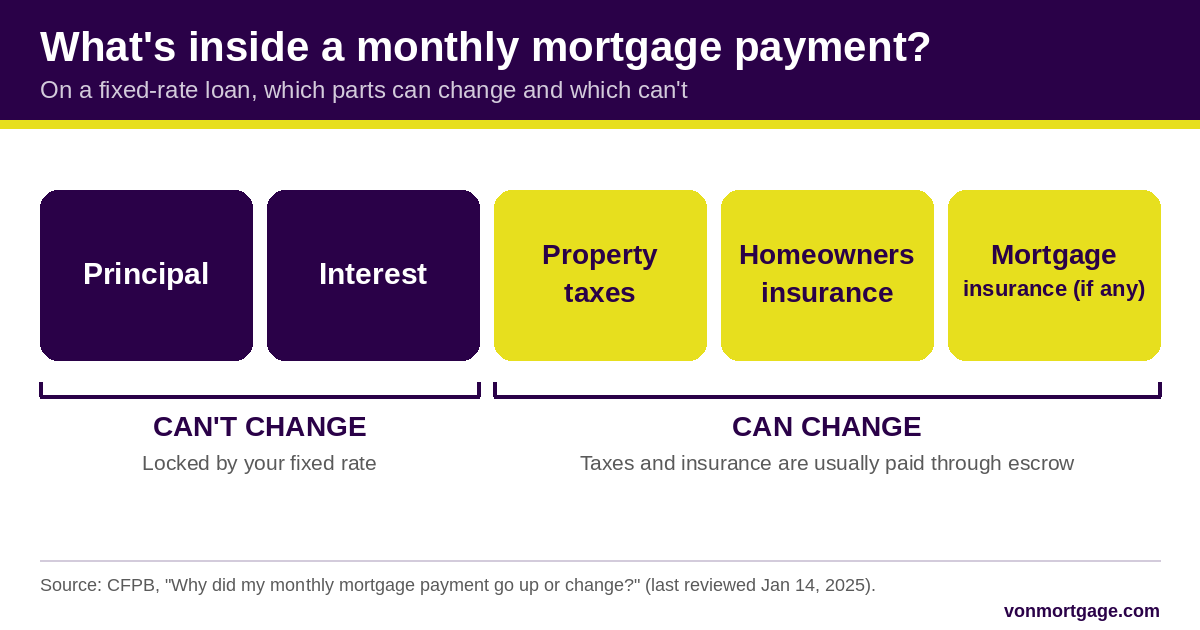
A payment can have five parts: principal, interest, property taxes, homeowners insurance and mortgage insurance. The Consumer Financial Protection Bureau (CFPB) lists other reasons it can change too (page last reviewed January 14, 2025):
- A temporary buydown ended.
- An adjustable rate reset.
- An interest-only period ended and you started paying principal.
- Your mortgage insurance changed.
- The servicer added new fees or made a mistake.
Why did my escrow go up, and what is an escrow analysis?
Your escrow went up because your servicer expects bigger tax or insurance bills this year than last year. The escrow analysis is the yearly review where it adds up those bills and resets your monthly deposit.
A federal rule, 12 CFR 1024.17 (Regulation X, read November 21, 2026), sets the math. Your monthly deposit can be one-twelfth of the year's expected bills, plus a cushion of up to one-sixth of the year's bills, which is about two months. After each escrow year ends, the servicer has to send you an annual escrow statement within 30 days.
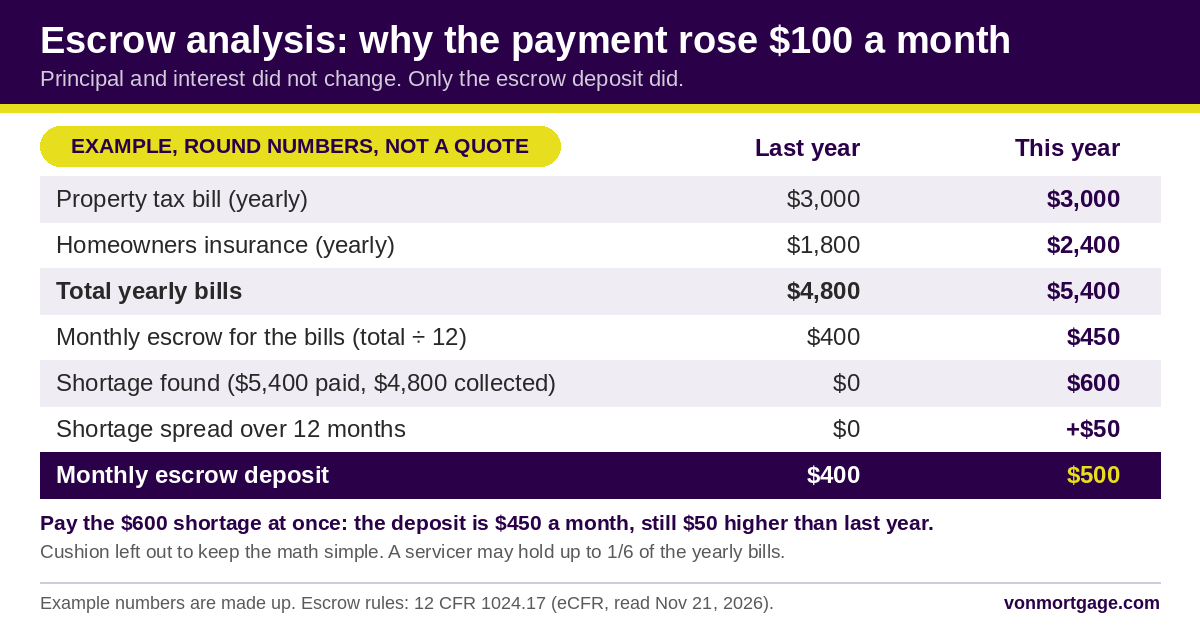
Here's an example with round numbers, not a quote. Last year escrow paid a $3,000 property tax bill and an $1,800 insurance premium. That's $4,800 a year, or $400 a month. This year the insurance renews at $2,400, so the bills are $5,400 a year, or $450 a month. The account also came up $600 short, because it collected $4,800 and paid out $5,400. Spread over 12 months, that's $50 a month. The new deposit is $500 a month. The payment rose $100 and principal and interest never moved. I left the cushion out to keep the math simple.
What is an escrow shortage, and should you pay it in one lump sum?
An escrow shortage means your escrow balance is below the target your servicer needs. Paying it in one lump sum lowers your new payment, but it usually won't bring back your old one.
In the example, paying the $600 at once drops the deposit from $500 to $450. That's still $50 more than last year, because the insurance bill is still higher.
You usually get a choice. Under 12 CFR 1024.17(f)(3), if the shortage is one month's escrow deposit or more, the servicer can spread it over at least 12 months, and it can't require a lump sum. If the shortage is smaller than one month's deposit, the servicer may ask you to pay it within 30 days. If the analysis finds a surplus of $50 or more and your payments are current, the servicer has to refund it within 30 days.
Why are mortgage payments going up in Shasta County?
Two bills drive it here: homeowners insurance and property taxes.
If your home is on the California FAIR Plan, rates went up an average of 29.1% for new and renewing policies on or after October 15, 2026, and homes with more wildfire risk may pay more (KQED, August 11, 2026). If escrow pays that premium, the increase shows up at your next escrow analysis. I cover local options on the Shasta County homeowners insurance page.
Property taxes usually move less. Proposition 13 limits the base tax rate to 1% plus voter-approved bonds, and it generally limits yearly increases in assessed value to 2% (California Board of Equalization, Publication 29, March 2025). The bigger change comes after a purchase or new construction. The county mails any supplemental tax bill to you, the owner, not to your lender, even if escrow pays your regular tax bill (Shasta County Tax Collector, read November 21, 2026). Due dates and the full calendar are on my Shasta County property tax due dates page. This is education, not tax advice, so take questions about your own bill to your tax pro or the county.
Can you remove escrow from your mortgage?
Sometimes. It depends on your loan type and your lender.
- FHA loans: no. FHA requires an escrow account (HUD Handbook 4000.1, update issued August 12, 2026).
- VA loans: VA doesn't require escrow, but the lender can (VA Lenders Handbook, Chapter 9, change date July 30, 2019).
- Conventional loans: Fannie Mae lets a lender waive escrow under a written policy that weighs whether the family can handle large tax and insurance bills, not just how much equity they have. If you pay for mortgage insurance yourself, that part of escrow can't be waived (Fannie Mae Selling Guide B2-1.5-04, April 1, 2020).
- USDA loans have their own rules, so ask me.
Removing escrow doesn't shrink the bills. You pay the same taxes and insurance yourself, in big chunks. Every loan is different, so reach out and I'll look at yours.
How can you lower your mortgage payment after an escrow increase?
Go after the bills escrow pays, because that's where the increase came from.
- Shop your homeowners insurance before it renews. A lower premium means a lower escrow deposit.
- Check your escrow statement and tax bill for errors. If something looks wrong, the CFPB says to call your servicer, ask for a corrected statement and write down a reference number, then send a written notice of error to the servicer's address for errors.
- If you pay private mortgage insurance (PMI), find out when PMI comes off.
- Refinance only if the numbers work. A new loan doesn't change your tax or insurance bills. Request a quote and I'll show you the payment with and without a refinance.
Why did my mortgage payment go up after a year?
Most of the time in Shasta County, it's because your property taxes were behind when you bought the home, and the county just caught up. When you buy, the county's records still show the last owner's assessed value. In my experience, it can take the county 6 to 10 months to update it to the value from your purchase. That timing is what I see with families here, not a county rule.
Here's how it usually plays out. Your new servicer sets up escrow on the old, lower tax bill. After a couple of months, it looks like you're overpaying into escrow. So the servicer sends you a refund and lowers your payment. Most families don't know any better, so they just move on with life.
Months later, the county catches up. It reassesses the home at its value when you bought it and sends a supplemental tax bill for the difference. Your later annual tax bills, the ones escrow pays, are based on the higher value too. The escrow account was set up for the old bill, so it doesn't have enough in it. Now the servicer has to raise your payment above where it was before the refund, to cover the higher taxes and make up the shortage. That's when families get really upset.
The supplemental bill comes to you, not your servicer, even if escrow pays your regular taxes. The county says it's up to you to call your lender and find out who will pay it (Shasta County Tax Collector, read November 21, 2026). If your servicer never lowered your payment after closing, you'll more than likely have enough in escrow to cover it. Just call your servicer and ask them to pay the supplemental bill from your escrow account. And if you just bought, don't take an early escrow refund or a lower payment as a sign your taxes are settled. The higher tax bill is still coming.
What else do families ask about escrow?
They ask about shortages vs deficiencies, notice, and whether the payment comes back down.
Is an escrow shortage the same as a deficiency?
No. A shortage means your escrow balance is below the target. A deficiency means the balance is negative, so the servicer paid a bill with its own money. Under 12 CFR 1024.17(f)(4), a deficiency of one month's escrow deposit or more can be collected over two or more monthly payments.
Can my servicer raise my payment without notice?
Not for an escrow change, as long as your payments are current. Your servicer has to send you an annual escrow account statement within 30 days after your escrow year ends, and it has to show your current monthly payment and how much goes into escrow (12 CFR 1024.17(i)). If your payment changed and you can't find that statement, call your servicer and ask for a copy.
Will my payment go back down next year?
Part of it can. Once a shortage is paid off over 12 months, that catch-up amount ends. In the example above, the deposit would drop from $500 to $450 if the bills stay the same. It only gets back to $400 if the tax or insurance bills come down.
What should you do if your escrow statement doesn't make sense?
Send it to me and I'll go through it with you line by line, before you pay a shortage or change anything.
Sources
- Consumer Financial Protection Bureau, "Why did my monthly mortgage payment go up or change?" Last reviewed Jan 14, 2025. Read Nov 21, 2026. consumerfinance.gov/ask-cfpb/why-did-my-monthly-mortgage-payment-go-up-or-change-en-213/
- 12 CFR 1024.17, Regulation X, Escrow accounts, paragraphs (b), (c)(1)(ii), (f)(2), (f)(3), (f)(4), (i) and (i)(1). eCFR current text, read Nov 21, 2026. ecfr.gov/current/title-12/chapter-X/part-1024/subpart-B/section-1024.17
- KQED, "California FAIR Plan Announces 29.1% Rate Hike for Homeowners This Fall," Aug 11, 2026. kqed.org/news/12094860/california-fair-plan-announces-29-1-rate-hike-for-homeowners-this-fall
- California State Board of Equalization, Publication 29, "California Property Tax: An Overview," March 2025. boe.ca.gov/proptaxes/pdf/pub29.pdf
- Shasta County Tax Collector, Tax Payment Dates and Supplemental Taxes pages. Read Nov 21, 2026. shastacounty.gov/tax-collector/page/tax-payment-dates and shastacounty.gov/tax-collector/page/supplemental-taxes
- HUD Handbook 4000.1, Update 18, issued Aug 12, 2026, section II.A.6, Projected Escrow.
- VA Lenders Handbook (VA Pamphlet 26-7), Chapter 9, Topic 12, Escrow for Taxes and Insurance, change date July 30, 2019.
- Fannie Mae Selling Guide B2-1.5-04, Escrow Accounts, dated 04/01/2020. Read Nov 21, 2026. selling-guide.fanniemae.com/sel/b2-1.5-04/escrow-accounts
Disclaimer: This information is educational and is not a commitment to lend, a loan approval, or an offer of credit. Any rates, payments, down payments or other figures shown are illustrative examples only, not quoted terms and not an offer to extend credit. Actual rates and terms depend on credit, income, property, occupancy and market conditions, and change daily. For current pricing see vonmortgage.com/rates.
Pete Metz, Mortgage Broker · NMLS #260571
Dream Big Ownership LLC dba Von Mortgage Company · NMLS #2592815
Loans made or arranged pursuant to a California Financing Law license, #60DBO-195824.
2777 Bechelli Lane, Redding, CA 96002 · (530) 221-7700 · Pete@VonMortgage.com
Equal Housing Opportunity.



 Equal Housing Opportunity
Join the conversation
Comments are reviewed before they appear. Have a question about your own situation? Ask Pete directly — that stays private.
No comments yet