




Recent Posts
Categories
Tags
Years
It depends on what you're buying. The self-employment waiting period applies when you're buying a primary residence or a second home, and the shortest path there is usually at least 12 months. An investment property can be done with a DSCR loan, which qualifies on the property's rent, not on how long you've been self-employed.
If you've been self-employed less than 12 months and you're buying a primary residence or a second home, reach out. Every situation is different, and there may be a way to structure the deal or an investor that allows it based on your family's situation.
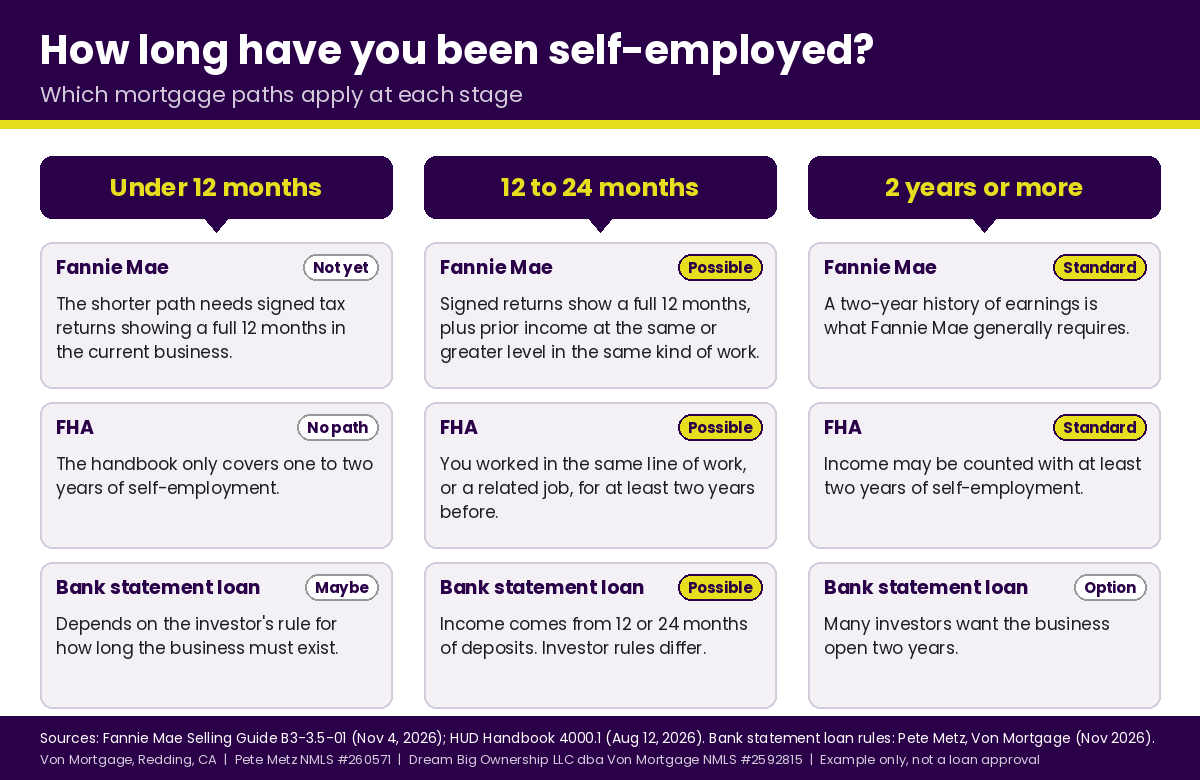
Two years isn't a law. It's a common lender rule. Most loans want two years, but Fannie Mae allows less than two years when your latest signed tax returns show a full 12 months in the current business and you earned similar income doing the same kind of work before. Some investors also allow a one-year tax return. A personal bank statement loan is a third option when your business income is deposited into a personal account. I've closed loans for self-employed families with less than two years in business, and for families whose first business tax return wasn't filed yet. Which rule fits you depends on what you're buying and how many months you've been at it.
How long do you need to be self-employed to get a mortgage?
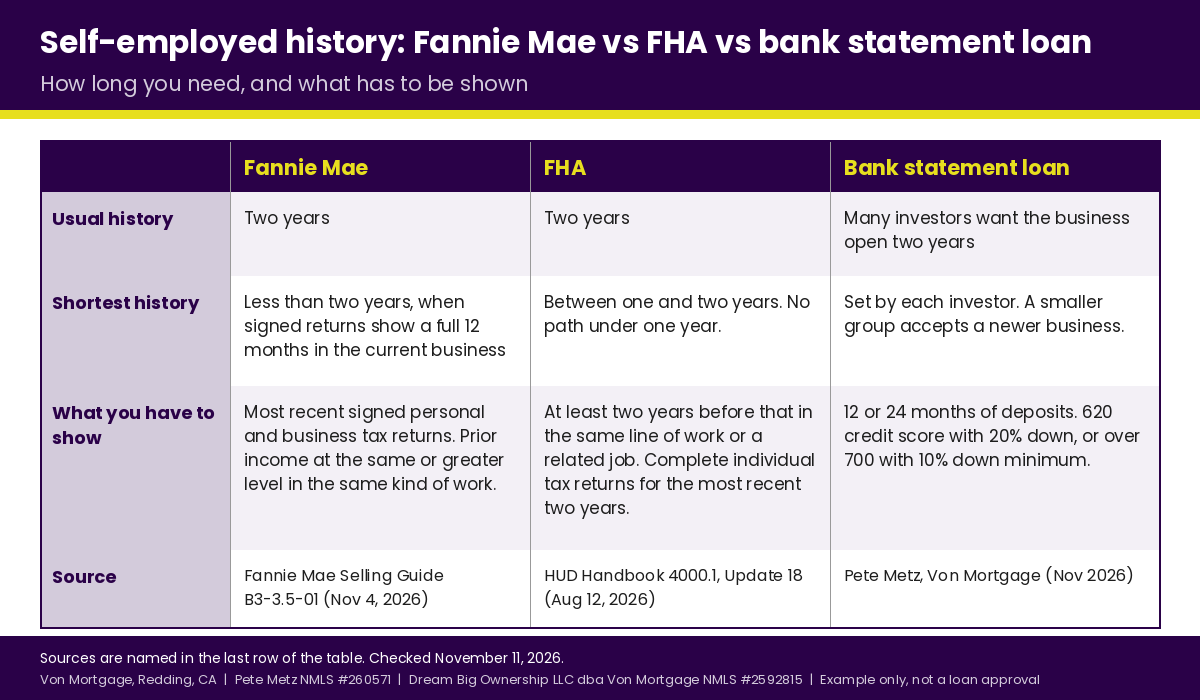
Two years is the standard answer. The Fannie Mae Selling Guide, section B3-3.5-01 (edition published November 4, 2026), says "Fannie Mae generally requires lenders to obtain a two-year history of the borrower's prior earnings." FHA starts from two years as well. Both have a shorter path.
Does the self-employment waiting period apply if I'm buying an investment property?
No. The waiting period comes into play when you're buying a primary residence or a second home. An investment property can be done with a DSCR loan, which qualifies on the property's rent instead of your personal income or how long you've been self-employed.
Can I get a mortgage with less than 2 years of self-employment?
Yes, on a Fannie Mae loan, if your file passes these tests from section B3-3.5-01:
- Your most recent signed personal and business federal tax returns show "a full year (12 months) of self-employment income from the current business."
- You can document "prior income at the same (or greater) level."
- That earlier income came from a field with the same products or services as your business, or from a job with similar responsibilities.
The lender also has to weigh your level of experience and how much debt the business has taken on.
Can I get a mortgage with 1 year of self-employment?
Yes, one year can be enough when that full year shows on a signed tax return. For Fannie Mae, the test is a return showing a full 12 months of income from the current business, so the first thing I ask is what your latest return shows. On an FHA loan, one year works only if you spent at least two years before that in the same line of work or a related job. There are also investors that allow only a one-year return.
For an example, read how a family 18 months into self-employment still closed on a second home.
Can I get a mortgage with 6 months of self-employment?
Not on a Fannie Mae or FHA loan. Fannie Mae's shorter path needs a tax return showing a full 12 months. The HUD handbook only provides for one to two years with prior work, and it has no path for under one year.
If you're buying an investment property, a DSCR loan can skip the self-employment waiting period, because it qualifies on the property's rent.
If you're at six months and buying a home to live in, reach out. Every situation is different, and there may be a way to structure the deal or an investor that allows it based on your family's situation. Keep proof of what you earned in the same field before, and file your first full-year return on time.
What if I haven't filed a business tax return yet?
You may still have options, but not Fannie Mae's shorter path, because that one runs on a signed return. A personal bank statement loan, covered below, is one place to look when the deposits are already in a personal account. I also covered these files in how self-employed families qualify with no tax return yet.
Do FHA loans allow less than 2 years of self-employment?
Yes, between one and two years, with one condition. HUD Handbook 4000.1 (Update 18, issued August 12, 2026) says the lender may only count the income if you were "previously employed in the same line of work in which the Borrower is self-employed or in a related occupation for at least two years."
FHA treats you as self-employed if you own 25% or more of the business. It also requires complete individual tax returns for the most recent two years.
Can a personal bank statement loan work if my income is deposited into a personal account?
Yes. If your business income is deposited into a personal account, some loans can use those personal bank statements to establish income. Eligible deposits are often counted in full. Transfers between your own accounts are not income, and neither are things like a tax refund or a paycheck from a job.
That is different from a business bank statement loan. Business deposits are treated as gross revenue, so an expense factor is applied. 50% is a common default. A letter from a CPA or tax preparer can support a different factor.
Many investors still want to see a couple of months of business statements, to show the accounts are separate and that money is moving from the business account into the personal account. If the business and personal money sit in one account, the file is often reviewed as a business bank statement loan, and the expense factor applies.
Income comes from 12 or 24 months of deposits. On the bank statement loans I work with, you'll always want to be looking at at least 20% down. Anything less will have a hard time making sense. The minimum credit score is 620 with 20% down. Anything under 20% down takes a score over 700, and 10% down is the floor. I explain the review in how bank statement loan underwriting works.
Different investors have different rules on how long the business must exist. Many want two years. A newer business usually means a higher rate or cost.
Can a mortgage broker help if lenders said no because you're self-employed under 2 years?
Often, yes, because the no usually came from one lender's rule. Many lenders require the business itself to exist two years, even for bank statement loans. As a Redding, California mortgage broker, I shop these files to the smaller set of lenders that accept a newer business.
It all depends on the occupancy. The self-employment waiting period only comes into play when you're buying a primary residence or a second home. An investment property would get done with a DSCR loan. So if you're buying a primary or a second home, the very minimum you will need is usually at least 12 months. If you've been at it less than 12 months, reach out. Every situation is different, and there may be a way to structure the deal or an investor that allows it based on your family's situation. There are investors that allow only a one-year tax return. A third option is a personal bank statement loan. Depending on whether the money is being deposited into a business account or a personal account, we can use a personal account to establish income.
On bank statement options, you'll always want to be looking at at least 20% down. Anything less will have a hard time making sense. If you're stuck on the down payment, we have options to help with a HELOC on other properties that you own. We have done this before, where we do a HELOC using bank statement deposits, then use that for the required down payment. The family is then not using any of their own money. The payment on that HELOC is counted in the debt ratios on the new loan.
What else do self-employed families ask about getting a mortgage?
The short answers to the questions I hear most are below.
How many months self-employed do you need for a mortgage?
It depends on what you're buying. For a primary residence or a second home, twenty-four months is the standard, and twelve months is usually the minimum. Twelve to 24 months can work on a Fannie Mae or FHA loan when you did the same kind of work before, under the Fannie Mae Selling Guide (November 4, 2026) and HUD Handbook 4000.1 (August 12, 2026). Some investors also allow a one-year tax return. Under 12 months, Fannie Mae and FHA do not have a path. Reach out anyway. Every situation is different, and there may be a way to structure the deal or an investor that allows it based on your family's situation. An investment property can be done with a DSCR loan, which does not use a self-employment waiting period.
Does switching from W-2 to 1099 in the same field count?
Yes, staying in the same field is what the shorter paths look for. Fannie Mae asks for prior income at the same or greater level in the same kind of work, plus a signed return showing a full 12 months in the current business. FHA asks for at least two years in the same line of work or a related job.
Can a bank statement loan work if I'm newly self-employed?
Sometimes. Twelve months is usually the minimum for a primary residence or a second home. A bank statement loan uses 12 or 24 months of deposits as income. Many investors still require the business to exist for two years. A smaller group accepts a newer business, usually at a higher rate or cost, so the answer depends on which investor reviews the file. If you've been at it less than 12 months, reach out. Every situation is different, and there may be a way to structure the deal or an investor that allows it based on your family's situation. If your deposits go into a personal account, a personal bank statement loan may be the fit. If you're buying an investment property, a DSCR loan is the path I use instead.
Do I need two years of tax returns if I'm self-employed?
Not always. FHA requires complete individual tax returns for the most recent two years. Fannie Mae's shorter path looks at your most recent signed personal and business returns showing a full 12 months. Fannie Mae has a separate one-year rule for businesses open five years, in the same section B3-3.5-01. A bank statement loan uses deposits. A DSCR loan on an investment property qualifies on the rent, not on your returns.
What's the difference between a personal and a business bank statement loan?
A personal bank statement loan looks at eligible deposits into a personal account, often counted in full. A business bank statement loan looks at deposits into a business account, then applies an expense factor because those deposits are gross revenue, not take-home pay. Transfers between your own accounts do not count as income. If the business and personal money sit in one account, the file is often reviewed as a business bank statement loan.
Can I use a HELOC on another property for the down payment?
Yes, that can work. If you own another property, we can sometimes do a HELOC using bank statement deposits, then use that money for the required down payment on the home you're buying. We have done this before, and the family was not using any of their own money. The payment on that HELOC is counted in the debt ratios on the new loan.
Send me how long you've been in business, what you did before, whether your last return is filed, and whether you're buying a home to live in or an investment property. I'll tell you which path fits. If you've been at it less than 12 months, reach out anyway. You can request a quote or read about self-employed mortgage options in Redding.
Disclaimer: This information is educational and is not a commitment to lend, a loan approval, or an offer of credit. Any rates, payments, down payments or other figures shown are illustrative examples only, not quoted terms and not an offer to extend credit. Actual rates and terms depend on credit, income, property, occupancy and market conditions, and change daily. For current pricing see vonmortgage.com/rates.
Pete Metz NMLS #260571
Dream Big Ownership LLC dba Von Mortgage Company NMLS #2592815
CA CFL license 60DBO-195824
(530) 221-7700 · 2777 Bechelli Lane, Redding, CA 96002
Equal Housing Opportunity.
 Equal Housing Opportunity
Join the conversation
Comments are reviewed before they appear. Have a question about your own situation? Ask Pete directly — that stays private.
No comments yet