




Recent Posts
Categories
Tags
Years
Bank Statement Loans: What Underwriting Still Asks For
Yes. A self-employed borrower can qualify for a mortgage on 12 or 24 months of bank statements, with no tax returns in the file. Underwriting still wants proof the business is real and active, a reasonable expense factor (50% by default, lower only with a letter from a CPA or tax preparer), an explanation for any big deposit, and a deposit trend that holds steady.
Most self-employed families hear "bank statement loan" and picture the statements as the whole file. They're the starting point. The friction lives in the paperwork around them: the CPA letter, the deposit from selling a truck, the down payment sitting in the business account. For the loan programs themselves, see our self-employed mortgage page.
Can you qualify with bank statements instead of tax returns?
Yes, on a non-QM loan, meaning one written outside the standard qualified-mortgage rules. Federal rules require a lender to verify income with third-party records it can reasonably rely on, and records from a financial institution are on that list (Consumer Financial Protection Bureau, Ability-to-Repay rule, 12 CFR 1026.43(c)(4)). Bank statements meet that standard, so they can stand in for a tax return.
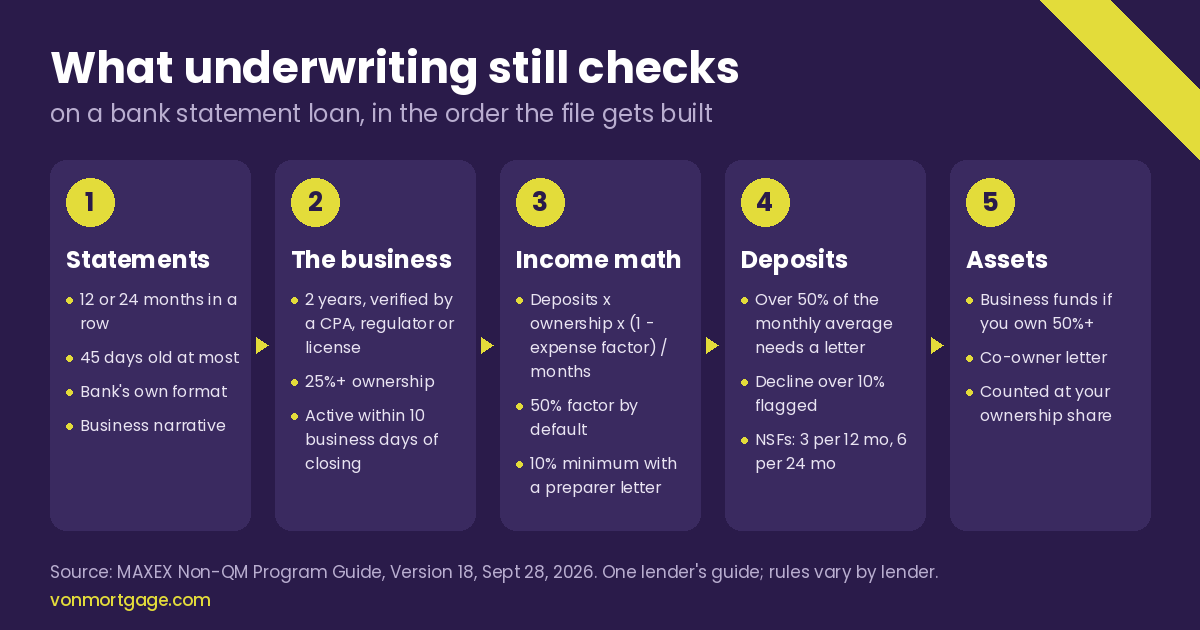
What the file needs varies by lender. As one example, the MAXEX Non-QM Program Guide (Version 18, dated September 28, 2026) asks for 12 or 24 consecutive months of personal or business statements. They can be no more than 45 days old at application, in the bank's own format. A spreadsheet you built won't work. The file also needs a short business narrative describing what the business does and how many employees it has.
One rule in that guide runs the other way. A loan submitted with tax returns or transcripts is ineligible for the bank statement program. You pick a path and document that path.
How does underwriting verify the business is real?
Through a third party. In the MAXEX guide, two years in the same business has to be confirmed by a CPA or tax preparer, a regulator, or a licensing bureau.
One to two years can still work under that guide, with six extra months of reserves and two years of prior experience in the same line of work. A contractor who worked for another company before going out on their own fits that shape, and Shasta County has plenty of them. For a newer business that closed, see how an 18-month self-employed buyer financed a second home.
You also need to own at least 25% of the business, shown by a CPA or preparer letter or an operating agreement. Then, within 10 business days before the note date, the lender confirms the business is still active. A CPA letter, signed contracts or invoices, recent account activity, or a working business website can each do it. Keep your license current and your website up until the loan funds.
How is income calculated on a bank statement loan?
For business statements, the MAXEX guide uses eligible deposits, times your ownership percentage, times one minus the expense factor, divided by 12 or 24 months. For personal statements, it's eligible deposits divided by 12 or 24 with no expense factor, as long as two months of business statements show the personal and business accounts are separate.
If the accounts are mixed, the personal statements get treated like business statements and the expense factor comes back.
Some deposits never enter the math. Transfers between your own accounts, wages, rental income, tax refunds and credit card refunds all come out first. Run more than three business accounts and that guide sends you to the personal-statement option.
| 50% default expense factor | 30% expense factor (preparer letter) | |
|---|---|---|
| Eligible business deposits, 12 months | $360,000 | $360,000 |
| Ownership | 100% | 100% |
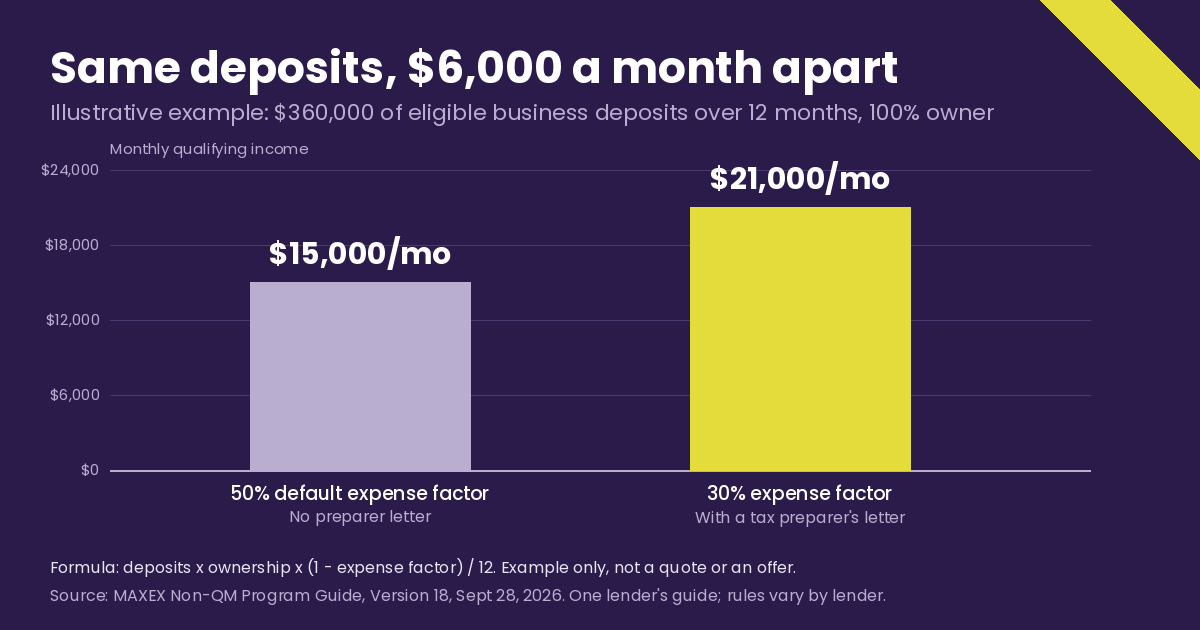
| Deposits counted as income | $180,000 | $252,000 |
| Monthly qualifying income | $15,000 | $21,000 |
Same deposits, $6,000 a month apart. Lenders compare that income to your monthly debts, a measure called debt-to-income ratio (DTI). A $6,000 swing can change how large a loan the file supports.
What is an expense factor, and how do you get a lower one?
An expense factor, also called an expense ratio, is the share of your deposits the lender assumes went to running the business. The standard is 50%, and in the MAXEX guide that default applies to every business. Using a lower number takes a third-party expense statement from a CPA or tax preparer.
That statement has rules in the guide. It comes from a CPA, an enrolled agent (EA) or a preparer registered with the California Tax Education Council (CTEC). The CPA or preparer signs it, states expenses as a percentage of gross revenue, and the lender verifies their license.
The floor is 10%. Even a business with almost no overhead counts no more than 90% of deposits as income under that guide. Ask your preparer about the letter before you apply, so it isn't the last item on the list.
Should you use 12 or 24 months of bank statements?
Use the period where your deposits look steadiest. Underwriting reads the trend as closely as the total, and the two periods are judged differently.
In the MAXEX guide, a 12-month file can show up to a 10% decline, comparing the most recent six months with the six before. Past that, the lender asks for 12 more months. On 24 months, a year-over-year decline over 10% makes the file ineligible. Returned or bounced items, called NSFs, are capped too: three in 12 months of statements, six in 24.
Why do large deposits hold up a bank statement loan?
Because in the MAXEX guide, any deposit over 50% of your average monthly deposits needs a letter of explanation, and the explanation has to fit the business. If it doesn't, and the money can't be sourced, the deposit is dropped from your income.
In the example above, average deposits are $30,000 a month, so any single deposit over $15,000 gets flagged. An equipment sale, a customer paying several months up front and an unusually large job each need their own letter. Keep the invoice or bill of sale when the money lands.
Can you use business funds for your down payment?
Yes, if you own at least 50% of the business, in the MAXEX guide. The lender verifies your ownership, and every owner who isn't on the loan signs a letter acknowledging the purchase and your access to the funds.
The balance counts at your ownership share. For example, own 60% of a business account holding $100,000 and $60,000 counts toward closing costs and reserves. If you have a partner, get that letter started early.
Do bank statement loans cost more than conventional loans?
Not always. Bank statement pricing can sometimes match Fannie Mae, Freddie Mac or other conventional pricing. For the closest pricing, I recommend at least 20% down. With 20% down and a credit score of 740 or higher, the pricing is usually very close to conventional. The minimum is lower, though. On a business bank statement loan, you can put as little as 10% down with a credit score over 700.
We recently closed a loan for a borrower who put 10% down with a 760 credit score. His loan came in about 0.5% higher than a conventional loan, once you factor in the mortgage insurance a conventional loan would have added. That's the benefit here: a bank statement loan with 10% down doesn't require mortgage insurance. It worked for him because he hadn't filed his tax return for the previous year, and his prior two years of returns didn't show enough income to qualify.
Who you work with matters too. Retail lenders, meaning mortgage banks, offer bank statement programs, but they tend to cost more on them. A loan officer at a retail lender can only offer that lender's rate and costs. They can't move you to a different bank with a better price, and they can only broker a loan when their own bank doesn't offer the program. So if the retail lender's rate and fees run higher, that loan officer has nothing lower to offer. A broker can shop the price across many wholesale lenders. That's why getting at least one of your quotes from a mortgage broker can save you money.
For reference, Freddie Mac's Primary Mortgage Market Survey put the 30-year fixed at 7.24% on October 29, 2026. That survey covers conventional purchase loans with 20% down and excellent credit. More on the cost gap is in buying a home without a filed tax return.
If the property is a rental, compare a DSCR loan, which qualifies on the property's rent instead of your income. On investment properties, accepting a prepayment penalty can bring a DSCR rate down 0.75% to 1% in Von Mortgage's October 2026 pricing.
When is a bank statement loan the wrong tool?
When your tax returns already show enough income. A loan qualified on returns will usually price at least as well, and any rate gap is money you pay every month you keep the loan.
The numbers in this post come from one published guide, and guides differ from lender to lender. That's why the broker side matters on this loan. Shopping the rate is part of it. The larger part is sending the file to the lender whose rules fit how your business banks. A retail bank has one guide, and if your file doesn't fit it, the answer is no. That matching is what I do every day at Von Mortgage in Redding, under my license, NMLS #260571.
Where do bank statement files get stuck?
Usually on the expense factor. The standard is 50%, but what's realistic depends on the type of business and how many employees it has. In general, more employees means higher expenses, and a smaller operation runs leaner. Underwriters check that the number fits the business. A borrower with 10 employees asking for a 10% expense factor is unlikely to get it. That's why most lenders require a CPA letter to use an expense factor lower than the standard 50%.
The second sticking point is getting that letter. Most CPAs have a hard time signing a letter with an expense factor that differs from what they reported on the tax returns they filed. And many self-employed borrowers don't have a CPA at all. We work with a lot of families who prepare their own returns, and some haven't filed their most recent return yet. In those cases, there are CPAs who will review your full bank statements and returns, or just the bank statements if the returns aren't filed.
We recently closed a bank statement loan for a chiropractor who prepared his own returns, with no tax preparer or CPA, and hadn't filed his most recent return. We had a CPA review his bank statements. His practice had no employees and one office, and the CPA determined his expense factor was 29%.
What should you gather before applying?
Start with 24 months of statements in the bank's own format, even if you end up using 12. That way both periods can be compared before one is chosen.
Ask your preparer now whether they'll sign an expense statement, and what percentage your most recent return supports. If you prepare your own returns, tell me early so we can line up a CPA review of your statements. Write down where any big deposit came from while the paperwork is still in a drawer. If the down payment is in a business account you share, start the co-owner letter. Keep the business visibly active through closing.
Don't try to time rates on this loan. Make sure the payment fits your budget today, then put the file with a lender whose rules fit your business. Send me what you have and I'll tell you which statements to use and where the file stands. Start a quote or check today's rates.
Disclaimer: This information is educational and is not a commitment to lend, a loan approval, or an offer of credit. Any rates, payments, down payments or other figures shown are illustrative examples only — not quoted terms and not an offer to extend credit. Actual rates and terms depend on credit, income, property, occupancy and market conditions, and change daily. For current pricing see vonmortgage.com/rates.
Pete Metz, Mortgage Broker · NMLS #260571
Dream Big Ownership LLC dba Von Mortgage · NMLS #2592815
2777 Bechelli Lane, Redding, CA 96002 · Pete@VonMortgage.com
Equal Housing Opportunity.
 Equal Housing Opportunity
Join the conversation
Comments are reviewed before they appear. Have a question about your own situation? Ask Pete directly — that stays private.
No comments yet