




Recent Posts
Categories
Tags
Years
Decreasing Housing Costs Executive Order: Refinance and PMI
On October 22, 2026, President Trump signed an executive order called "Decreasing Housing Costs for the American People." My phone started ringing the next morning. What I'm telling clients is simple. Nothing about your loan changed this week.
The order is a set of instructions to the Federal Housing Finance Agency (FHFA), which oversees Fannie Mae and Freddie Mac. It tells them to work on making refinancing cheaper and removing mortgage insurance sooner. That's real progress. It's also the start of a process, and most of the refinances I'm closing right now fall outside it. Updated October 2026.
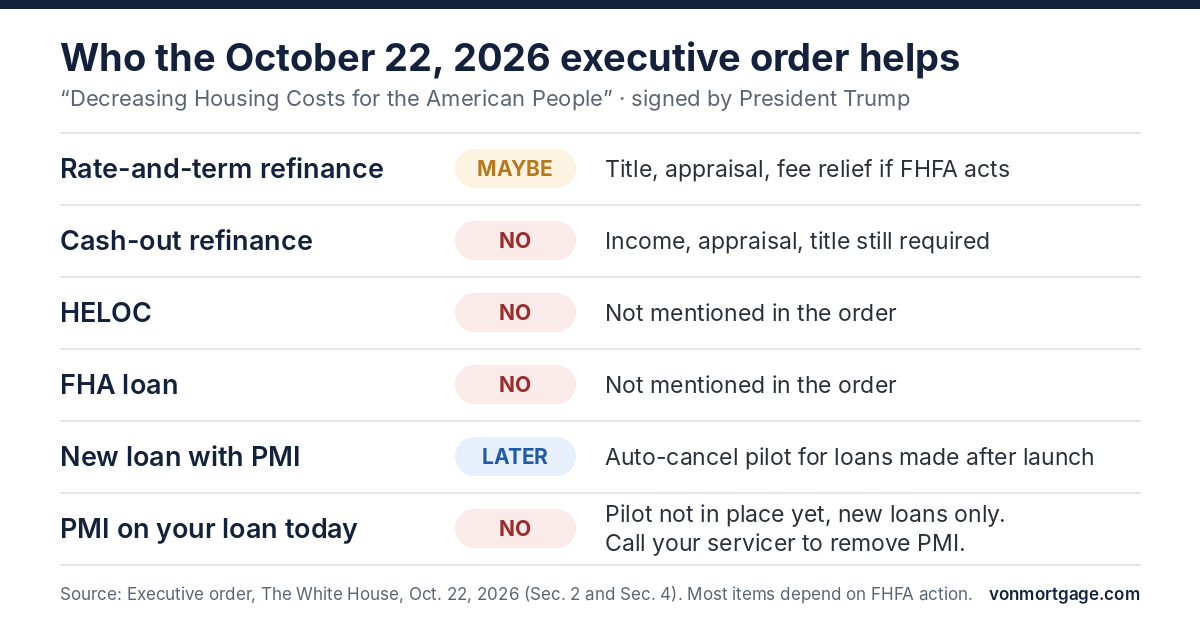
What did the October 22 executive order actually do?
It directed FHFA to work on four things and left most of the details to FHFA's judgment. The order:
- Expands Fannie Mae's title acceptance pilot into a permanent nationwide program at both Fannie and Freddie. An automated title review would replace the lender's title insurance policy on eligible refinances.
- Asks FHFA to consider waiving appraisals, income re-verification and other paperwork on certain refinances, and to consider cutting loan-level price adjustments (LLPAs) and other fees on them.
- Creates a pilot to cancel mortgage insurance proactively on new Fannie and Freddie loans once the home's value shows enough equity.
- Tells the VA and USDA to lower rates on the small number of home loans those agencies make directly.
Even the firm items carry a condition. The FHFA Director acts "if he determines" it's in the best interests of Fannie, Freddie and the public. The order also says it creates no right anyone can enforce. Source: the order text, published by the White House on October 22, 2026.
Does the order waive appraisals and income verification on a refinance?
Possibly, and only on one kind of refinance. Section 4 asks FHFA to consider those waivers for "limited cash-out refinances that reduce the borrower's monthly payment."
A limited cash-out refinance is Fannie Mae's name for a rate-and-term refinance. You replace your loan with one at a better rate or term, and you take out very little cash: no more than the lesser of 2% of the new loan or $2,000, under the Fannie Mae Selling Guide. The waivers would apply only where Fannie's or Freddie's existing data supports skipping the step.
If you want to lower your rate and leave your balance alone, this could make your next refinance faster and cheaper. If you want to pull money out, it doesn't touch you.
Why won't this help most people refinancing right now?
Because most people refinancing today need cash out. With rates where they are in late 2026, the refinances crossing my desk are ones people have to do. Consolidating debt. A divorce or separation where one spouse has to come off the title and the mortgage. Pulling equity to buy a rental or a second home.
A cash-out refinance adds to the original loan amount. That means full income documentation, a full appraisal and a full title policy. Nothing in this order changes that.
Many of those borrowers are better off with a home equity line of credit than a cash-out refinance anyway. A HELOC leaves your existing first-mortgage rate alone. The executive order says nothing about HELOCs. If you're weighing the two, start with how a HELOC works.
How much could a rate-and-term refinance save if FHFA acts?
Somewhere from several hundred to a couple thousand dollars in closing costs, depending on the loan. Two line items carry most of it.
The first is the lender's title policy. In its March 2024 FAQ on the title acceptance pilot, FHFA estimated that skipping it saves $500 to $1,500 per refinance. The pilot has been limited to refinances under 80% loan-to-value in certain areas. The order asks FHFA to drop the geographic limits and consider going above 80%.
The second is the appraisal. On the conventional files we close in Redding, appraisals run about $500 to $900, depending on location, size and how complex the report is. Starting November 2, 2026, appraisals on loans sold to Fannie and Freddie must use a new format, the redesigned Uniform Residential Appraisal Report under UAD 3.6. I expect that to push fees up. A waiver also gets an owner past a house with deferred maintenance, where an appraiser might call for repairs before closing.
As an example, a rate-and-term refinance that skips both could keep roughly $1,000 to $2,400 out of closing costs, plus any LLPA relief FHFA approves. The order requires that those savings be passed through to borrowers, and that lenders tell borrowers what they saved.
How fast could FHFA make these changes real?
My guess is months. FHFA has to decide what it wants. Fannie and Freddie then have to write it into their guides, and lenders have to update their systems.
FHFA can move fast when it wants to. During COVID it added a 0.5% Adverse Market Refinance Fee to Fannie and Freddie refinances. It was announced in August 2020, took effect December 1, 2020, and ended for loans delivered on or after August 1, 2021. On a $400,000 refinance, that fee was $2,000. In my opinion it was a quick money grab, and it went through quickly. So I'll take any tailwind homeowners can get. I just wouldn't put a refinance on hold waiting for this one.
What does the order do about mortgage insurance?
For anyone paying PMI, this is the part to watch. The order sets up a pilot where Fannie and Freddie periodically check home values with automated valuation models. When a borrower qualifies, they cancel the mortgage insurance on their own.
There's a catch. The pilot applies only to loans made after it launches. If you're paying PMI today, you still have to do it the old way.
I know the old way because I did it myself. I paid mortgage insurance on my own home for about a year after I no longer needed it. Then I called the servicer, paid $500 for a new appraisal and sent it in. They removed $183 a month. The appraisal paid for itself in under three months. Most people I talk to don't know they can do this, or it feels like too much work.
Under current Fannie Mae and Freddie Mac servicing rules, PMI on a conventional loan can come off three ways:
- Pay the balance down to 80% of the original value (the lower of the purchase price or the appraisal) and ask in writing. A new appraisal usually isn't needed, though the servicer can ask for proof the value hasn't dropped.
- Wait for it to end automatically when the balance is scheduled to reach 78% of the original value, under the federal Homeowners Protection Act.
- Use today's value. After two years the balance has to be 75% or less of a new appraisal. After five years, 80% or less. You pay for the appraisal.
Rising home values unlock the third route, and that's the one the new pilot would automate for future loans. The order doesn't mention FHA mortgage insurance.
What won't change, even if FHFA acts on all of it?
Cash-out refinances, HELOCs, FHA loans and purchase loans fall outside the refinance provisions. The VA and USDA rate cuts cover only loans those agencies fund directly. Most VA and USDA borrowers have guaranteed loans from private lenders and won't see a change.
Every refinance item depends on FHFA's judgment, and the title piece has organized opposition. The title industry has fought the pilot since 2024, and in July 2024 Republican attorneys general from 14 states asked FHFA to end it.
A waiver also helps only if refinancing makes sense in the first place. Saving $1,500 in closing costs doesn't fix a new rate that's higher than the one you have.
What should you do right now?
It depends which group you're in.
If you need cash out, compare a HELOC to a cash-out refinance today. This order won't change that math.
If you'd refinance only to lower your rate, watch rates and FHFA announcements. When the waivers arrive, they'll make a rate drop easier to act on. Our Rate Drop Refi™ covers the lender fees when a purchase client refinances after rates fall. The terms are on that page.
If you have PMI, compare your loan balance to your purchase price and to what your home is likely worth now. If you're close, call your servicer this week.
I'm Pete Metz, a mortgage broker at Von Mortgage in Redding, California, NMLS #260571. I'd rather you hear what this order does and doesn't do from me than from a headline. If you want to know whether your PMI can come off, or whether a HELOC beats a cash-out refinance for you, I'll run your actual numbers. Current pricing is on our rates page.
Disclaimer: This information is educational and is not a commitment to lend, a loan approval, or an offer of credit. Any rates, payments, down payments or other figures shown are illustrative examples only — not quoted terms and not an offer to extend credit. Actual rates and terms depend on credit, income, property, occupancy and market conditions, and change daily. For current pricing see vonmortgage.com/rates.
Pete Metz, Mortgage Broker · NMLS #260571
Dream Big Ownership LLC dba Von Mortgage · NMLS #2592815
2777 Bechelli Lane, Redding, CA 96002 · Pete@VonMortgage.com
Equal Housing Opportunity.
 Equal Housing Lender
Join the conversation
Comments are reviewed before they appear. Have a question about your own situation? Ask Pete directly — that stays private.
No comments yet