




Recent Posts
Categories
Tags
Years
How to Shop for a Mortgage: Broker vs Bank Margins Explained
Updated October 2026
I always tell people to get a second opinion on their mortgage. Sometimes I'm the first lender a buyer talks to, and they go get another quote after meeting with me. Sometimes I'm the second, after they've already sat down with someone else. Either way is fine with me.
Most buyers shop the rate. Very few know what's built into it. Every quote carries a margin, the money the lender and everyone on the loan earns, and how much margin is in there depends a lot on where you got the quote.
Should you get more than one mortgage quote?
Yes. One extra quote is usually worth real money. Freddie Mac looked at borrowers in October and November 2022, when rates were high. Getting two rate quotes could save up to $600 a year. Getting four or more could save over $1,200 a year (Freddie Mac, February 16, 2023). The Consumer Financial Protection Bureau also recommends requesting Loan Estimates from more than one lender and comparing them line by line (CFPB).
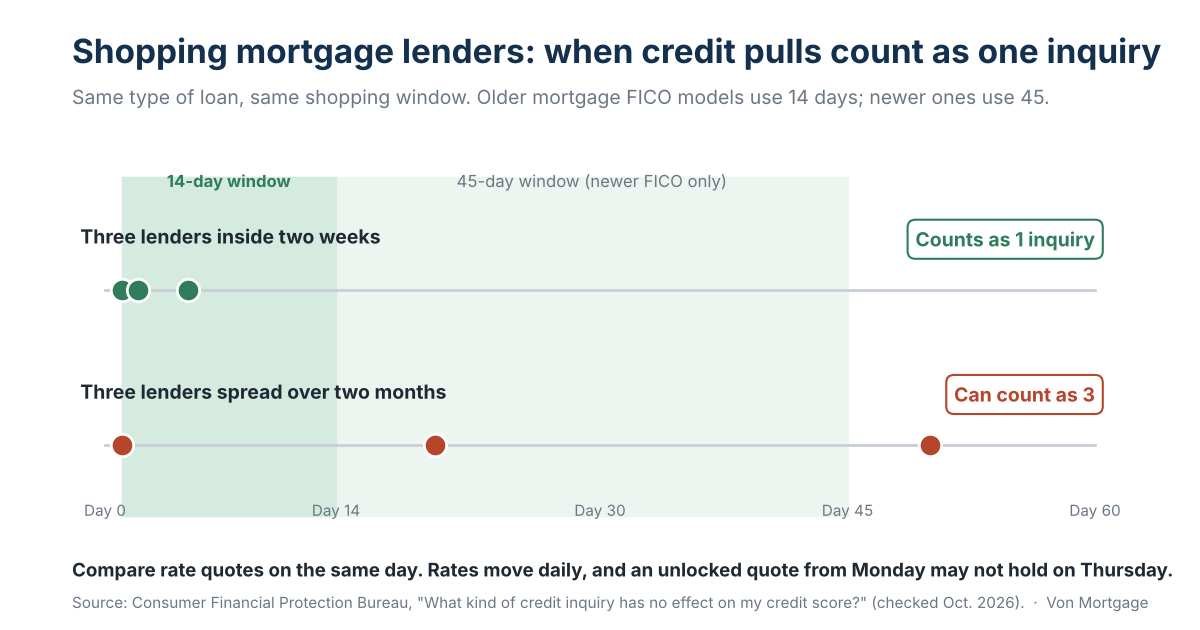
Get the quotes on the same day, as close together as you can. Rates move every day. A quote from Monday that wasn't locked may not hold on Thursday, and then you're comparing two markets instead of two lenders. Shopping inside a short window also keeps the credit inquiries counting as one, which we cover in does pre-approval hurt your credit.
Should you tell the second lender what the first one quoted?
Not at first. If the second lender sees your first quote, they can simply come in a little lower to win the deal. Most of the time that's an eighth to a quarter of a percent lower. That's how the mortgage game works.
Let the second lender give you their honest offer first. Once you have it, share the first quote and negotiate from there.
When I'm the second opinion, I ask borrowers not to tell me their first rate or closing costs. I run a transparent business, and I believe the more transparent I am, the more my clients trust me. It's why our rates are posted live on the website for anyone to see.
What is a lender's margin, and where does it show up in your quote?
Margin is what the lender and the people working your loan earn on it. You don't see it as a separate line. It shows up in one of three places: a higher interest rate, more points or fees at closing, or a combination of both.
On a $300,000 loan, each point is $3,000. If a quote carries 1.5 extra points of margin, you pay $4,500 for it one way or another. As cash at closing, that's $4,500 more to close. Built into the rate instead, at roughly a quarter percent per point, a 7.00% loan becomes about 7.375%. That's around $76 more a month in principal and interest, or about $4,567 over five years. These are illustrative numbers. The trade between points and rate changes by lender and by day.
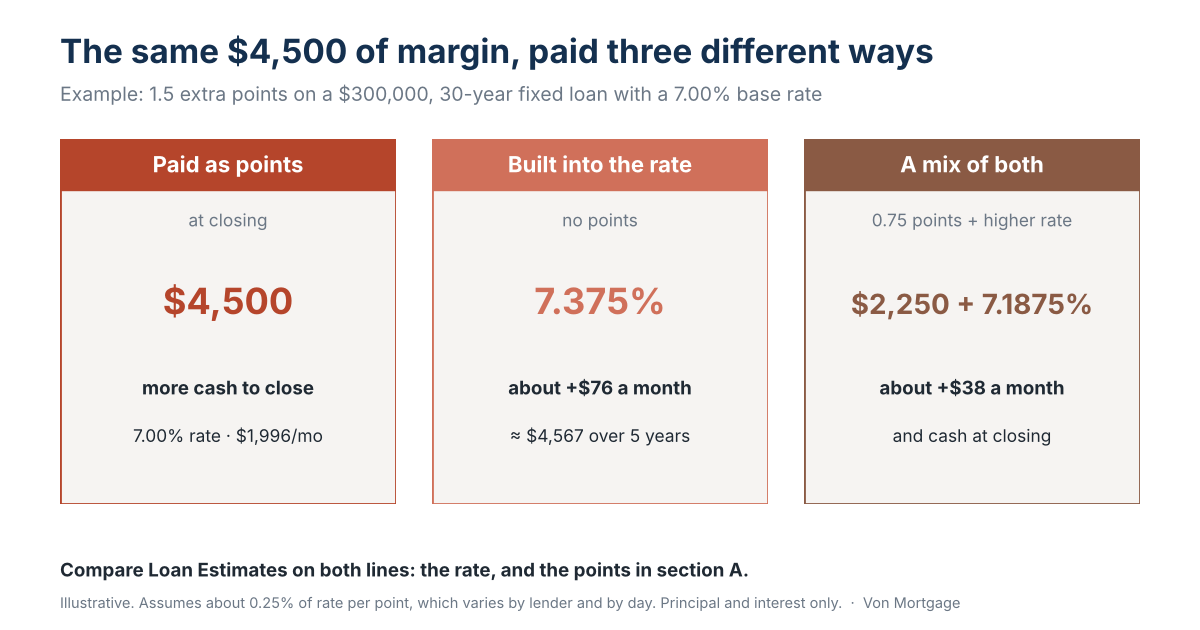
That's why you compare Loan Estimates on two lines, not one. Look at the interest rate on page 1, and the points in section A on page 2. A lower rate with a pile of points isn't a better deal. It's the same margin collected a different way.
Which costs on a Loan Estimate should you ignore when comparing lenders?
Ignore the costs that will be the same no matter which lender you pick. Property taxes are set by the county. Homeowners insurance comes from your insurance company. Title and escrow fees come from the title company, and it's the same title company whichever lender you use. None of that is lender margin, so none of it tells you which quote is better.
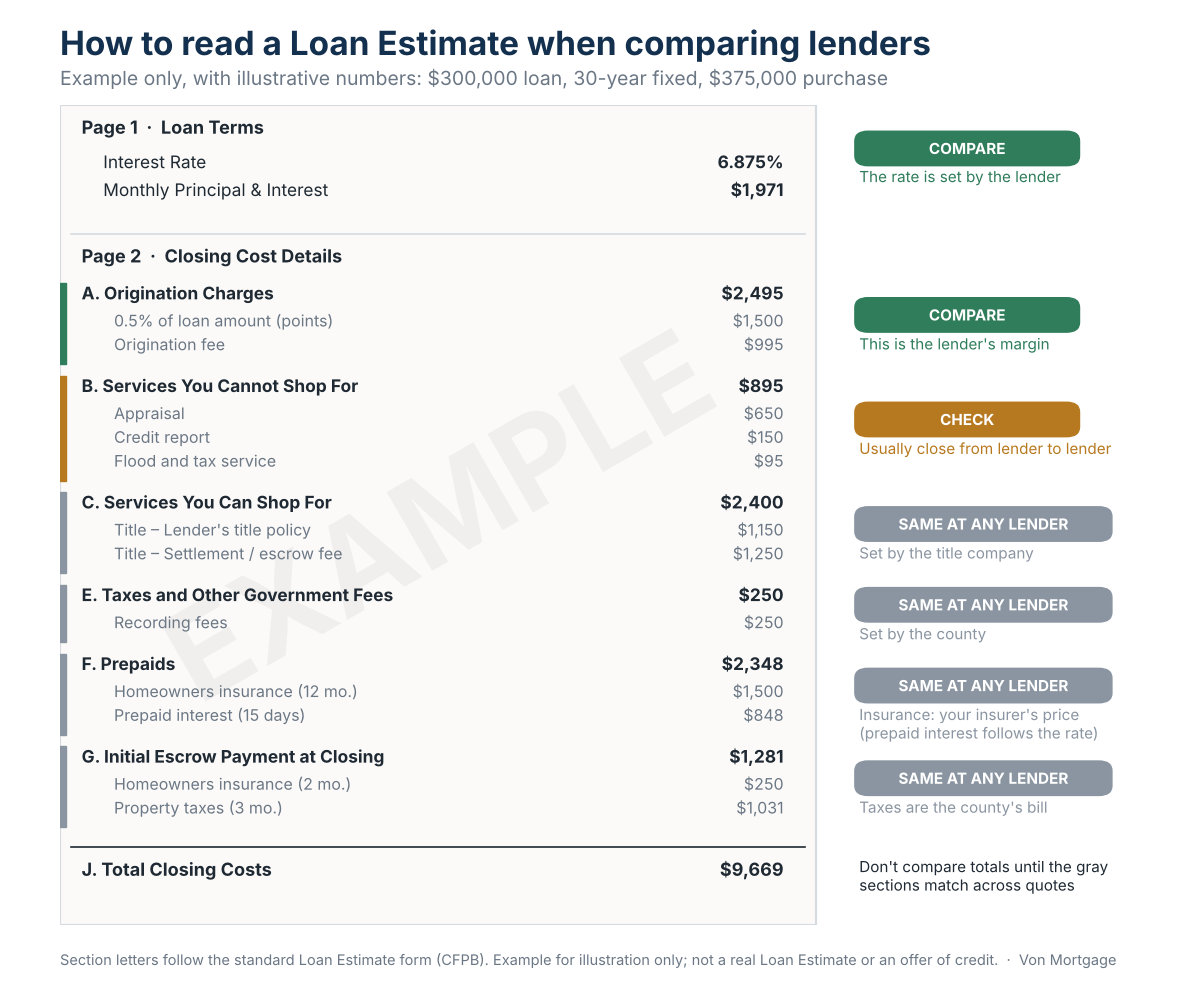
Watch for one trap. Those costs are only estimates on a Loan Estimate, and a lender can show lower numbers to make its bottom line look cheaper. Your actual tax bill, insurance premium and title fees at closing won't change because of it. If one quote shows lower taxes, insurance or title fees than another, that isn't a better deal. It's a different guess. Treat those numbers as equal across every quote, and compare what the lender actually controls: the rate and the lender's own fees.
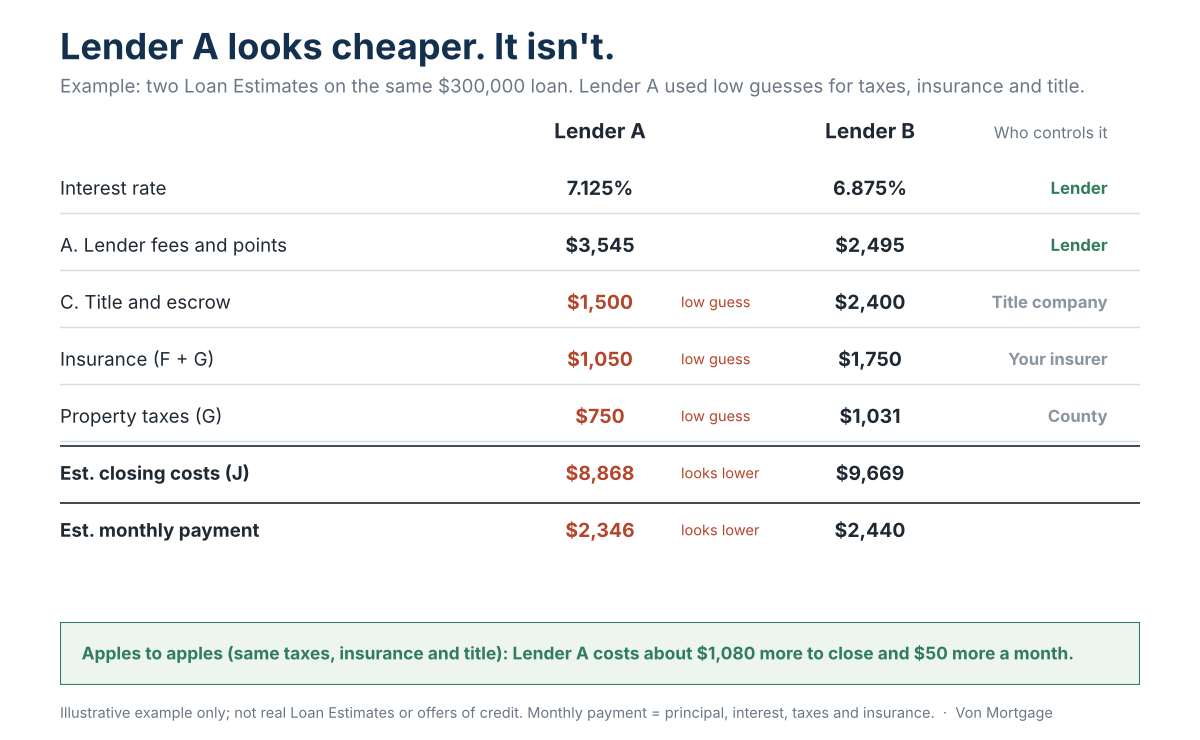
In that example, Lender A's quote looks about $800 cheaper to close and $94 a month cheaper. Once the taxes, insurance and title match, Lender A actually costs about $1,080 more at closing and $50 more a month, because its rate and its own fees are both higher.
Why does a bank's quote usually carry more margin than a broker's?
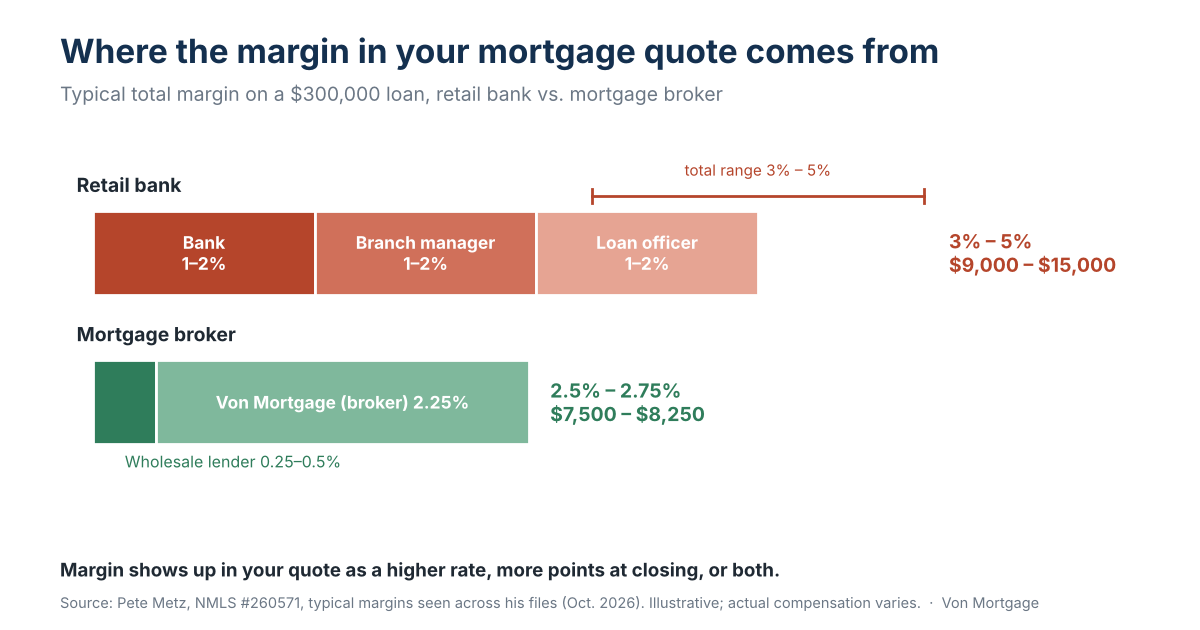
Because more people get paid out of it. At a retail bank or retail lender, the bank needs its margin, typically 1% to 2%. The branch manager needs margin, typically 1% to 2%. The loan officer needs margin, typically 1% to 2%. By the time the quote reaches you, 3% to 5% is often built in.
On a $300,000 loan, that's $9,000 to $15,000 in total margin, split between the loan officer, the branch manager, middle management and the bank.
A mortgage broker works differently. Von Mortgage is a brokerage. Wholesale lenders compete for our business, and they hold only about 0.25% to 0.5% in margin to win it. Our typical margin is 2.25% of the loan amount. I'm comfortable sharing that because I'd rather you know. All in, the broker side runs about 2.5% to 2.75%, or $7,500 to $8,250 on the same $300,000 loan.
That gap is why I think anyone shopping for a mortgage should include a local mortgage broker in the comparison.
Should you just take the lowest quote?
Not automatically. Shopping for the lowest rate and fees isn't always the smart choice. It depends on the file. On a complex loan, like self-employed income, a tight escrow or anything unusual about the property, you want a lender who is reputable and knows what they're doing. A cheaper quote doesn't mean the service will be the same. A loan that falls apart in escrow costs far more than an eighth of a point.
That cuts both ways for brokers too. The broker model has less margin built in, but you still want a broker who knows the business and gives great service. Ask how long they've been doing this, how they handle a file that hits a snag, and whether they'll explain every line of the Loan Estimate.
The numbers in this post come from what I've seen across my own files, not an industry survey. Retail margins vary by bank and loan officer, and our margin varies by loan. The point isn't the exact figure. It's that the margin exists, it's in every quote, and you're allowed to ask about it.
What does this mean for you?
Get at least two quotes, on the same day. Don't show the second lender the first quote until they've made their offer. Compare the rate and the lender's own fees, and set aside taxes, insurance and title, which are the same everywhere. And make sure at least one of your quotes comes from a local broker who can shop wholesale lenders for you.
I'm Pete Metz, a mortgage broker at Von Mortgage in Redding, California (NMLS #260571). I've funded thousands of loans since 2003, and I never expect anyone to work with me. If you've already got a quote, I'm happy to be your second opinion. Just don't tell me the number yet. You can check our live rates, see how we help first-time buyers, or start an application with a soft credit pull.
Disclaimer: This information is educational and is not a commitment to lend, a loan approval, or an offer of credit. Any rates, payments, down payments or other figures shown are illustrative examples only — not quoted terms and not an offer to extend credit. Actual rates and terms depend on credit, income, property, occupancy and market conditions, and change daily. For current pricing see vonmortgage.com/rates.
Pete Metz, Mortgage Broker · NMLS #260571
Dream Big Ownership LLC dba Von Mortgage · NMLS #2592815
2777 Bechelli Lane, Redding, CA 96002 · Pete@VonMortgage.com
Equal Housing Opportunity.

 Equal Housing Lender
Join the conversation
Comments are reviewed before they appear. Have a question about your own situation? Ask Pete directly — that stays private.
No comments yet