




Recent Posts
Categories
Tags
Years
Will Mortgage Rates Go Up After the Fed's October Hold?
Not because of the hold itself. The Federal Reserve left its benchmark rate at 3.75% to 4.00% on Wednesday, October 28, 2026, as markets expected. The pressure on mortgage rates comes from what came with it. Two officials voted for a hike, the Fed said inflation is still too high, and futures traders now see a December hike as likely. The 10-year Treasury yield, which mortgage rates follow, rose after the announcement.
When it comes to locking your rate, my advice is not to try to time the market. Make sure you're comfortable with the rate and the monthly payment, and that the home truly fits your budget. Waiting for an eighth of a percent better can work out, and if it does, great, but it's a gamble. The bigger question is whether you can comfortably afford the home and whether it's the right home for you and your family.
Yesterday's preview, will mortgage rates go down after the October Fed meeting, covered why the Fed doesn't set mortgage rates and how oil is feeding inflation. This is the follow-up: what happened, what the Fed said about inflation, and what to expect on December 9.
What did the Fed decide on October 28, 2026?
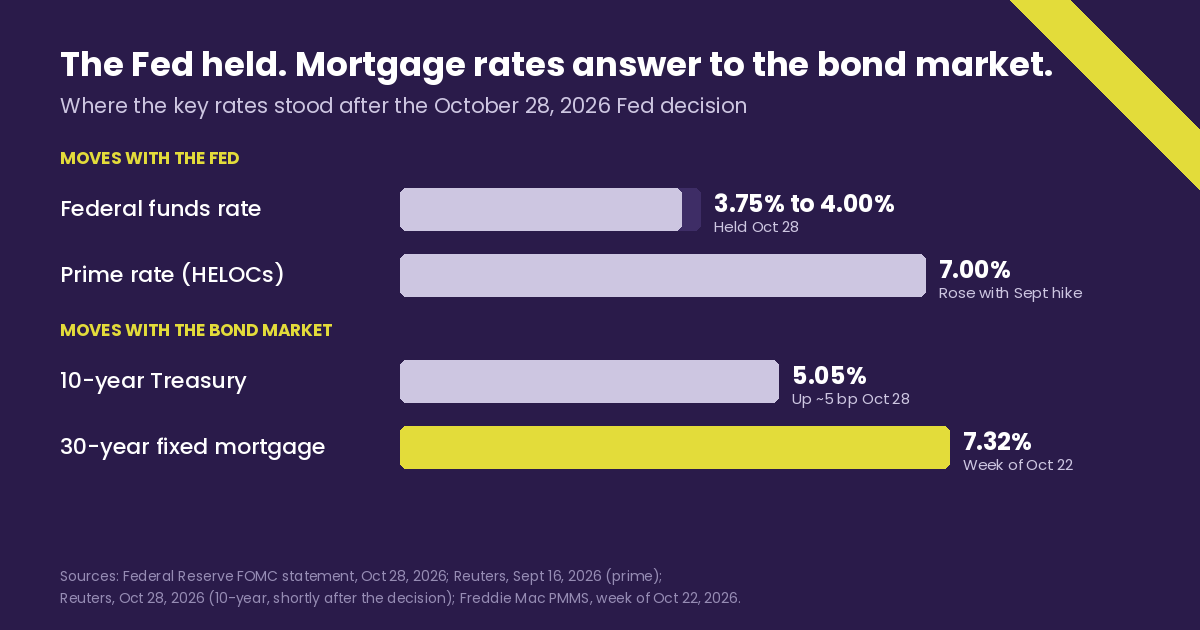
The Fed held the federal funds target range at 3.75% to 4.00% in a 10-2 vote (Federal Reserve FOMC statement, October 28, 2026). Governor Lisa Cook and Cleveland Fed President Beth Hammack dissented. Both wanted a quarter-point hike at this meeting.
The hold follows a quarter-point hike on September 16, the Fed's first increase in three years (Associated Press, October 28, 2026). The statement now says the economy is expanding at a "strong pace," up from "solid" in September (Federal Reserve FOMC statements, September 16 and October 28, 2026). On prices it said three words: "Inflation remains elevated."
Fed Chair Kevin Warsh also said one of the Fed's eight meetings in 2027 will cover strategy only, with no rate vote (Federal Reserve, press conference transcript, October 28, 2026). December is unaffected.
What did the decision do to Treasury yields and mortgage rates?
Yields rose. Shortly after the announcement at 11 a.m. Pacific, the 10-year Treasury yield was up about 5 basis points to 5.047%, and the 2-year was up about 4 basis points to 4.776% (Reuters, October 28, 2026). A basis point is one-hundredth of a percentage point.
The two split once Warsh started talking. The 2-year, which tracks where traders expect the Fed in the near term, gave back its whole gain and was down about 4 basis points at 4.70%. The 10-year held on to its increase at about 5.04% (Reuters, October 28, 2026).
Freddie Mac's latest 30-year fixed average is 7.32%, for the week of October 22, 2026 (Freddie Mac Primary Mortgage Market Survey). The first reading that includes the Fed decision comes out Thursday, October 29.
Why isn't a Fed hold the same as a rate cut?
A hold leaves rates where the September hike put them. The prime rate, which most home equity lines of credit follow, is still 7.00%, up from 6.75% before that hike (Reuters, September 16, 2026).
A 30-year fixed works differently. Investors price it off the 10-year Treasury yield, which moves on where they expect inflation and the Fed to be over several years. On the day the Fed held, that yield went up.
What did the Fed say is driving inflation?
Energy first, with a strong economy behind it. In his opening statement Warsh said, "Energy and related prices have moved higher again in recent weeks." He said the Fed's job is to keep price jumps in some sectors from spreading "across the economy" and to keep inflation expectations anchored (Federal Reserve, press conference transcript, October 28, 2026).
That's the oil story from yesterday's post. Consumer prices rose 3.7% in the year through September, and gasoline alone accounted for over half of September's monthly increase (Bureau of Labor Statistics, October 14, 2026). The Fed can't move a barrel of oil. A hike is aimed at keeping fuel costs from spreading into everything else.
The growing economy makes that harder. "Economic growth has strengthened," Warsh said. First-half GDP growth was revised up from 1.8% to 2.4%, and he said the third quarter looks faster still, led by consumer spending and likely above 3% (Federal Reserve, press conference transcript, October 28, 2026). When families and businesses keep spending, sellers have room to keep raising prices.
He said inflation has been running above the Fed's 2% goal "for close to 6 years," and added, "It's our responsibility to get inflation down" (same transcript).
The Associated Press noted that two of the forces behind inflation now, the rapid buildout of artificial intelligence infrastructure and higher energy prices, may not be easily tamed by higher rates (Associated Press, October 28, 2026).
The outlook from the Fed's own projections: in September, officials' median estimate had PCE inflation at 3.7% for 2026, falling to 2.3% in 2027 and 2.1% in 2028. Seventeen of 18 officials said the risk to that inflation forecast leaned higher (Federal Reserve Summary of Economic Projections, September 16, 2026).
Why does Thursday's PCE inflation report matter?
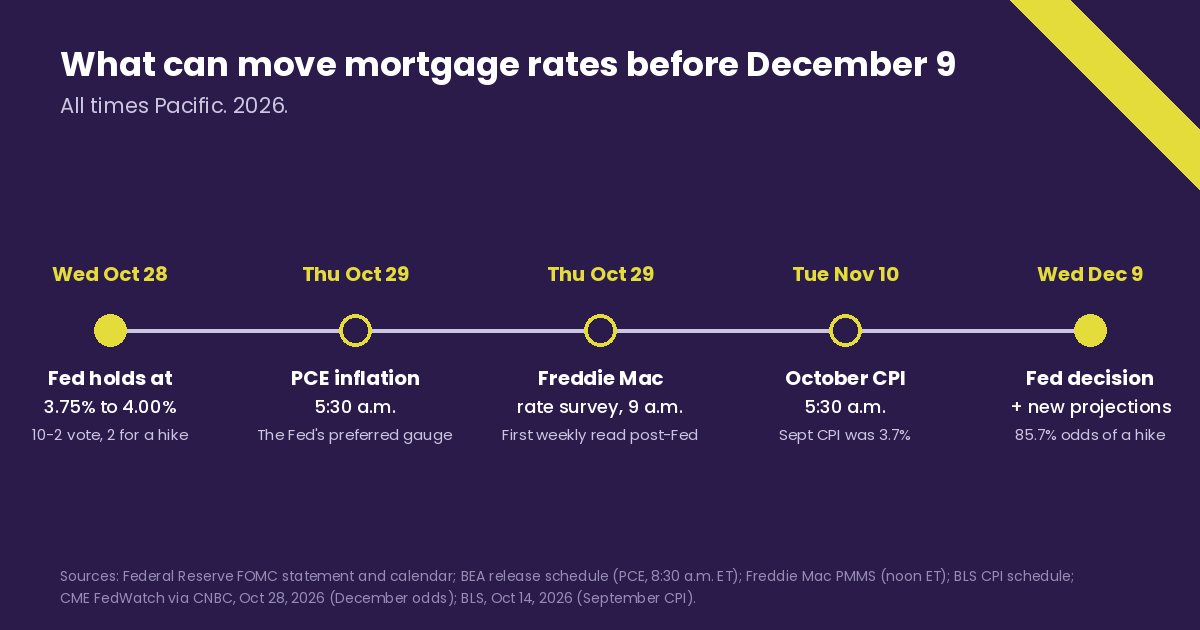
PCE is the inflation measure behind the Fed's 2% goal, so the Fed weighs it more than any other price report. The Bureau of Economic Analysis releases September's numbers Thursday, October 29, 2026, at 8:30 a.m. Eastern, which is 5:30 a.m. here in Redding (BEA release schedule). Warsh repeated Wednesday that the target is 2% as measured by PCE (press conference Q&A, as reported by Admiral Markets, October 28, 2026).
Forecasts call for core PCE, which leaves out food and energy, to rise about 0.3% in September, lifting the annual rate to 3.1% (CNBC, October 15, 2026). The overall PCE index is expected at 3.6% for the year, up from 3.4% in August (Associated Press, October 28, 2026). A hotter number adds weight to a December hike and can push the 10-year and mortgage rates up that morning. A cooler one can ease both.
When is the next Fed meeting, and will the Fed raise rates in December?
The next meeting is December 8 and 9, 2026, with the decision on Wednesday, December 9, and a new set of economic projections (Federal Reserve FOMC meeting calendar). After Wednesday's decision, futures traders put the odds of a quarter-point hike at that meeting at 85.7% (CME FedWatch, via CNBC, October 28, 2026).
The committee points the same way. Two of 12 voters wanted to hike this week. In September, 16 of 18 officials projected at least one more quarter-point increase before the end of 2026 (Federal Reserve Summary of Economic Projections, September 16, 2026). A hike in December would take the range to 4.00% to 4.25%.
Before then, two inflation reports land: September PCE on October 29 and the October consumer price index on November 10 (BEA and BLS release schedules).
What would a December hike or hold mean for mortgage rates?
A hike that is already expected may not move mortgage rates much. With odds near 86%, most of it is already in today's 10-year yield. What moves mortgage rates on December 9 is the message: the new projections, the statement, and whether officials signal more hikes in 2027.
A hike does reach HELOCs directly. In September, the big banks raised prime to 7.00% effective the day after the Fed acted (Reuters, September 16, 2026). If they repeat that in December, prime goes from 7.00% to 7.25%, and families with a variable-rate home equity line of credit would see it in their payment.
A hold would surprise the market. Paired with cooler inflation data, it could bring the 10-year down and mortgage rates with it. Paired with hot data and a signal that a hike is only delayed, it may not help at all.
Should you lock or float before December?
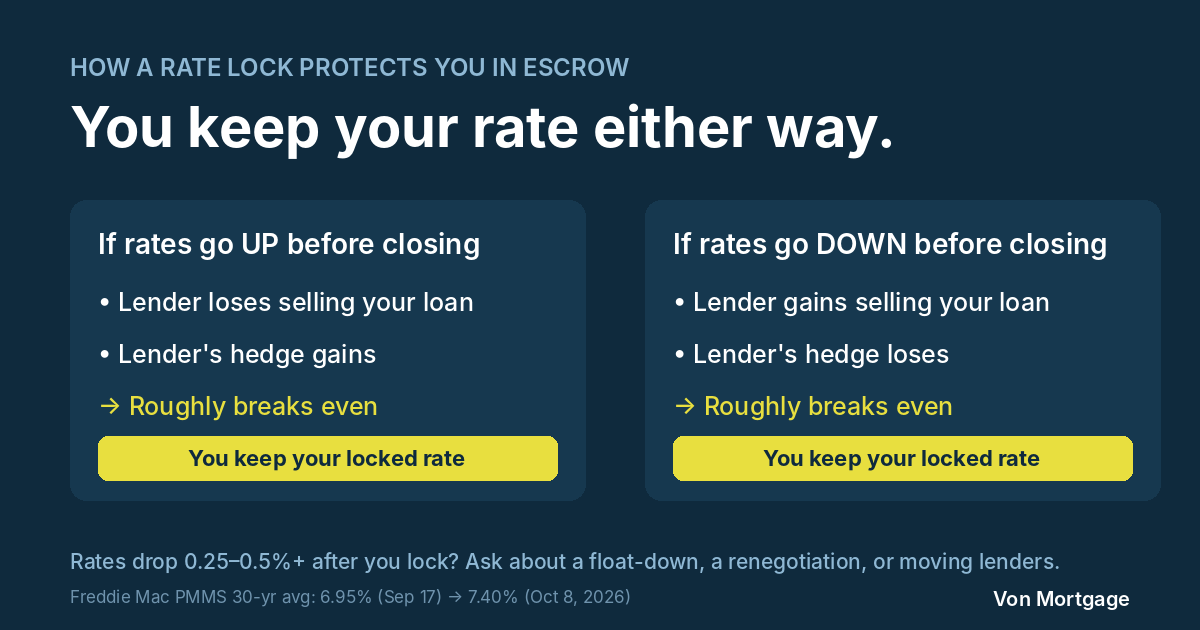
If you close in the next 30 to 45 days, lock. That's what I told families before this meeting, and nothing on Wednesday changed it. The scheduled news between now and December 9 leans toward higher rates, and a lock protects you from a hot PCE or CPI morning.
Locking has a cost. If rates fall after you lock, that loan keeps the higher rate. I'd still take that over betting that two inflation reports and a Fed meeting all go your way.
How does a broker help when rates are rising?
Rate shopping is only part of it. When rates go up, the payment goes up, and so does your debt-to-income ratio, the share of your monthly income that goes to debt payments. Fannie Mae caps that ratio at 50% for loans approved through its automated underwriting system (Fannie Mae Selling Guide, B3-6-02). A file that fit at one rate can fall just outside at a quarter point higher.
A bank can only offer its own programs and its own guidelines. As a broker, I have access to many lenders and loan programs, each with its own guidelines on income, reserves and ratios, so I can place the file where it fits. The pricing side is in how to shop for a mortgage: broker vs bank margins.
What nobody can tell you about December yet
The odds move. On October 7, futures priced about a 69% chance of a December hike (Trading Economics, October 7, 2026). After Wednesday they were at 85.7%. One soft inflation report could pull them back down just as fast.
Warsh doesn't hint. He has spoken out against forward guidance, the practice of signaling the next move in advance, so December will be decided on the data, not on anything said this week (CNN, October 28, 2026).
And mortgage rates can rise when the Fed does nothing. Wednesday showed it.
What this means for you
If you're in contract, lock. If you're shopping, start from a payment you're comfortable with and price it now, not after December 9. If you have a HELOC, plan for prime to move with the Fed in December.
I'd rather run your real numbers than have you guess from a press conference. Send me your scenario and I'll show you what a December hike would do to your payment and which programs fit your file.
Disclaimer: This information is educational and is not a commitment to lend, a loan approval, or an offer of credit. Any rates, payments, down payments or other figures shown are illustrative examples only — not quoted terms and not an offer to extend credit. Actual rates and terms depend on credit, income, property, occupancy and market conditions, and change daily. For current pricing see vonmortgage.com/rates.
Pete Metz, Mortgage Broker · NMLS #260571
Dream Big Ownership LLC dba Von Mortgage · NMLS #2592815
2777 Bechelli Lane, Redding, CA 96002 · Pete@VonMortgage.com
Equal Housing Opportunity.
 Equal Housing Opportunity
Join the conversation
Comments are reviewed before they appear. Have a question about your own situation? Ask Pete directly — that stays private.
No comments yet