




Recent Posts
Categories
Tags
Years
Can You Qualify for a Mortgage on Retirement Savings?
Many retired couples who want to buy a home could qualify using their savings, but the lenders they were with didn't know this rule, or didn't know how to use their retirement assets to help them qualify for the mortgage.
I've had multiple loans in the last 12 to 24 months that came to me from other lenders where the families weren't able to qualify. Those lenders didn't realize they could use the families' assets, through asset depletion, to help qualify them to purchase the home. That's why I'm writing this.
Yes, usually. A lender can count retirement and other savings as income two ways: a withdrawal you take that will continue for at least three years, or an "asset depletion" calculation that divides your balance by a set number of months. The rules differ by loan program, and that's where a broker earns his keep, because the same savings can qualify for a different amount depending on where the loan goes.
That gap just got wider. On August 5, 2026, Freddie Mac announced in Bulletin 2026-10 that it will divide qualifying assets by 180 months instead of 240, for loans settling on or after February 3, 2027. Lenders may start using it now. On a Freddie Mac loan, the same savings will produce a third more monthly income.
Families asked me some version of this 22 times between September 1 and October 9, 2026. Can my IRA count as income? Do I have to start withdrawals first? Can I add it to Social Security? Do you still want reserves on top? Below is how lenders count those assets. It isn't investment or tax advice, and your CPA or financial advisor should weigh in on when and how much to withdraw.
Can IRA or 401(k) withdrawals count as mortgage income?
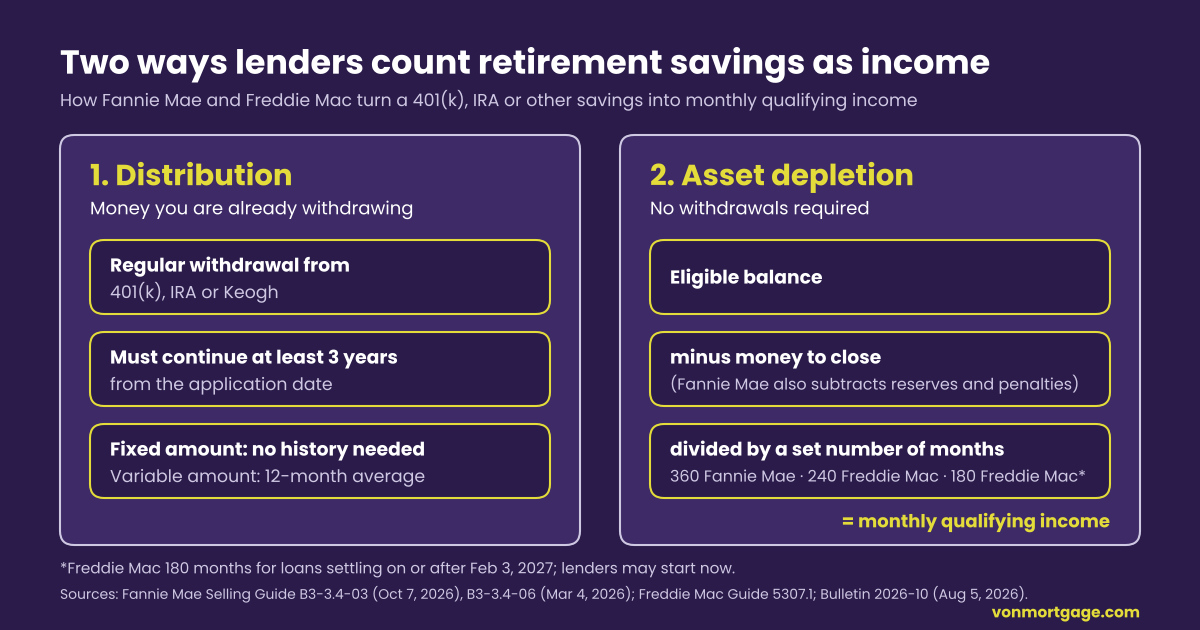
Yes, if the withdrawals will continue for at least three years from the date you apply. Fannie Mae's Selling Guide (Section B3-3.4-03, dated October 7, 2026) counts a regular distribution from a 401(k), IRA or Keogh as retirement income once the lender documents that it will last that long.
How it counts depends on whether the amount moves. A fixed distribution, the same amount on a set schedule, needs no minimum history, so a withdrawal you set up recently can still count. A variable distribution needs a 12-month history, and the lender averages it.
If one account can't carry three years by itself, Fannie Mae lets the lender combine 401(k), IRA and Keogh balances to show it, as long as you can take the money without a penalty.
What is asset depletion, and how do lenders calculate it?
Asset depletion is a way to qualify on savings you aren't withdrawing. The lender takes your eligible balance, subtracts what you need to close the loan, and divides what's left by a set number of months. The result counts as monthly income.
Fannie Mae (Selling Guide B3-3.4-06, dated March 4, 2026) divides by the loan term in months, which is 360 on a 30-year loan. Before dividing, it subtracts any early-distribution penalty, the down payment, closing costs and required reserves. Fannie's own example starts with a $500,000 IRA, takes off a 10% penalty ($50,000) and $100,000 to close, and divides the remaining $350,000 by 360. That's $972.22 a month.
Freddie Mac (Guide Section 5307.1) subtracts the money needed to close, any gift or borrowed funds, and any pledged portion, then divides by 240. Freddie has cut that number twice. It dropped from 360 to 240 in Bulletin 2019-7 on April 3, 2019, and drops to 180 under Bulletin 2026-10.
The account has to qualify, too. Freddie Mac counts a retirement account only if it's an IRS-recognized plan like a 401(k) or IRA, solely yours, fully vested, not already being used as income, and withdrawable in full without a penalty or early-distribution tax as of the note date.
Do you have to start retirement withdrawals to qualify for a mortgage?
No, not under asset depletion. That calculation uses the balance itself, so the account can stay untouched. You need ongoing withdrawals only when the lender is counting them as distribution income, the first method above.
The penalty question is where the two agencies split. Freddie Mac won't count a retirement account that would trigger an early-withdrawal penalty (Guide 5307.1). Fannie Mae will count it, after subtracting the penalty (B3-3.4-06).
What changes with Freddie Mac's 180-month rule?
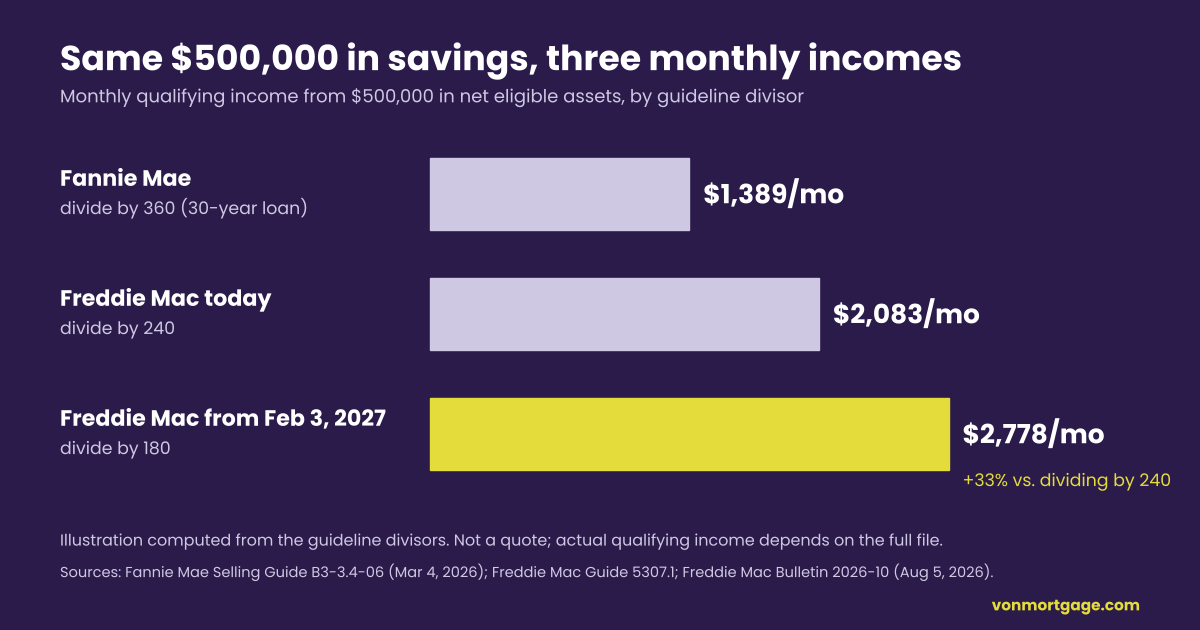
The same savings produce a third more monthly income. Dividing by 180 instead of 240 raises the result by 33%. Freddie Mac Bulletin 2026-10, issued August 5, 2026, applies to loans settling on or after February 3, 2027, and lenders may adopt it now.
The bulletin rewrote more than the divisor. Under the new rules, you need at least $30,000 in net eligible assets and an LPA Accept, which is an approval from Loan Product Advisor, Freddie Mac's automated underwriting system. Primary homes, second homes and investment properties all qualify, on a purchase or a no cash-out refinance. The old 80% maximum loan-to-value cap is gone, and loan-to-value now follows Freddie's standard limits in Guide Section 4203.1. The borrower age restriction on bank and brokerage accounts is gone too.
One rule will catch buyers who move money around before applying. Bank and brokerage accounts must be seasoned 12 months unless the money came from an eligible source. If a bank balance fell more than 20% over those 12 months, it isn't eligible, unless the money went into securities or retirement accounts. If it rose more than 20%, you can count only up to 120% of where it stood 12 months earlier. Transfers from retirement accounts, lump-sum distributions, and proceeds from selling a business or real estate are among the listed exceptions.
How do Fannie Mae and Freddie Mac compare on asset depletion?
Freddie Mac produces more income from the same savings and allows investment properties. Fannie Mae counts accounts that carry a penalty and caps loan-to-value lower.
| Rule | Fannie Mae | Freddie Mac |
|---|---|---|
| Divide by | Loan term in months (360 on a 30-year) | 240 today; 180 for loans settling on or after Feb 3, 2027 |
| Subtracted first | Early-distribution penalty, down payment, closing costs, required reserves | Funds to close, gift and borrowed funds, any pledged portion |
| Account with a penalty | Counts after subtracting the penalty | Must be withdrawable in full without penalty |
| Eligible assets | 401(k), IRA, SEP, Keogh, severance or lump-sum retirement distributions | Retirement accounts plus bank and brokerage accounts (seasoned 12 months) |
| Property | Principal residence, second home | Primary, second home, investment property |
| Loan purpose | Purchase or limited cash-out refinance | Purchase or no cash-out refinance |
| Max loan-to-value | 70%, or 80% if the asset owner is 62+ at closing | Standard limits in Section 4203.1 (old 80% cap removed) |
| Minimum | No minimum income history | $30,000 in net eligible assets; LPA Accept required |
Can you combine Social Security with IRA income to qualify?
Yes. You can add your Social Security income to your asset depletion income and use both together to qualify. Social Security or a pension counts on its own documentation, and the income from your savings is added on top. What you can't do is count the same account twice. Freddie Mac excludes any retirement account already being used as income from the asset depletion calculation (Guide 5307.1).
Do lenders want reserves on top of asset depletion income?
At Fannie Mae, yes. Required reserves come out of the balance before the division (B3-3.4-06), so a dollar set aside for reserves can't also produce income. Freddie Mac's formula in Guide 5307.1 subtracts the money needed to close, so ask how reserves are handled on your loan before you count on every dollar.
Why can the same savings qualify differently at different lenders?
Each program has its own divisor, deductions and limits, and most lenders work from one set of rules. A lender working only from Fannie Mae's guide divides by 360 on a 30-year loan. Run the same savings through Freddie Mac's 240 and the monthly income is 50% higher. At 180 it doubles.
As a broker, I can send the same file to Fannie Mae, Freddie Mac or a non-QM asset-based program, whichever fits. Non-QM means "non-qualified mortgage," and those lenders set their own asset rules outside the Fannie and Freddie guides. Shopping the rate is part of my job. Finding the program whose rules fit your savings is the bigger part. You can read more about how lenders count each kind of income.
This question comes up often in Shasta County. U.S. Census Bureau QuickFacts (Vintage 2025 estimates) puts 24.1% of county residents at 65 or older, compared with 17.5% across California. The same math also helps self-employed buyers with large balances and thin tax returns, and there's a separate post on qualifying when you're self-employed without tax returns.
What the divisor doesn't show you
Asset depletion usually means a bigger down payment. Fannie Mae caps the loan-to-value at 70% on asset depletion, or 80% if the account owner is at least 62 at closing (B3-3.4-06). Neither agency allows a cash-out refinance on this income. Fannie limits it to a purchase or limited cash-out refinance, Freddie to a purchase or no cash-out refinance.
The income also has to carry a payment at today's rates. Freddie Mac's Primary Mortgage Market Survey put the 30-year fixed at 7.32% for the week of October 22, 2026. At that rate, a $300,000 loan runs about $2,061 a month in principal and interest, before taxes and insurance. That one payment nearly equals the $2,083 a month that $500,000 produces at Freddie's 240 divisor. For most retired buyers, asset depletion works best stacked on Social Security, a pension or a larger balance.
Withdrawing money to qualify has tax consequences that have nothing to do with the mortgage. Talk to your CPA before you move anything.
If you want to stay in a home you already own and draw on its equity, a reverse mortgage is a different tool with its own rules.
What does this mean for you if you're retired and buying?
Leave your accounts where they are and pull 12 months of statements for each one before you apply. Freddie Mac's seasoning and 20% rules look back that far, and moving money early can shrink what counts.
Then ask the lender which divisor they're using. If the answer is 360, ask whether your file fits Freddie Mac's 240, or 180 once the lender adopts the new rule.
I give every buyer a total cost analysis: the up-front costs, plus what the mortgage costs over 3 to 5 years, 10 to 15 years and 25 to 30 years, with the options side by side. For a retired buyer it often decides the program. A larger down payment to meet a 70% cap, a smaller loan and a different rate can change which option costs less over the time you plan to stay.
If you're wondering whether your savings will qualify, send me the account types and rough balances and I'll run them through each program. You can start a quote here. I'd rather you see all three numbers before you pick one.
Disclaimer: This information is educational and is not a commitment to lend, a loan approval, or an offer of credit. Any rates, payments, down payments or other figures shown are illustrative examples only — not quoted terms and not an offer to extend credit. Actual rates and terms depend on credit, income, property, occupancy and market conditions, and change daily. For current pricing see vonmortgage.com/rates.
Pete Metz, Mortgage Broker · NMLS #260571
Dream Big Ownership LLC dba Von Mortgage · NMLS #2592815
2777 Bechelli Lane, Redding, CA 96002 · Pete@VonMortgage.com
Equal Housing Opportunity.
 Equal Housing Opportunity
Join the conversation
Comments are reviewed before they appear. Have a question about your own situation? Ask Pete directly — that stays private.
No comments yet