




Recent Posts
Categories
Tags
Years
Will Mortgage Rates Go Down After the October Fed Meeting?
Probably not. Markets expect the Federal Reserve to leave its benchmark rate where it is on Wednesday, October 28, and the Fed doesn't set mortgage rates anyway. Mortgage rates follow the 10-year Treasury yield and inflation. The bigger risk for buyers is the December meeting and the next inflation report.
Every Fed week, families ask me whether they should wait for the announcement before they lock. On October 20 I said lock, don't float, because rates have more room to go up than down. Nothing on this week's calendar changes that.
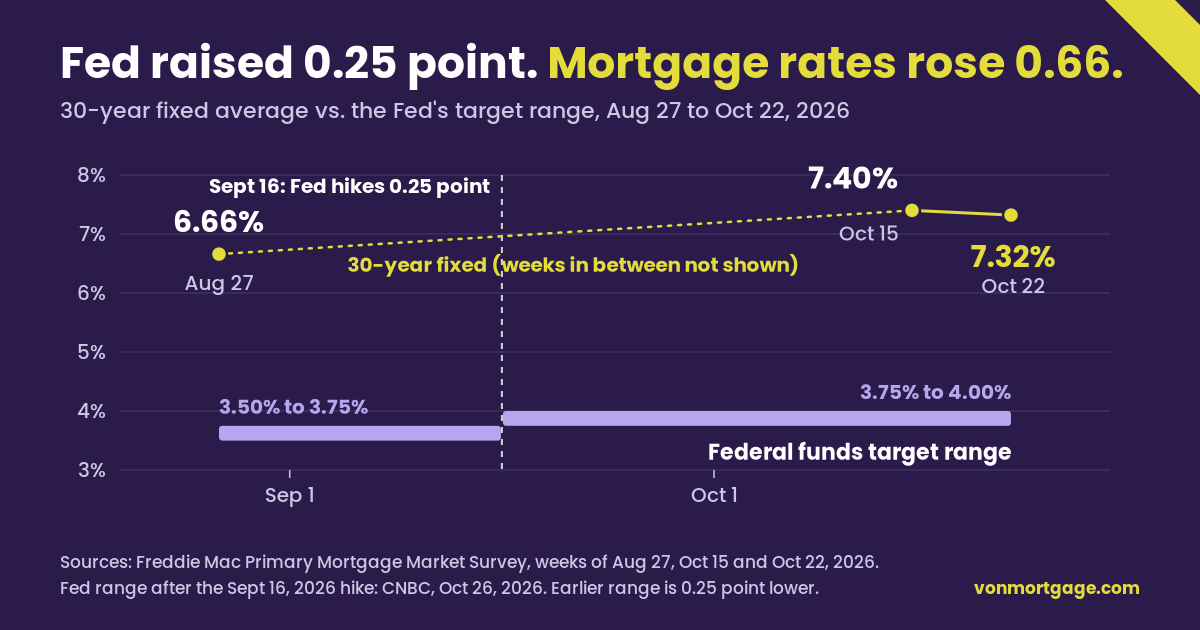
The Fed's rate committee meets October 27 and 28, according to the Federal Reserve's FOMC calendar. The decision comes out Wednesday at 2 p.m. Eastern, which is 11 a.m. here in Redding (MortgageResearch.com, October 27, 2026). The Fed raised its benchmark rate a quarter point on September 16 to a range of 3.75% to 4.00%, its first hike since 2023 (CNBC, October 26, 2026). As of Monday evening, CME FedWatch put the odds of another hike this week at about 10% (MortgageResearch.com, October 27, 2026).
Does the Fed set mortgage rates?
No. The Fed sets the federal funds rate, the overnight rate banks charge each other. A 30-year mortgage is priced by investors who buy long-term mortgage bonds, and what they demand tracks the 10-year Treasury yield.
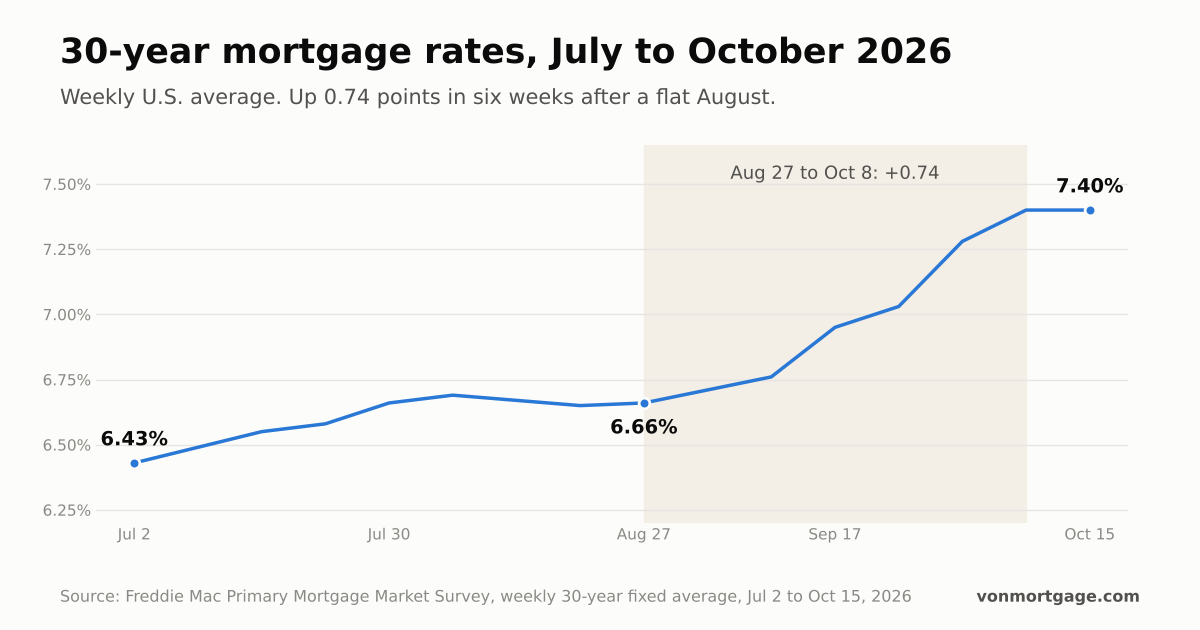
September showed it. Bankrate's Jeff Ostrowski told Realtor.com that after the Fed's quarter-point hike, mortgage rates jumped three-quarters of a point in a month, because mortgage rates move with 10-year Treasury yields (Realtor.com, October 2026). Freddie Mac's Primary Mortgage Market Survey had the 30-year fixed at 6.66% on August 27, 2026 and 7.32% for the week of October 22. A year earlier it was 6.19%.
What is moving mortgage rates right now?
Inflation, and right now inflation is mostly an oil story. The Bureau of Labor Statistics reported on October 14, 2026 that consumer prices rose 3.7% in the year through September, up from 3.4% in August. Energy was up 20.4% and gasoline 34.2%. When inflation runs that hot, investors want a higher yield before they lend money for ten or thirty years.
The trouble is that the Fed has no control over oil. Raising rates slows borrowing and spending here at home. It doesn't move a single barrel through a shipping lane. Brent crude, the global benchmark, settled at $115.81 a barrel on Monday, October 26, and West Texas Intermediate, the U.S. benchmark, settled at $101.76 (FinanceFeeds, October 27, 2026). A year earlier, Brent was about $66 (Fortune, October 26, 2026).
Oil is flowing out of the Persian Gulf again, just not the way you'd picture it. Iran closed the Strait of Hormuz during this year's war, so Gulf producers found a workaround (Al Jazeera, September 18, 2026). Tankers load at Arab ports and run the strait, often at night with their trackers switched off, along a southern route near Oman. Once they're through, they pump the oil at sea onto very large tankers waiting off Sohar, Oman, and Fujairah in the UAE, and those big ships carry it the rest of the way (Al Jazeera, October 12, 2026). Ship-to-ship transfers done outside the usual rules often involve older vessels with no standard insurance (Al Jazeera, September 18, 2026).
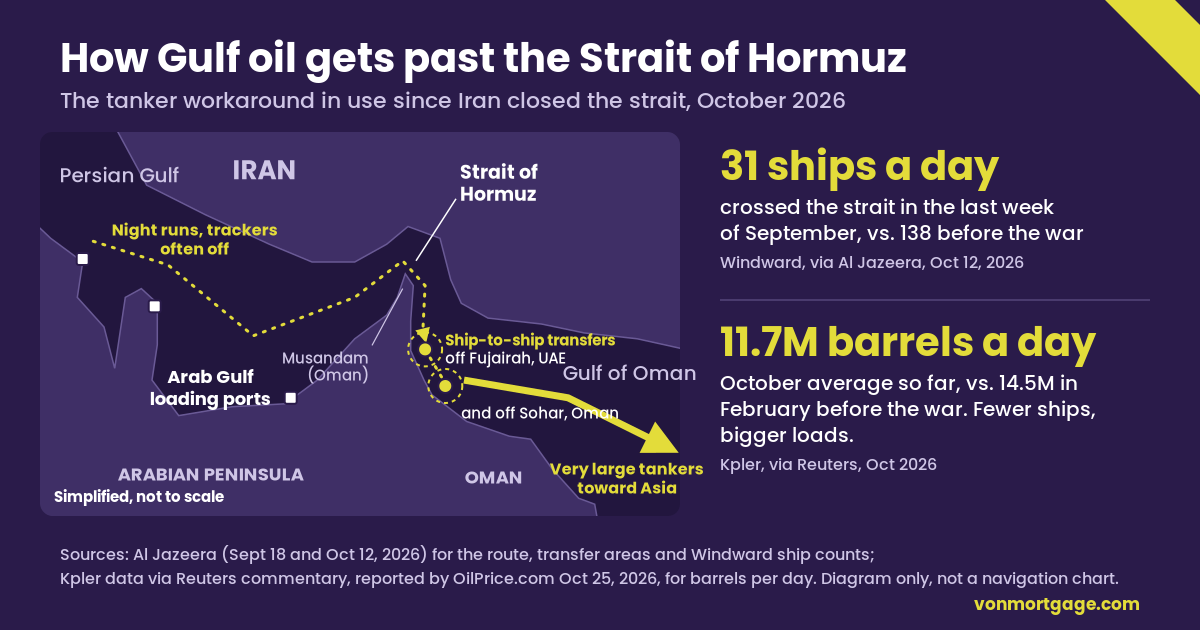
It works, and it's expensive. In the last week of September, 31 ships a day moved through the strait, compared with 138 before the war (Windward, via Al Jazeera, October 12, 2026). The ships are bigger, though, so more oil gets out than that count suggests. Kpler, a firm that tracks tankers, puts October flows at about 11.7 million barrels a day, roughly 82% of pre-war levels (Kpler, via Reuters, October 22, 2026). Shipping now makes up 25% to 30% of what Gulf crude costs, up from 1% to 3% before the war (Windward, via Al Jazeera, October 12, 2026). That cost lands at the pump and in the inflation report, and nothing the Fed decides on Wednesday changes it.
The 10-year eased a little last week, from about 5.24% to 5.13% (Realtor.com Economic Research, October 22, 2026), and the 30-year fixed slipped with it, from 7.40% to 7.32% (Freddie Mac PMMS, week of October 22, 2026).
What happens to mortgage rates when the Fed announces on October 28?
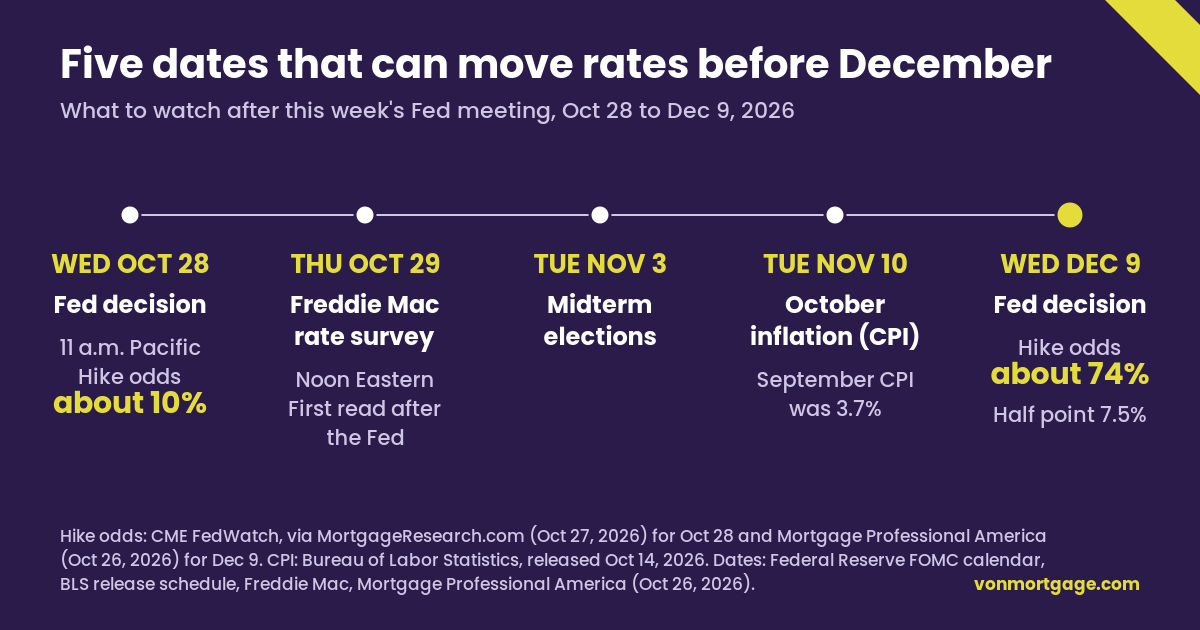
Probably a small move in either direction. A hold is about 90% priced in, according to CME FedWatch (Realtor.com, October 2026), so the decision itself is old news by the time it's announced. The 10-year reacts to what the Fed says about inflation and about December, in its statement and the press conference afterward.
Freddie Mac's next weekly survey comes out Thursday, October 29, at noon Eastern. That's the first read on mortgage rates after the decision.
Why is December the meeting to watch?
Because the market expects a hike there. As of Monday morning, October 26, CME FedWatch showed about 74% odds of a quarter-point increase at the December 9 meeting and 7.5% odds of a half point (Mortgage Professional America, October 26, 2026).
Two things land before then. The midterm elections are November 3 (Mortgage Professional America, October 26, 2026), and the October inflation report comes out November 10 (Bureau of Labor Statistics). A hot October number is the likeliest thing on the calendar to push the 10-year, and mortgage rates, higher.
How much does a quarter point change your payment?
About $68 a month in principal and interest on a $400,000 loan. At 7.32%, Freddie Mac's October 22 average, a $400,000 30-year loan runs about $2,748 a month. At 7.07% it runs about $2,680. That's the size of the bet a buyer makes by floating through a Fed week. You can price your own scenario against today's rates.
What does locking through a Fed week cost you?
If rates drop after you lock, this loan doesn't get the lower rate. That's the real cost of locking. I still tell buyers to lock, because I can't tell you where rates are going, nobody on TV can either, and the calendar between now and December leans the wrong way. I laid out the full reasoning in why I told buyers to lock instead of float, and how an inflation report can move your rate lock covers the CPI side.
What I can control is showing you the whole cost. Every buyer I work with gets a total cost analysis: up-front costs, plus what the loan costs over 3 to 5 years, 10 to 15 years and 25 to 30 years, with each option side by side. Most of the time that analysis talks families out of discount points. Points buy a lower rate up front, and most buyers don't keep the loan long enough to earn the money back.
If rates fall far enough after you close, you're not stuck with the rate. I'm a broker, so I can shop the refinance, and Rate Drop Refi™ covers the lender fees on it.
What this means for you
If you're in contract or close to it, lock and stop watching the Fed. If you're still shopping, start with a real payment number and the first-time homebuyer options that fit it.
I'd rather run your actual numbers than have you guess from a press conference. Send me your scenario and I'll put the options side by side.
Disclaimer: This information is educational and is not a commitment to lend, a loan approval, or an offer of credit. Any rates, payments, down payments or other figures shown are illustrative examples only — not quoted terms and not an offer to extend credit. Actual rates and terms depend on credit, income, property, occupancy and market conditions, and change daily. For current pricing see vonmortgage.com/rates.
Pete Metz, Mortgage Broker · NMLS #260571
Dream Big Ownership LLC dba Von Mortgage · NMLS #2592815
2777 Bechelli Lane, Redding, CA 96002 · Pete@VonMortgage.com
Equal Housing Opportunity.


 Equal Housing Opportunity
Join the conversation
Comments are reviewed before they appear. Have a question about your own situation? Ask Pete directly — that stays private.
No comments yet