




Recent Posts
Categories
Tags
Years
Yes, you can buy a house before selling yours if you have an approved way to fund the purchase and meet the new lender’s rules while you still own the current home. But having money for the down payment, being comfortable with two payments, and qualifying for the loan are three different things.
Purchasing before you sell can be different for every single family. Here are the situations I look at, explained in plain language. This is my guidance about different needs, not the story of one actual family or a promise of a particular result.
What are the five planning scenarios for buying before selling?
The five scenarios below come from my explanation of families with savings, families considering a HELOC, and families who cannot qualify with both mortgages counted. The last situation has two branches: a buyer is already under contract, or there is no buyer yet. Those branches are shown separately as scenarios four and five. These are not five steps, and a family can fit more than one scenario.
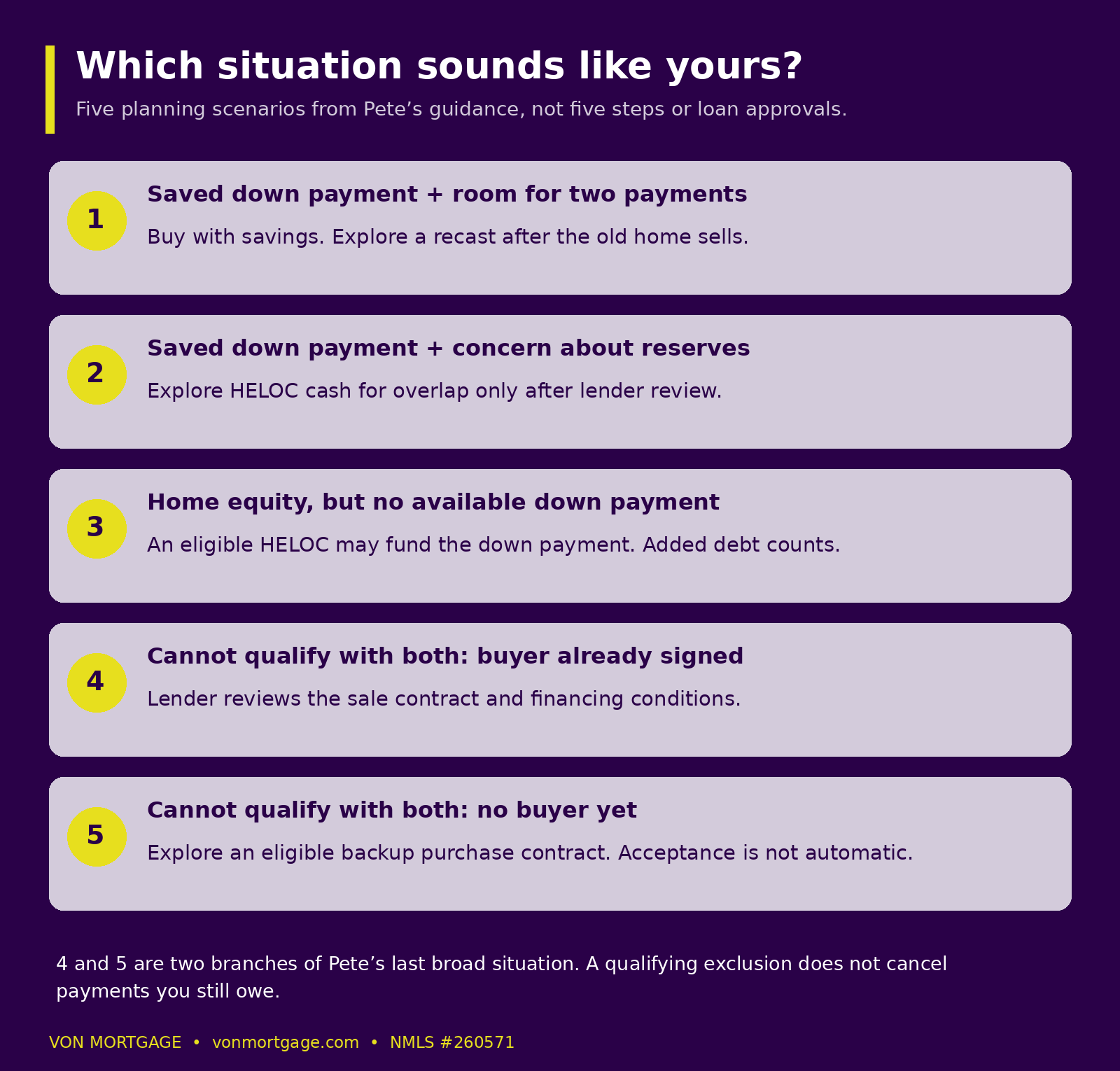
1. Have the down payment saved and comfortable with two payments?
You may be able to buy with your savings, sell the old home later, and use some of the sale money to lower the new mortgage payment through a recast. You do not need to borrow against the old home to get the down payment in this situation.
In my explanation, this family already has the minimum required down payment saved. I used roughly 3% to 5% as an example, not a rule for every loan. The required amount depends on the program and the family’s eligibility. A low-down-payment option does not automatically mean the loan can be recast.
Here is how I described the situation:
Purchasing before you sell can be different for every single family that is in this position. Some families will be able to afford the next mortgage and just purely want to make sure that their payment gets lowered once they purchase the home and then eventually sell their previous home, knowing eventually that they’ll have that equity that they can put down on the mortgage. In a situation like this, a recast is often the best opportunity for these sellers because they’re okay with having two mortgage payments, number one. Number two, they know it’s only going to be for a short time, maybe 30 days to 60 days.
That 30-to-60-day window is an expectation in this situation, not a guaranteed sale or closing timeline. Before buying, the family still needs a budget for a longer overlap.
How does a mortgage recast lower the payment?
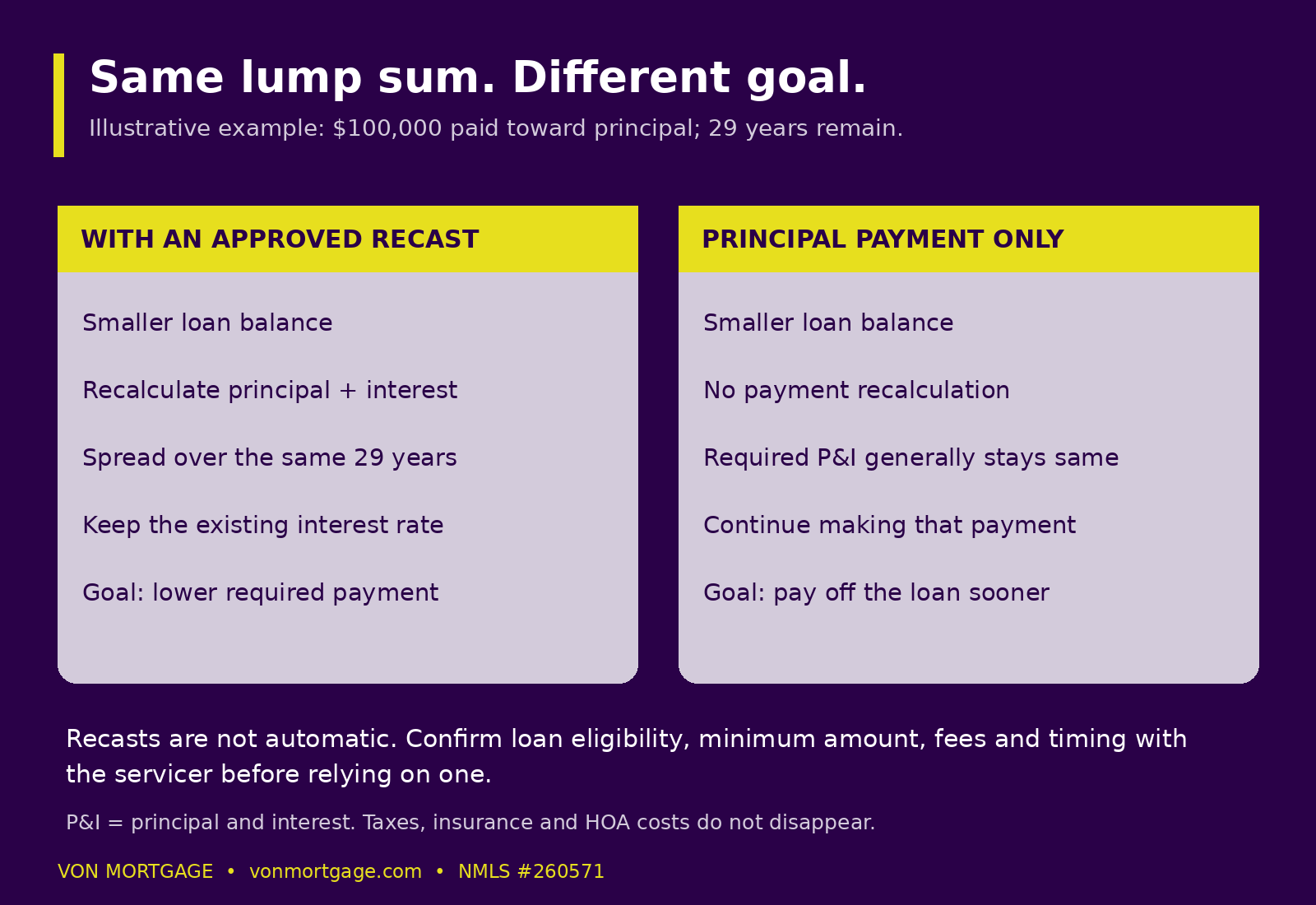
A recast means the company handling your mortgage recalculates the principal-and-interest payment after you reduce the loan balance. It uses the same remaining loan term and keeps the existing interest rate. It is not a refinance.
Here is my illustrative example: suppose you have 29 years left on the loan and put $100,000 from your sale toward the principal, the amount you owe. With an approved recast, the smaller balance is spread over those same 29 years. The required principal-and-interest payment goes down. Taxes, insurance and HOA dues are separate costs; a recast does not make them disappear.
If you put the same $100,000 toward principal without a recast, the required principal-and-interest payment generally stays the same. Continuing that payment can pay the loan off sooner instead. One approach aims for a smaller required payment; the other aims for an earlier payoff.
Do not assume there is a universal $25,000 minimum. Minimum amounts, fees, timing and eligible loans vary by servicer and investor. For example, Chase’s recast page, checked November 8, 2026, states no minimum for its program and excludes FHA, VA and USDA loans. Confirm the rules for your own loan before relying on a recast.
2. Have the down payment but worried about using up savings on two payments?
A HELOC on the departing residence may be worth reviewing as a temporary source of cash. “Departing residence” simply means the home you plan to leave and sell. A HELOC is a line of credit secured by that home’s equity, the value left after the debt against it.
In this situation, the family’s concern is preserving reserves, meaning money kept available for bills and surprises. In my explanation, we would explore whether HELOC funds could help with payments during the overlap rather than draining savings.
This needs a specific lender review, not a blanket promise. The general rules allowing secured borrowed funds for down payment, closing costs and reserves do not, by themselves, establish that every program permits planned HELOC draws to make the new mortgage payments. Both lenders must review the intended use, availability of the line, and how the borrowing affects qualification. Do not count on this arrangement until it is approved for your situation.
Borrowing cash does not remove either mortgage. The lender must still qualify you using the applicable housing payments, HELOC payment and other debts. The line can add interest, fees and another obligation secured by your home. It shifts where payment cash comes from; it does not make the payments free.
3. Have home equity but no available down-payment cash?
An eligible HELOC on the current home may provide the down payment for the next one. This family differs from scenario one: they need access to equity before the sale because the down-payment money is not already available in savings.
Fannie Mae’s secured-borrowed-funds rule, checked November 8, 2026, allows funds borrowed against an asset, including real estate, for down payment, closing costs and reserves, with documentation and debt review. That is not automatic approval for a particular HELOC or purchase loan.
We need enough available equity, an eligible line, and approval for the new purchase with all applicable payments considered. A HELOC draw creates debt; it is not the same as receiving sale proceeds you do not have to repay.
This family may be comfortable with two mortgages, like scenario one, or worried about cash reserves, like scenario two. The categories can overlap. Using a HELOC for the down payment does not automatically approve its use for ongoing payments.
Check occupancy and listing restrictions before depending on a line. Do not assume it will be available after listing or moving out. Review the rate, fees, required payment and payoff at sale. Learn more on our HELOC program page and in What is a HELOC?.
4. Cannot qualify with both mortgages, but already have a buyer under contract?
A qualifying sale contract may allow the lender to leave the departing home’s payment out of the debt-to-income calculation. That calculation compares monthly debt payments with income. This can help a family who cannot qualify when both housing payments are counted.
The rules are specific, and Fannie Mae and Freddie Mac do not word them exactly the same way:
- Fannie Mae: Its B3-6-06 rule, dated September 2, 2026 and checked November 8, requires an executed sales contract for the current residence and confirmation that any financing contingencies have cleared. A financing contingency is a contract condition related to the buyer obtaining financing.
- Freddie Mac: Its Section 5401.2, checked November 8, 2026, allows exclusion with an executed sales contract. If that contract includes a financing contingency, the file must also show that it cleared or contain a lender’s commitment to the buyer of that property.
A listing or an unsigned offer is not the same as the required contract. Your lender must review the actual paperwork, applicable program and any additional lender requirements.
Leaving a payment out of qualifying does not cancel the payment. You still owe it while the debt remains outstanding. And you still need an approved source for the new down payment and closing costs.
5. Cannot qualify with both mortgages and do not have a buyer yet?
An eligible guaranteed-sale or backup purchase contract may be another option to explore. This is the second branch of the qualification problem above, not a separate promise that any offer will work.
I mentioned Flyhomes as an example. Its Guaranteed Backup Contract provides a backup purchase agreement on the current home. A lender may accept an eligible contract when reviewing whether the departing mortgage payment can be excluded. The lender must approve the actual agreement under the applicable loan rules. The provider’s approval is not the same as approval of your new mortgage.
Flyhomes’ current DTI Buster page and FAQs, checked November 8, 2026, describe a predetermined backup price, program costs and eligibility requirements. You can list with your own agent. Review the backup price, fees, sale costs, obligations and deadlines before signing. A backup price is not a promise that you will receive your asking price.
The current pages describe a 180-day window, not a universal 90-day promise. Your signed contract controls. Flyhomes advertises its Guaranteed Backup Contract in all 50 states, while its loan-based products have different location limits. That does not establish that your property, lender or loan program qualifies. Check the specific address, product and lender acceptance.
A backup contract also is not automatically down-payment cash. If you need equity funds as well, that requires a separate financing review. Even if the old payment is excluded for qualifying, you remain responsible for payments until the debt is paid or otherwise resolved.
What should families check before buying first?
Check the cash plan and the qualifying plan separately. Having enough money to make payments does not automatically mean the lender can approve the loan. And qualifying does not mean the household will be comfortable with the cost.
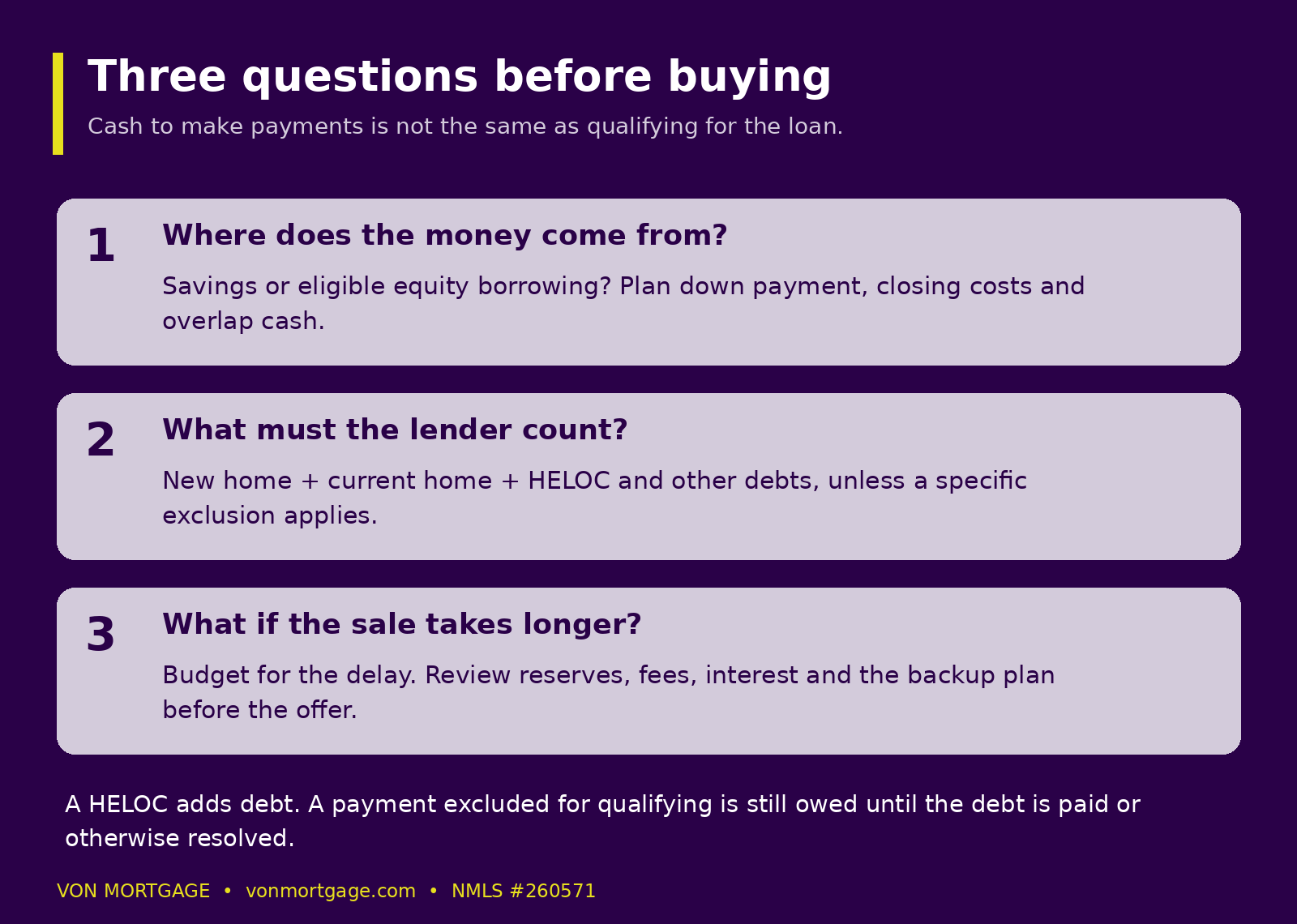
Before writing an offer, work through three questions:
- Where will the down payment, closing costs and overlap money come from?
- Which payments must the lender count, including any HELOC borrowing?
- What is the backup if the current home sells later than expected?
Selling first or coordinating sale-contingent closings may be a better fit for some families. A sale contingency is a timing and contract approach, not a source of funds for closing before the sale. Review the terms with your real estate agent.
Buying first with a plan to sell is also different from keeping the first home as a rental. Our Buy, Save, Buy post covers that separate strategy. If the bigger question is whether to give up the current home’s low rate, see the portable mortgage post.
How can we work out which situation fits you?
Start with the current home, the next home and your available savings. Then we can review the funding, qualifying requirements and overlap budget together before you commit to an offer. You can start with a quote or book a time.
Von Mortgage is a mortgage broker in Redding, California. We work with families in Redding, Shasta County and across California, Oregon, Washington, Indiana, Texas, Louisiana and Florida. Program availability varies.
What else do families ask about buying before selling?
Is putting the minimum down a separate client type?
No. In the first scenario, the family already has the required down payment saved and can handle overlapping payments. My roughly 3% to 5% example belongs there; it is not a separate client type or a promise of eligibility.
Does a recast happen automatically when I pay extra principal?
No. Confirm eligibility and request the recast through the company servicing your loan. An extra principal payment alone generally does not reduce the required principal-and-interest payment.
Does a HELOC let me avoid qualifying for two mortgages?
No. Borrowing against your old home provides cash, not a debt exclusion. The lender must review the HELOC and all applicable payments. A qualifying sale-contract exception is a different rule.
Does any guaranteed offer remove the old mortgage payment from qualifying?
No. The lender must accept the actual contract under the applicable program and documentation rules. A provider’s marketing claim is not a loan approval, and an exclusion does not cancel payments you still owe.
---
Disclaimer: This information is educational and is not a commitment to lend, a loan approval, or an offer of credit. Any rates, payments, down payments or other figures shown are illustrative examples only, not quoted terms and not an offer to extend credit. Actual rates and terms depend on credit, income, property, occupancy and market conditions, and change daily. For current pricing see vonmortgage.com/rates.
Pete Metz, Mortgage Broker · NMLS #260571
Dream Big Ownership LLC dba Von Mortgage Company · NMLS #2592815
Loans made or arranged pursuant to a California Financing Law license, #60DBO-195824.
2777 Bechelli Lane, Redding, CA 96002 · (530) 221-7700 · Pete@VonMortgage.com
Equal Housing Opportunity.

 Equal Housing Opportunity
Join the conversation
Comments are reviewed before they appear. Have a question about your own situation? Ask Pete directly — that stays private.
No comments yet