




Recent Posts
Categories
Tags
Years
A house gets turned down for an FHA loan when it is not safe, sound, and secure — and the problem cannot be fixed. Bad roofs, structural damage, unsafe wiring, no working heat or water, failing wells or septic systems, and peeling paint on homes built before 1978 all get flagged. Most of these can be repaired before you close.
Those rules come from HUD Handbook 4000.1, Update 18, issued Aug. 12, 2026. They apply to the house. Your credit, income, and loan limit are a separate review. That part is covered on our FHA loan page for Redding families.
Redding homes do not get more FHA flags than homes in other cities or states. Dry rot (wood that has gone soft and crumbly from moisture) is more common here, and appraisers can and do spot it when they walk through. The main FHA difference versus a conventional loan (a regular bank loan that is not FHA-backed) is peeling paint on pre-1978 homes and, when there is a septic tank, the right distance from the home. Everything else is health and safety, and that is up to the appraiser. It can feel subjective, but for the most part it is pretty consistent.
Some realtors and buyers think a home has to go conventional because of its condition. Then they get surprised when a conventional appraisal calls out health and safety too. Appraisers have to follow FHA's rules on peeling paint and septic. Peeling paint is normally pretty easy to fix, and the seller usually paints what is needed. I currently have a file with that same issue. The seller was not willing to paint, so they gave the buyer permission to do the painting.
Dry rot applies to every loan type. Appraisers are not home inspectors. They do not get into attics or crawl spaces. But if they see dry rot on the walk-through, they have to photograph it. Once it is on the report, the underwriter (the person at the lender who reviews the loan) can ask for those areas to be repaired. Or, depending on the condition, they can ask for a home inspection. Home inspections are not required on any loan. A required inspection can show more dry rot or other health and safety items and open a Pandora's box — meaning one problem leads to finding many more.
Most move-in-ready Redding homes pass. Trouble tends to show up on fixer-uppers, foreclosures, and older homes where repairs were put off for a long time (deferred maintenance). Out here, add rural property to that list. A national checklist will not tell you much about a house on a well at the end of a shared gravel road.
What are the property requirements for an FHA loan?
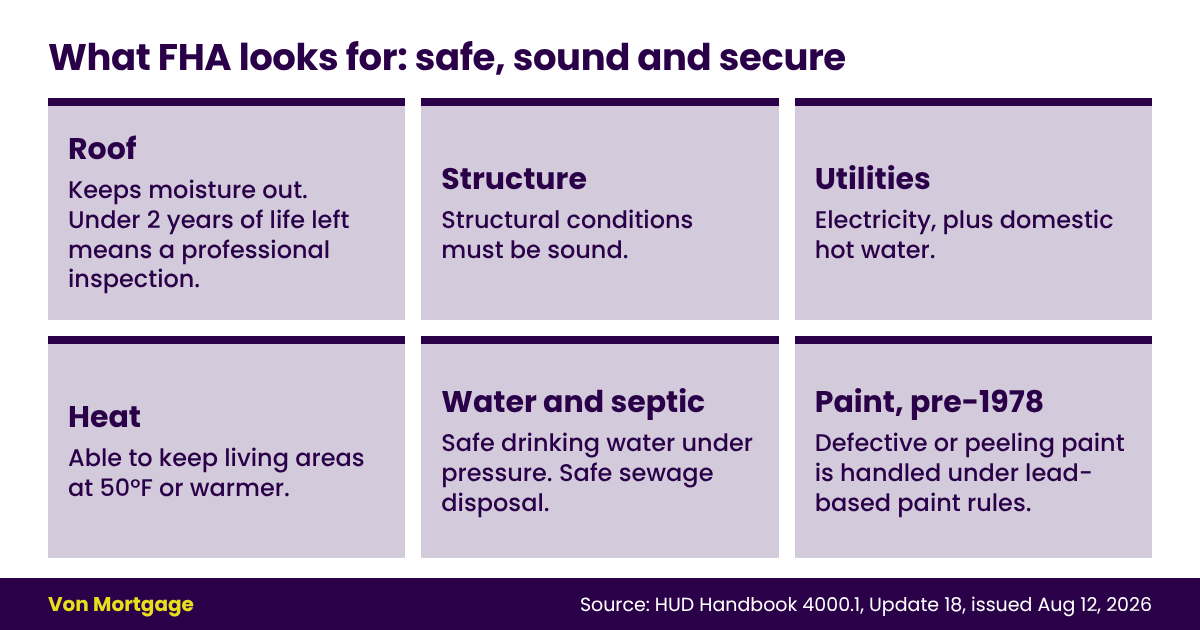
Every FHA-insured home must be safe, sound, and secure. HUD calls these Minimum Property Requirements (the basic safety and condition rules a home must meet). They apply to existing homes. New construction has its own Minimum Property Standards (the rules for brand-new builds).
Under Handbook 4000.1, Update 18, a living unit needs safe drinking water under pressure, bathrooms with safe sewage disposal, enough space, electricity, hot water for the home, and a kitchen with a sink and a stove hookup. Heat must be able to keep living areas at 50°F or warmer.
What would cause a house to fail an FHA appraisal?
A house fails an FHA appraisal when the appraiser finds a problem with safety, security, or soundness. The same list answers the search for what fails an FHA inspection, because the FHA check happens during the appraisal (the bank's check of the home's value and condition).
The common flags under Handbook 4000.1, Update 18:
- A roof that cannot keep moisture out. Under 2 years of remaining life calls for a professional roof inspection.
- Structural problems.
- Defective or peeling paint on a pre-1978 home.
- Wood-destroying insects.
- Heat, water, sewage, or electrical systems that do not work.
When the appraiser finds one, the report notes the repair and the cost to cure (what it would cost to fix it). If the problem is not clear, the lender may order a qualified inspection. The lender must reject the property only if fixing it is not realistic.
Is an FHA appraisal the same as a home inspection?
No. The appraisal sets the value and checks the home against FHA's property rules. A home inspection is a separate, deeper look you hire someone to do. Get one. Appraisers are not home inspectors, and they do not crawl attics or crawl spaces the way a home inspector does.
What are the FHA well and septic requirements?
FHA requires a well to meet water quality standards and, on existing homes, a continuous flow of at least 3 gallons per minute. The Handbook's distance table sets 10 feet from the property line, 50 feet from a septic tank, and 100 feet from a drain field, or 75 feet if the local authority allows it.
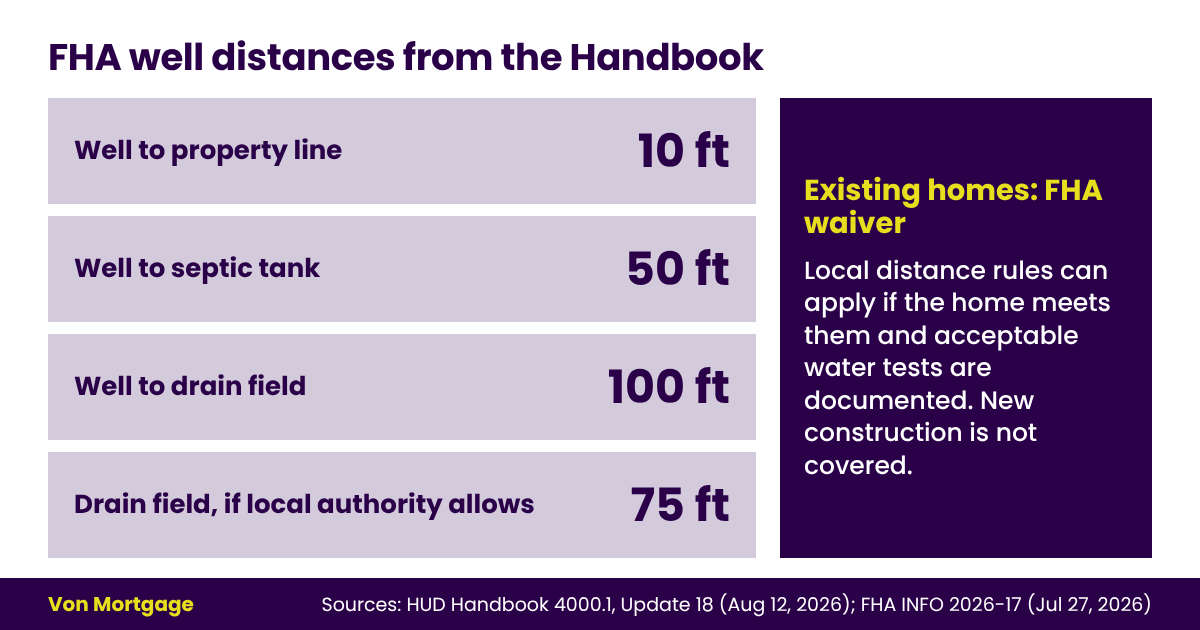
Those distances got easier on existing homes this year. FHA INFO 2026-17, dated July 27, 2026, waived them when two things are true. The property meets the distance rules of the local jurisdiction (the local health department, environmental agency, or city that inspected, permitted, or grandfathered the system), and the lender documents acceptable water tests.
The waiver covers distance only, so water quality still has to pass. It does not apply to new construction, where standards include 5 gallons per minute over at least four hours.
Some water sources are not allowed under the Handbook's well rules: springs, lakes, rivers, sand-point wells, artesian wells, and mechanical chlorinators. That one is usually a deal-killer unless the water source changes. Shared wells have their own paperwork rules, so bring those up early.
An existing septic system is fine if it works and meets local health rules. Visible failure means repair or inspection. If the system is not enough and public sewer is not available, the lender must reject the home unless the system is repaired or replaced to local standards.
Can you get an FHA loan on a house on a private road?
Yes, if the access is legal and permanent. Handbook 4000.1, Update 18, Section II.A.3 (Access to Property) requires safe walking access and Adequate Vehicular Access (a safe way for cars to reach the home) from a public or private street. A private street or shared driveway needs a permanent recorded easement (a legal right of way on file), an ownership interest, or HOA ownership and maintenance.
A handshake with the neighbor does not count. Have title check for the recorded document before you get attached to the house.
Can you get an FHA loan on a fixer upper?
Yes, if the required repairs get done before closing or you use an FHA 203(k) loan. Cosmetic items can usually stay as they are. The Handbook's examples include screen holes, cracked window glass, defective interior paint on a post-1978 home, and a minor drip that is not causing damage.
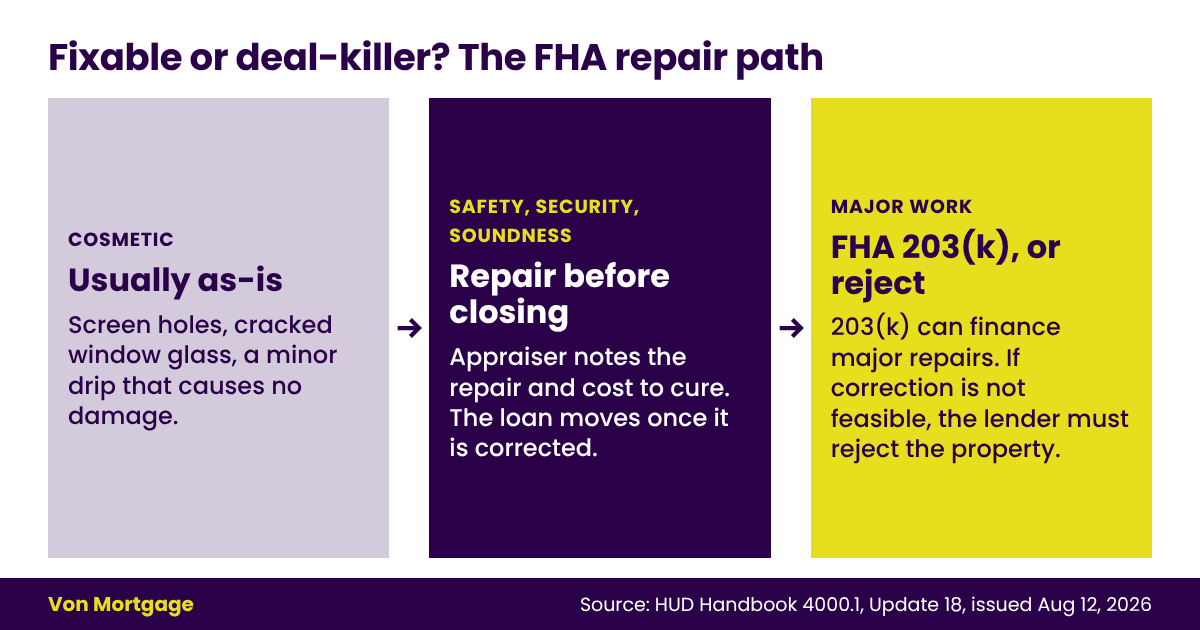
Anything that touches safety, security, soundness, or the health of people living there gets fixed first. Major repairs and alterations often point to a 203(k), which is built so the home meets FHA rules after the work is done.
Do manufactured homes qualify for an FHA loan in Shasta County?
Yes, if they meet FHA's manufactured housing standards. The home must be at least 400 square feet, built on or after June 15, 1976 with its HUD Certification Label, on a permanent foundation, and treated as real estate. Our Shasta County manufactured home guide covers the local details.
Have FHA property rules changed in 2026?
Yes, in two ways that are in effect now, with a larger rewrite still in draft. The July 27 well waiver above is live. Handbook 4000.1, Update 18, issued Aug. 12, refined the language on flood zones, the manufactured housing definition, and well water tests. Changes that were not already announced in a Mortgagee Letter (an official notice from FHA to lenders) may be used now and must be in place by Nov. 10, 2026.
Separately, FHA INFO 2026-22 (Sept. 22, 2026) proposed updates to the Minimum Property Requirements (the basic safety and condition rules), with feedback through Nov. 6, 2026. That proposal is a draft and is not current policy.
What would disqualify a house from an FHA loan?
A serious safety, security, or soundness problem that cannot be fixed disqualifies a house from an FHA loan. Examples include a water source that is not allowed, no legal access, or a failed septic system with no sewer option that cannot be repaired. Most other problems can be fixed before closing.
Does FHA require a septic inspection?
Not on every home. An existing septic system is fine when it works and meets local health rules. Visible signs of failure call for repair or inspection, and the lender must reject the home if a weak system cannot be repaired or replaced and public sewer is not available.
Are FHA appraisals hard to pass?
Not for most move-in-ready homes. Appraisers look for safety, security, and soundness, and cosmetic wear usually does not matter. The harder cases are fixer-uppers, foreclosures, older homes where repairs were put off, and rural homes with well, septic, or access questions that need documents.
Can you buy a fixer upper with an FHA loan?
Yes. A standard FHA loan works when required repairs are finished before closing and the home then meets FHA's property rules. When the work is major, an FHA 203(k) loan can combine the purchase and the repairs so the home meets FHA rules after the work is done.
Who qualifies for an FHA 203(k) loan?
Families who meet FHA borrower requirements and will live in the home may qualify for an FHA 203(k) loan. The home and the repair plan also have to meet program rules. It is built for owner-occupants (people who will live in the home), so investors generally cannot use it.
What disqualifies you for an FHA loan?
Your credit, income, debts, assets, and whether you will live in the home decide whether you qualify, and that review is separate from the house. A home can pass while the borrower does not, or the reverse. Our FHA loan page covers borrower requirements and the Shasta County loan limit.
Does passing an FHA appraisal mean the house is in good shape?
No. Passing means the home met FHA's minimum on the day the appraiser saw it. Cosmetic items stay. A roof with a few years left passes. FHA also says nothing about what the home costs to insure, which matters in Shasta County, so read our fire insurance guide for Shasta County before you write an offer.
Which FHA repair problems are fixable before closing, and which make you walk away?
Each situation is different. It depends on whether the seller agrees to do the repairs or allows the buyer to do them, and both parties have to agree. Smaller requests are easier to finish before closing. Some items can be handled after closing with an escrow holdback, where money is set aside up front plus extra reserves for the repair.
What should you check before writing an offer on a Shasta County home?
Rely on a realtor who knows health-and-safety rules, and talk to your lender before you write the offer. Lenders often only see pictures. The realtor is in the property and can judge whether it looks financeable (whether a loan can work on it).
Check the water, the sewage, the access, and the roof. On a rural home, ask for the well records, a recent water test, any county permit history, and the recorded road easement.
MLS private remarks sometimes say "cash only." Do not always trust that. The listing agent may not know the home could still go FHA or conventional.
Starting with a pre-approval lets us look at the property questions alongside your numbers. Send me the address before you write the offer and I'll tell you what I see.
Can you waive the appraisal on an FHA loan?
No. Appraisal waivers (skipping the appraisal) only happen on conventional loans. FHA currently has no appraisal waiver because the minimum down payment is 3.5%, and that will not change unless FHA updates its rules. On conventional loans, waivers typically come with 20% down or more and good comps (recent sales of similar nearby homes), and most buyers take them. Some clients still order a private appraisal just to be sure, but often they can save the lender appraisal fee and skip it.
First-time buyers stacking FHA with assistance can also read how down payment assistance works for Redding families. Updated November 2026.
---
Disclaimer: This information is educational and is not a commitment to lend, a loan approval, or an offer of credit. Any rates, payments, down payments or other figures shown are illustrative examples only, not quoted terms and not an offer to extend credit. Actual rates and terms depend on credit, income, property, occupancy and market conditions, and change daily. For current pricing see vonmortgage.com/rates.
Pete Metz, Mortgage Broker · NMLS #260571
Dream Big Ownership LLC dba Von Mortgage · NMLS #2592815
California Financing Law license 60DBO-195824
2777 Bechelli Lane, Redding, CA 96002 · (530) 221-7700 · Pete@VonMortgage.com
Equal Housing Opportunity.


 Equal Housing Opportunity
Join the conversation
Comments are reviewed before they appear. Have a question about your own situation? Ask Pete directly — that stays private.
No comments yet