

Recent Posts
Categories
Tags
Years
What Is a Mortgage Rate Lock, and How Long Should You Lock?
A rate lock is a promise that your interest rate won't change while your loan is in escrow. Lock for long enough to cover your realistic closing date, plus a cushion. A longer lock usually costs a little more in rate or points, and an extension or relock can cost more than that. This month, a 30-day lock taken November 2, 2026 runs to December 2, so a closing that could slip past that date needs a longer lock.
What is a mortgage rate lock, and why lock at all?
You lock so that if rates jump before closing, your rate and payment stay the same while your loan is in escrow.
The lock holds as long as you close within the time frame and nothing changes in your application, such as loan amount, credit score or verified income. Locks typically run 30, 45 or 60 days, sometimes longer (CFPB).
Here's what happens behind the scenes. After your loan closes, the lender usually sells it to Fannie Mae, Freddie Mac or another investor. That buyer doesn't ask about your lock. It pays whatever the market says your loan is worth on the day it buys it.
That leaves the lender exposed. Say you lock at 7%, and rates climb to 7.5% before you close. A 7% loan is now worth less to investors, so the lender loses money when it sells. If rates fall instead, your loan is worth more, and the lender makes more when it sells.
To protect itself, the lender buys a kind of insurance on your loan the day you lock. This is called a hedge. If rates rise, the lender loses money selling the loan but makes it back on the hedge. If rates fall, it earns more selling the loan but loses on the hedge. The goal is to break even either way.
So a lock is really just a hedge the lender places the day you lock, protecting both the lender and you from the market moving during escrow.
What did the Fed and Freddie Mac report last week?
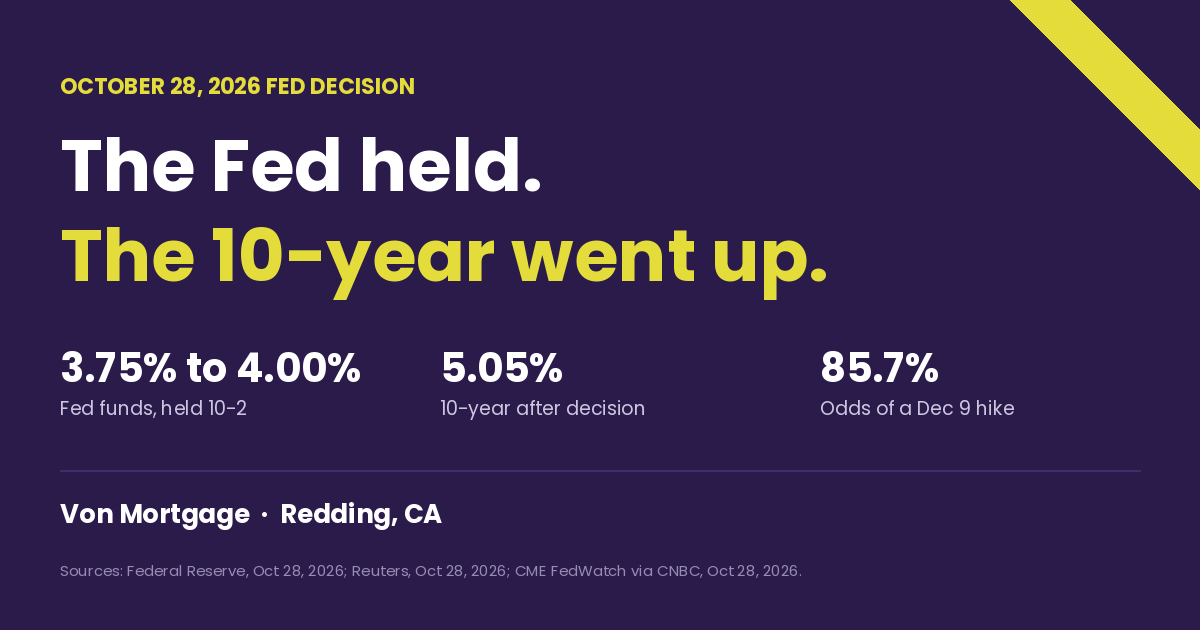
The Fed held and the 30-year average fell. On October 28, 2026, the Fed kept its target range at 3.75% to 4.00% in a 10-2 vote, with two dissenters wanting a quarter-point hike (Federal Reserve). Futures put the odds of a December hike at 83% on October 29 (CME FedWatch, via CNBC). More is in the recap of the October Fed hold.
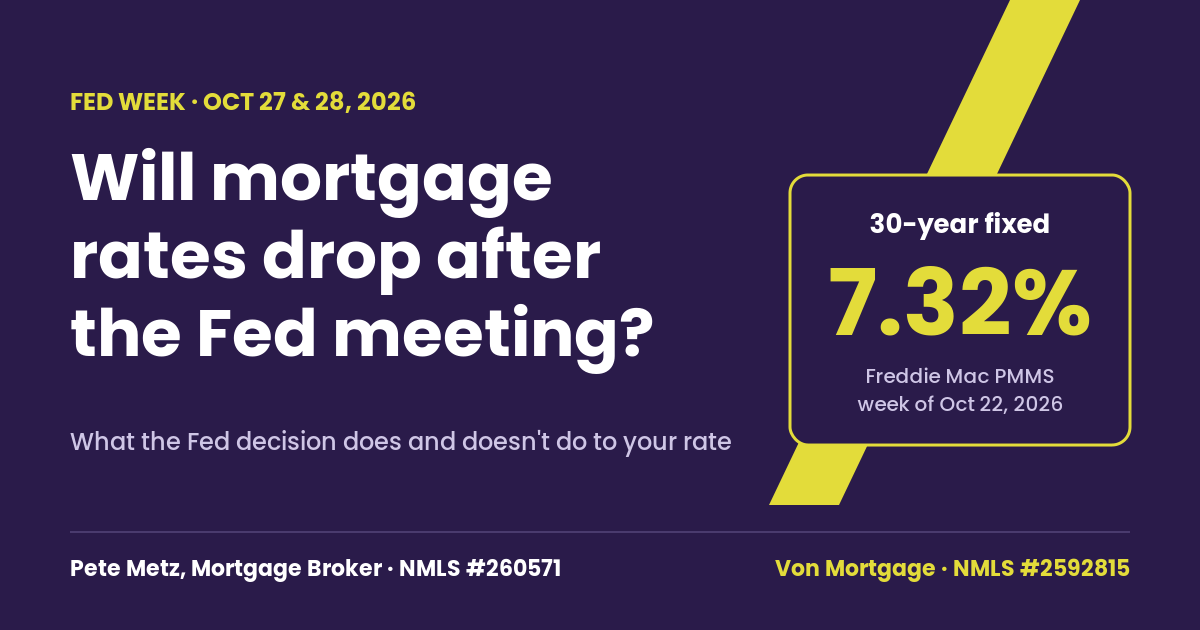
Freddie Mac's 30-year fixed average was 7.24% on October 29, down from 7.32% a week earlier and up from 6.17% a year ago (Freddie Mac PMMS). That survey covers conventional conforming purchase loans with 20% down and excellent credit, so your own quote can differ.
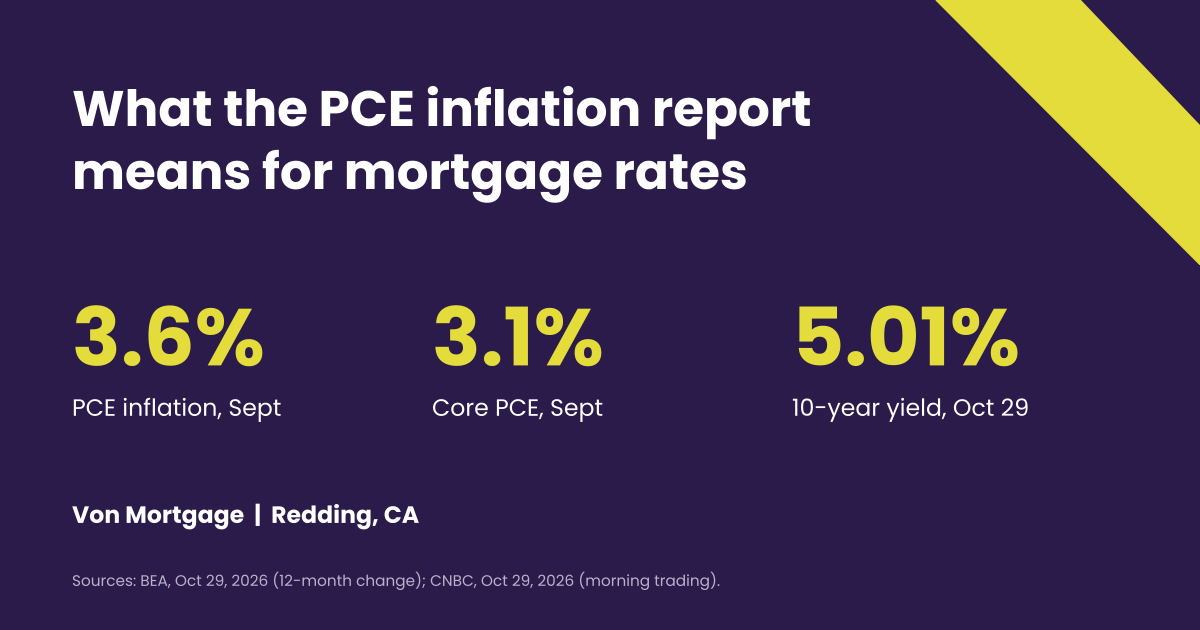
The 10-year Treasury yield was about 4.91% early Monday, November 2 (CNBC), down from a 5.31% high on October 5 (U.S. Treasury, via MortgageDaily, November 1, 2026).
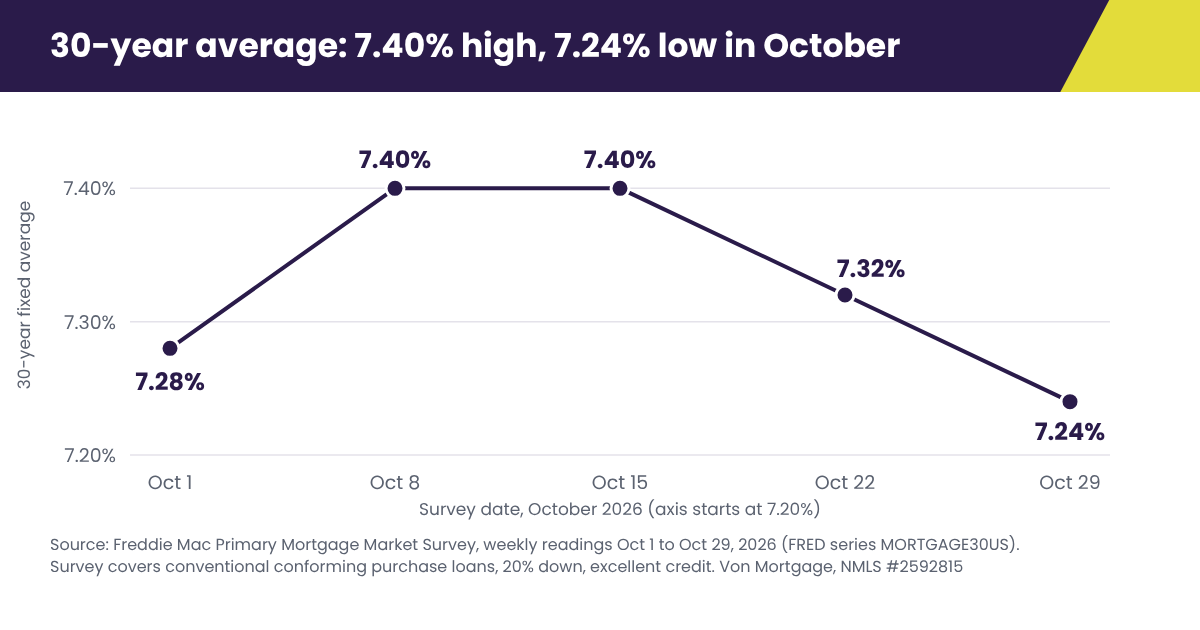
That October range is 0.16 percentage point, from 7.40% to 7.24%. On a $400,000 30-year loan, as an example, that's about $44 a month in principal and interest.
Does a longer rate lock cost more?
Usually, yes, by a little, in the rate or in points. A point is 1% of the loan amount paid at closing. Lenders set rate sheets from mortgage-backed security prices, which trade off the 10-year Treasury. Those prices move daily, so a lender can't hold a price for 60 days for free.
The Loan Estimate won't show what the lock costs, so ask (CFPB).
30 vs 45 vs 60 day rate lock: which one fits?
Start from your closing date and work backward. Our Redding closing timeline guide puts a conventional or FHA purchase at about 30 days, VA at 30 to 35, USDA at 35 to 45, and a refinance at three to four weeks (Von Mortgage, September 2026). A 30-day lock on a 30-day escrow has no cushion. A USDA file at 45 days needs more than a 45-day lock, or a lock taken later in escrow.
The clock starts the day you lock. Days before that are days your rate can still move.
For most purchases, we lock for 30 days, and that's usually all it takes. Many investors also give a free one to three extra days if closing runs a little late. When the contract has a longer escrow, we match the lock to it, so a 45-day escrow gets a 45-day lock.
New builds work differently. If the home won't be finished for another three to six months, we can do a long-term lock, but it's expensive: you pay either a higher rate or more upfront for the same rate. So on most new builds, we "float," which means we don't lock yet. Instead, we check rates every week and lock once the home is about 45 to 60 days from being finished.
What falls inside a lock taken this week?
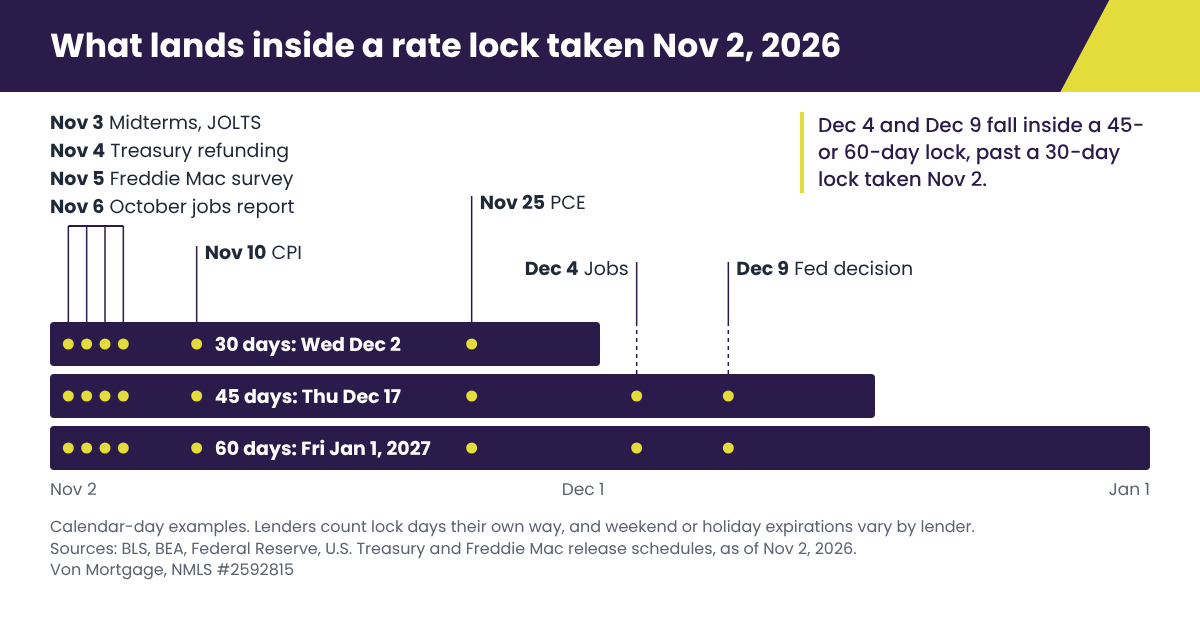
Seven dated events fall inside a 30-day lock taken November 2, 2026, and two more fall inside a 45- or 60-day lock. The seven: the midterms and JOLTS job openings on November 3, the Treasury refunding on November 4, the Freddie Mac survey on November 5, the jobs report on November 6, CPI on November 10 and PCE on November 25.
The two later ones are the November jobs report on December 4 and the Fed decision on December 9 (BLS, Federal Reserve). A 45-day lock runs to December 17 and a 60-day lock to January 1, 2027. Those are calendar-day examples, and lenders handle counting and weekend or holiday expirations their own way.
If you close by December 2, the December 9 decision doesn't touch your loan. If closing slips, you could be extending or relocking days before both events.
Should I lock before the jobs report or the election?
Don't try to time it. Make sure you're comfortable with the rate and the monthly payment, and that the home fits your budget. Waiting for an eighth better can work out, but it's a gamble.
Friday's jobs report comes out at 8:30 a.m. Eastern, 5:30 a.m. in Redding. September payrolls rose 29,000 with unemployment at 4.2% (BLS, October 2, 2026). After an election, analysts say the bond market's read of government borrowing is what can move long-term Treasury yields (FXStreet, October 21, 2026). I can't tell you which way either one goes. For more on timing, see lock now or wait.
What if rates drop after I lock?
Some lenders offer a "float down," also called a lock renegotiation. If rates improve by a set amount, usually 0.25% to 0.5% depending on the lender or investor, they'll lower your locked rate.
At a retail bank, that float down is usually your only option. Working with a mortgage broker gives you another one. If there's still enough time to close on schedule, a broker can sometimes move your loan to a different investor offering the better rate.
That's decided case by case, because brokers are held to what's called a pull-through ratio. Investors expect a broker to close at least 80% of the loans it locks with them, and a broker who drops below that can be cut off for good. A broker whose pull-through stays well above 80% has room to take a loan to another investor when it makes sense for the family.
What happens if my rate lock expires?
You'll need an extension or a relock, and either can cost you. An extension buys more days at your locked rate. A relock is a new lock after the old one expires. At one large bank, as an example, you pay a relock fee and get the current market rate or your original rate, whichever is higher. You might owe an extension fee even when the delay came from the lender's processing time (CFPB).
Sometimes a lock runs out before closing without being extended. If that happens because of our mistake, I normally cover the cost for the family. It's happened before, but not often.
When a lock expires, we can't simply reprice with that same investor at today's rates, because the lender's hedge is still tied to the loan. At a retail lender, if you let a lock expire, you usually have to wait 30 days before you can lock at current market rates again. If you need to relock and close sooner, the lender charges a relock fee plus the cost of the extension.
That's one more reason we stay in close touch with every family about their lock, and make sure everyone involved knows the timeline.
How much does a rate lock extension cost?
More than most families expect. On average, a 15-day extension costs about 0.35% of the loan amount, and a 30-day extension about 0.6% to 0.7%. On a $400,000 loan, that's about $1,400 for 15 days and $2,400 to $2,800 for 30 days.
That's why it pays to talk through your closing timeline and the length of your lock before you choose a lender.
An extension longer than 30 days costs even more, so it's best avoided. We usually extend no more than 30 days at a time to keep the cost down, and most lenders allow a total of 60 days of extensions past the original lock's expiration date.
The exact cost depends on the lender, and the Loan Estimate won't show it (CFPB). Before you lock, ask whether you can change to a longer lock, at what cost, and what the extension policy is. The top of page 1 of your Loan Estimate shows whether your rate is locked and until when.
I shop each family's rate across many wholesale lenders, with access to programs and guidelines that may not fit a traditional lender's box. Lock periods, lock pricing and extension policies differ lender to lender, so that shopping covers more than the rate.
When is a longer lock a waste of money?
When you close early, you've paid for days you didn't use. A lock can also keep you out of a lower rate if rates fall, and a change to your loan amount, credit score or income can end the protection (CFPB).
What this means for you
If you're in contract, pick a realistic closing date, add a cushion, and check today's rates. If you're still shopping, you can't lock until you have a property under contract.
Send me your closing date and start a quote, and I'll price the lock lengths side by side, with each lender's extension policy, so you can decide with real numbers.
Written November 2, 2026, by Pete Metz, mortgage broker at Von Mortgage in Redding, California, NMLS #260571.
Disclaimer: This information is educational and is not a commitment to lend, a loan approval, or an offer of credit. Any rates, payments, down payments or other figures shown are illustrative examples only — not quoted terms and not an offer to extend credit. Actual rates and terms depend on credit, income, property, occupancy and market conditions, and change daily. For current pricing see vonmortgage.com/rates.
Pete Metz, Mortgage Broker · NMLS #260571
Dream Big Ownership LLC dba Von Mortgage · NMLS #2592815
2777 Bechelli Lane, Redding, CA 96002 · Pete@VonMortgage.com
Equal Housing Opportunity.
 Equal Housing Opportunity
Join the conversation
Comments are reviewed before they appear. Have a question about your own situation? Ask Pete directly — that stays private.
No comments yet