




Recent Posts
Categories
Tags
Years
DSCR Loan Requirements: What You Need (No Tax Returns)
A DSCR loan doesn't use your tax returns, W-2s, pay stubs or a P&L. It qualifies on the property's rent compared to its payment. You still document the rent, your credit, the cash for your down payment and reserves, your housing payment history, and your LLC if you're buying in one. The exact list changes from investor to investor.
A DSCR loan is a mortgage for a rental property. DSCR stands for debt service coverage ratio. That's a fancy way of asking one question: does the rent cover the house payment? A regular home loan is built around your paycheck. A DSCR loan is built around the rental. The investors behind these loans are the companies that actually fund them, and different investors sometimes have different rules. Updated November 2026.
Do DSCR loans require tax returns or proof of income?
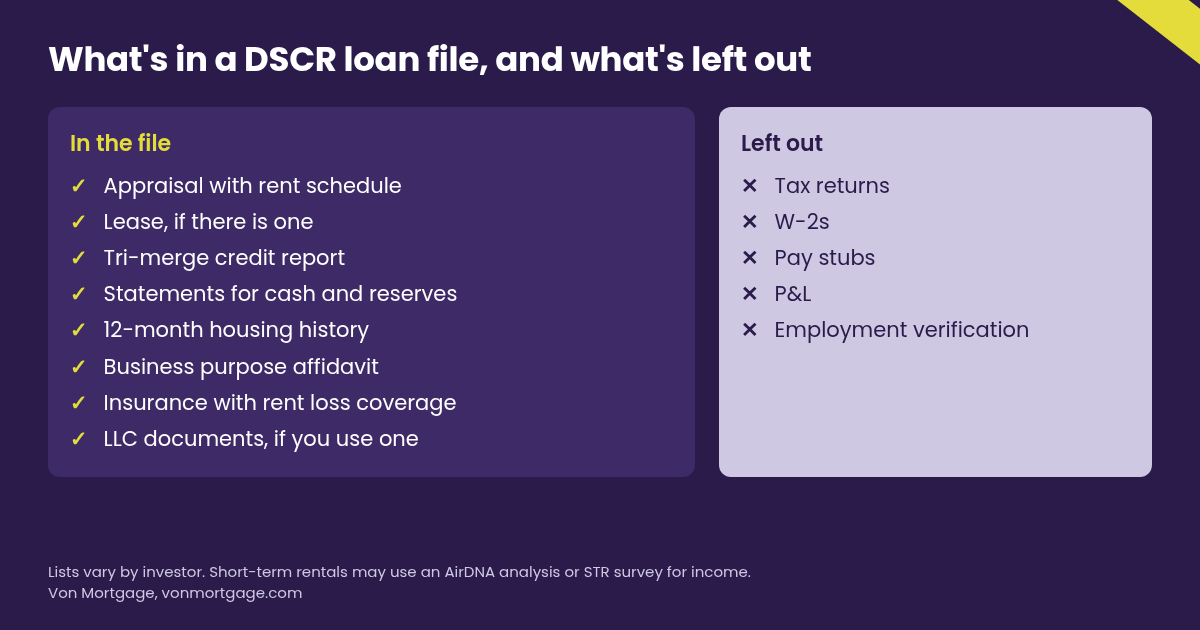
No. On a true rental, your income stays out of the decision. The loan qualifies on the property's cash flow alone. The income part of your loan application stays blank, other than a token amount such as $1, and you don't have to list your job.
Why is that allowed? Federal lending rules treat a loan on a rental you won't live in as a business loan, not a personal home loan. Business loans don't have to pass the income test a home loan must meet. That's why you sign a Business Purpose and Occupancy Affidavit, a form that says the home is a rental and you won't live there. If you plan to stay in the home more than 14 days in the coming year, it doesn't count as a rental for this rule.
A regular (conventional) investment loan works differently. It asks for your most recent tax return, including the schedule that shows your rentals, and it checks your own income against all your debts. If you're buying a home to live in instead, see how self-employed families buy without a filed return or how a bank statement loan is underwritten.
How does a DSCR loan qualify you on rent instead of income?
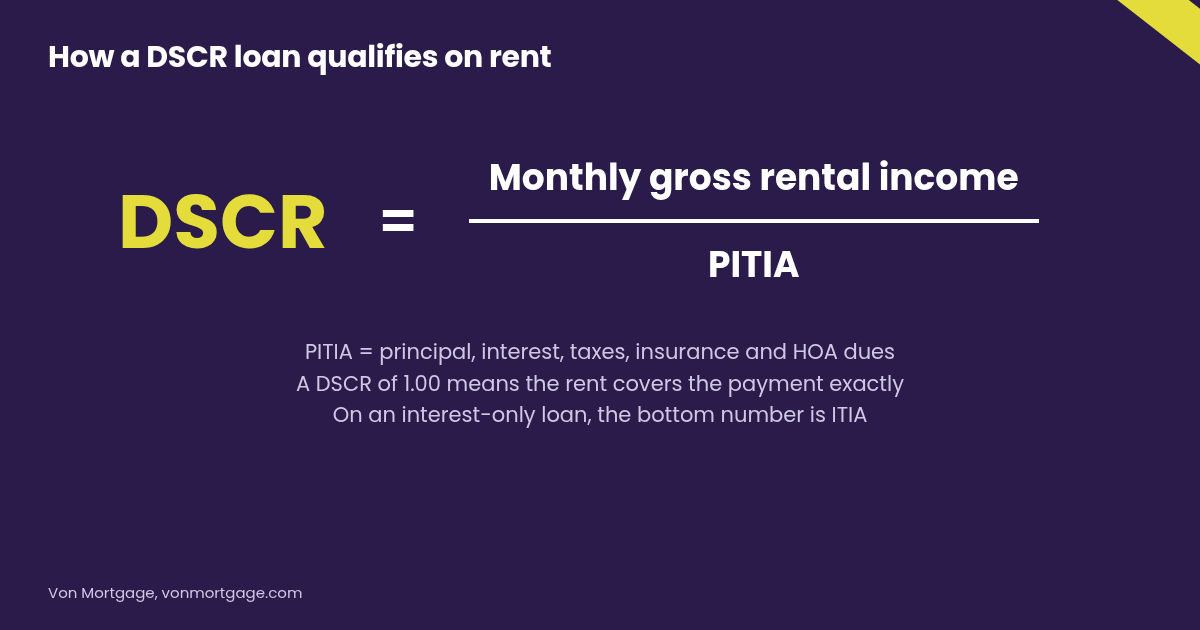
The lender divides the property's monthly rent by its monthly payment. That payment is called PITIA: principal, interest, taxes, insurance and HOA dues. A DSCR of 1.00 means the rent covers the payment exactly. Above 1.00, the rent covers more than the payment. Below 1.00, it covers less. For example, $2,500 in rent divided by a $2,000 PITIA is a DSCR of 1.25.
Which rent goes on top of that math depends on how the home is rented.
How is rental income calculated for a DSCR loan?
It depends on which of 3 rental types the home is:
- Long-term rental: a regular tenant on a lease, usually for a year.
- Mid-term rental: stays of 30 days or more, like a traveling nurse who rents for a few months.
- Short-term rental: nightly or weekly stays, like an Airbnb or Vrbo.
Short-term and mid-term rentals often won't DSCR, meaning they won't qualify, using long-term rents. So we document their income a different way. That gives us 3 ways to count the rent.
Long-term rentals: the lower of the 1007 or the lease
For a long-term rental, the income is the lower of two numbers: the appraiser's 1007 or the current lease. The 1007 is the appraiser's rent estimate form. The appraiser looks at similar homes rented nearby and writes down what this home should rent for each month. If the lease says $2,400 and the 1007 says $2,200, the loan uses $2,200. If the home is vacant, the income is based on the 1007 alone.
Short-term and mid-term rentals: AirDNA or an STR survey
For a short-term or mid-term rental, we can use one of 2 options:
- An AirDNA income analysis. AirDNA is a data company that tracks Airbnb and Vrbo listings. It looks at their nightly rates and occupancy, which is how many nights they're booked, to estimate what a short-term rental should earn.
- A short-term rental survey from the appraiser, called an STR. The appraiser compares the home to other short-term rentals nearby and estimates what it should earn.
Why is an STR survey from an appraiser hard to get?
Most appraisers have a hard time completing an STR. They aren't trained on it, and appraisal rules haven't really addressed how an STR should be formatted. So appraisers worry about doing one and not knowing how to complete it. They also don't really know where to look for recent local comparables, meaning other short-term rentals nearby to compare against. Appraisers could look on AirDNA, but it's a subscription, and they don't want to pay for it.
On a file we just tried in a remote area, every appraiser in the area turned the STR down. They had no way of finding other short-term rentals nearby. On an earlier file, the appraiser backed out of the STR before delivering it. Knowing a bank statement option existed kept that deal alive, and that second home closed.
In bigger, more urban areas, appraisers are sometimes more used to this kind of report. And if the home is already running as a short-term rental, it's much easier. The appraiser asks for the home's financials, like its booking income and expenses, and bases the report on the home's actual numbers.
Can you get a DSCR loan on a short-term rental with AirDNA?
Yes. The best way to do a short-term rental DSCR loan is the AirDNA income analysis. AirDNA gives its estimate a confidence score, which shows how sure it is about the numbers. Investors will want:
- A good confidence score
- Occupancy of at least 50%, meaning the home is booked at least half the nights
- A higher DSCR ratio than a long-term rental needs
We have closed multiple STR DSCR loans using the AirDNA method. If you have a short-term rental and want to use its short-term income for the DSCR, we have investors that will go down to a DSCR as low as 1.00, and it goes up from there.
What can hold up a DSCR loan?
There isn't one document that holds up a DSCR file. What holds it up is the rent calculation. If there's no lease in place, the rent number doesn't come until the appraisal is back. On a short-term rental, it comes with the appraiser's STR survey. Either way, the loan doesn't really qualify until about a week into escrow, and the appraisal can bring surprises.
So work with a lender that really knows how to research rents and sets a realistic rent number for the file from the start. And have a backup plan in case the rent doesn't come in where it needs to be. That's what saved the second-home file above when the STR fell through. We always have a backup plan for our families, and we present it up front in case the rental income isn't enough. That way each family knows the best case and the worst case and is okay moving forward.
DSCR loan requirements: what documents are needed?
A DSCR purchase file usually holds these items. Each investor's list is a little different.
- An appraisal with a rent estimate (the 1007), or for a short-term rental, an AirDNA analysis or an STR survey
- Your lease, if there is one
- A tri-merge credit report, which pulls your credit from all 3 credit bureaus
- Bank or investment statements for your down payment, closing costs and reserves
- A 12-month housing payment history
- A signed Business Purpose and Occupancy Affidavit
- Homeowners insurance plus rent loss coverage, which pays you the rent if damage keeps the home from being rented (6 months of coverage is common)
- LLC documents, if you're buying in one
If there's no lease, the purchase qualifies on the appraiser's 1007 rent. Some investors don't even need a copy of the lease when the appraiser lists the rent.
How much in reserves do you need, and what statements prove it?
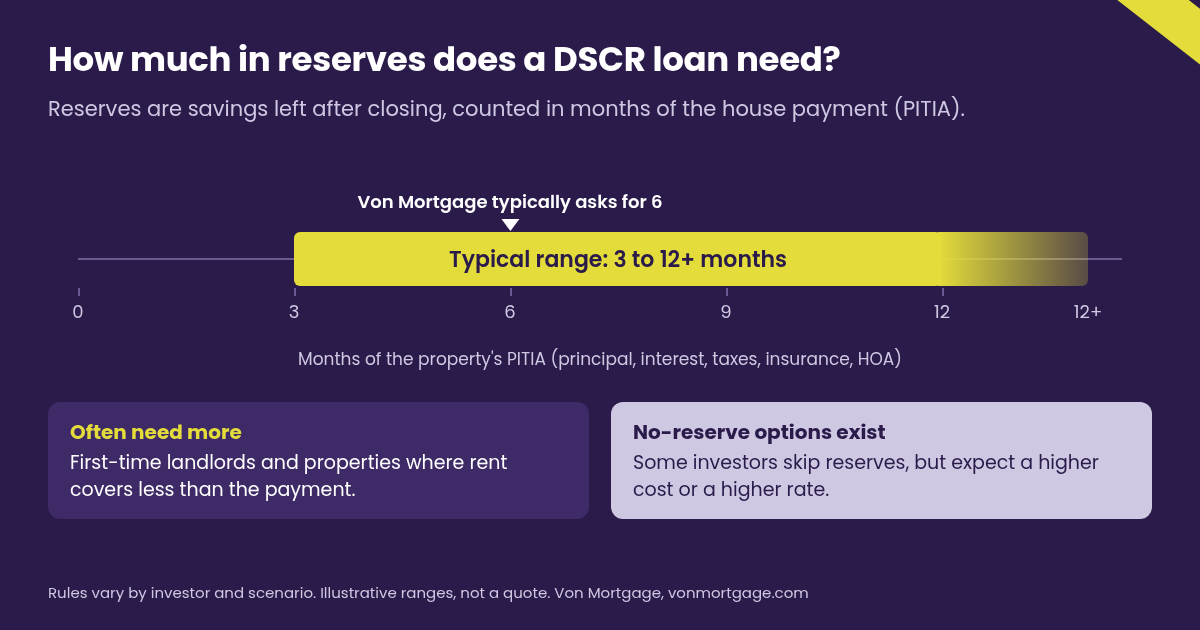
Reserves are savings you still have after closing. They're counted in months of the property's PITIA. For example, 6 months of reserves on a $2,000 PITIA is $12,000 left in the bank. Different investors have different rules, and reserves typically range from 3 months to 12 months or more. First-time landlords and homes with a DSCR below 1.00 tend to need more. Von Mortgage's DSCR program typically asks for 6 months, and guidelines vary by scenario.
Some investors want reserves, and some don't. If an investor doesn't require reserves, expect a higher cost, usually in the form of a higher rate.
To prove the money, you usually show one recent monthly or quarterly statement with every page, or a Verification of Deposit from your bank. Statements usually can't be more than 120 days old at closing. Retirement accounts often count at only part of their value, such as 70%, because cashing them out early costs taxes and penalties. Some investors let gift money or 1031 exchange money go toward closing, but not toward reserves.
What LLC documents are needed for a DSCR loan?
An LLC is a small company you can use to own the rental. Investors usually ask for:
- Articles of Organization, the paper that created the LLC
- An Operating Agreement, which says who owns and runs it, if your state requires one
- The LLC's tax ID number, called an EIN
- A Certificate of Good Standing, which shows the state says the LLC is active
Some investors also want an EIN letter from the IRS, a form showing who can sign for the LLC, and papers from both states if the LLC was formed outside the property's state.
An LLC doesn't keep you off the loan. Owners of 25% or more usually sign a personal guarantee, which is a promise to pay if the LLC doesn't, plus their own loan application. If you live in a community property state, including California, Texas, Washington and Louisiana, your spouse may also need to sign a consent form. Final loan papers usually can't be signed with a power of attorney.
Do they check mortgage history on your other properties?
Yes, for mortgages that show on your credit. Investors usually look at 12 months of payments on the home being refinanced, the home you live in, and your other financed properties. A common rule is no more than one payment 30 days late in the last 12 months, and you must be current at closing.
Proof can be your credit report, a verification of mortgage from your lender, or 12 months of canceled checks. If you rent where you live, you show a verification of rent, or 12 months of bank statements or canceled checks plus your lease. Some investors count a home you own free and clear, with no mortgage, as paid on time.
What documents does a DSCR refinance need?
The same file, plus proof of how long you've owned the property. Many investors want you on title for at least 6 months before a cash-out refinance, which is a new loan that puts cash in your pocket. Time owned by an LLC you control usually counts. If you bought the home with cash less than 6 months ago, you show the closing statement proving no loan was used, plus where the purchase money came from.
Rules on vacant homes differ. Some investors allow a vacant unit on a refinance only after a recent remodel, with an active rental listing and a DSCR of at least 1.00. Some skip reserves on a rate-and-term refinance, which just changes your rate or loan length, if it cuts your principal and interest payment by 10% or more.
Does a DSCR loan require an appraisal?
Yes. Every DSCR appraisal includes a rent estimate, and it usually can't be more than 120 days old at closing. On a 1-unit home, that's the 1007. On 2 to 4 units, it's Form 1025. These forms are built on long-term, monthly rents from similar homes, so the appraiser can't just take a nightly Airbnb rate and multiply it by 30. For a short-term or mid-term rental, the income comes from an AirDNA analysis or an STR survey instead, as explained above.
Does a DSCR loan require a credit check?
Yes. Most investors pull a tri-merge report and use your middle score. They also want at least 2 tradelines, which are credit accounts like a credit card or car loan, and credit papers no more than 120 days old at closing. Von Mortgage's DSCR program lists 660+ credit.
Why does the DSCR list change from lender to lender?
Each investor writes its own rules, and the rules don't always match. Experience is a good example. We don't ask for a letter about your real estate experience. It isn't really needed. We just make sure you currently own a home, and that shows on your application.
If you're a first-time investor, we can still make it work. We just make sure it will truly be an investment property. Some investors don't allow first-time homebuyers, meaning people who don't own a home yet, but others do. If you're buying your first home as an investment property with a DSCR loan, expect to put a little more down, and terms can be more expensive than for a seasoned investor. Reserves can change too. One investor might accept a first-time landlord at a 1.00 DSCR, 700 credit and 3 months of reserves. Another might want 12 months of reserves or more.
A shorter document list doesn't make it an easier loan. Without tax returns, the investor leans on cash in the bank, a personal guarantee if you buy in an LLC, and rent loss coverage. In Von Mortgage's October 2026 pricing, a prepayment penalty can bring a DSCR rate down 0.75% to 1%. A prepayment penalty is a fee you'd owe if you pay off the loan early.
As a broker, I shop your file across many wholesale lenders. On a DSCR loan, the first job is matching your file to the investor whose rules fit, and the rate comes after that.
How long does a DSCR loan take to close?
A DSCR loan typically closes in 30 days or less. It can go very quickly, sometimes in 2 to 3 weeks, if the family is able to work fast and we get the appraisal back and the rental income documented. Since the rent number comes with the appraisal, that's usually the step that sets the pace. Because there's so little paperwork, DSCR loans can go quick, but not all are created equal.
What does this mean for your DSCR file?
Know how the home will be rented: long-term, mid-term or short-term. That decides how the rent is counted. Pull a full statement for every account you plan to use. If you're buying in an LLC, gather those papers before you write the offer. You can see the minimums for Von Mortgage's DSCR program anytime. If you don't own a rental yet, another first step is to live in the fourplex on a VA loan, then use a DSCR loan for the next one.
If you have a rental in mind in Redding, Shasta County or anywhere else I'm licensed, send me the property and I'll tell you which investors' rules fit your file. I'd rather you see the whole list now than meet it in escrow.
Written November 3, 2026, by Pete Metz, mortgage broker at Von Mortgage in Redding, California, NMLS #260571.
Disclaimer: This information is educational and is not a commitment to lend, a loan approval, or an offer of credit. Any rates, payments, down payments or other figures shown are illustrative examples only — not quoted terms and not an offer to extend credit. Actual rates and terms depend on credit, income, property, occupancy and market conditions, and change daily. For current pricing see vonmortgage.com/rates.
Pete Metz, Mortgage Broker · NMLS #260571
Dream Big Ownership LLC dba Von Mortgage · NMLS #2592815
2777 Bechelli Lane, Redding, CA 96002 · Pete@VonMortgage.com
Equal Housing Opportunity.


 Equal Housing Opportunity
Join the conversation
Comments are reviewed before they appear. Have a question about your own situation? Ask Pete directly — that stays private.
No comments yet