



Recent Posts
Categories
Tags
Years
How Does Down Payment Assistance Work for Redding Families?
Down payment assistance is usually a second loan, sometimes a grant, that covers some or all of your down payment and sometimes closing costs. It sits behind your first mortgage (FHA, conventional, VA or USDA). Around Redding, the City of Redding, Shasta County and CalHFA offer second loans with no monthly payments, income limits and first-time buyer rules.
Assistance lowers the cash you need to close. It does not lower your monthly payment, and a second loan adds to what you owe. So I start with the payment, then look at which program can cover the cash.
How does down payment assistance work when buying a house?
A program lends you part of the down payment, records that loan behind your first mortgage, and you close with less of your own cash. The CFPB describes these as second mortgages on special terms, or grants, from state and local governments and nonprofits.
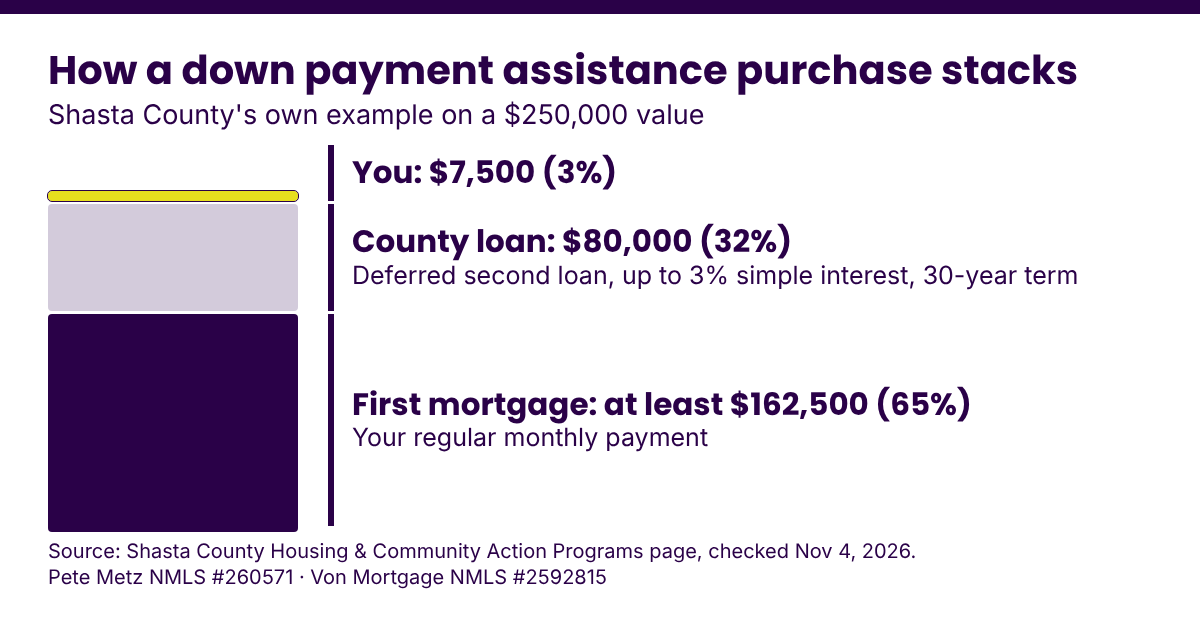
Shasta County's own example uses a $250,000 value: a first mortgage of at least $162,500, a county loan of $80,000, and $7,500 from the buyer. Down payments on the first mortgage start as low as 3% for first-time buyers on conventional, 3.5% on FHA and 0% on USDA.
Is down payment assistance a loan or a grant?
Around Redding, it's a loan. None of the programs in this post is a grant. But there are 3 kinds of loans.
Deferred means no monthly payments, and you repay when you sell, refinance or pay off the home. Shasta County and CalHFA MyHome work this way, and they aren't forgiven.
Forgivable means you don't have to pay the loan back if you follow the rules. Some are forgiven the day you close, and some after up to 5 years. These programs do exist, and I cover them in the catch section below. The ReCoverCA program for wildfire families is forgiven after 5 years.
Repayable means monthly payments from day one. The only one here that works that way is the new Prop 37 loan, which I cover below.
Who qualifies for down payment assistance in Redding and Shasta County?
Families who haven't owned a home in the past 3 years and fall under the program's income limit may qualify. Location picks the program. Homes inside Redding city limits go to the City. Unincorporated Shasta County, Anderson and Shasta Lake go to the County.
City of Redding limits run from $4,533 a month in gross income for a household of 1 to $8,550 for a household of 8 (City table effective June 1, 2026). Shasta County goes up to 120% of area median income, depending on funding source. CalHFA's limit in Shasta County is $201,000 (Bulletin #2026-07, effective June 30, 2026).
What down payment assistance programs can Redding families use?
Redding families can use the City of Redding Homebuyer Program, the Shasta County First-Time Home Buyer Program and CalHFA MyHome. My Redding down payment assistance guide goes program by program.
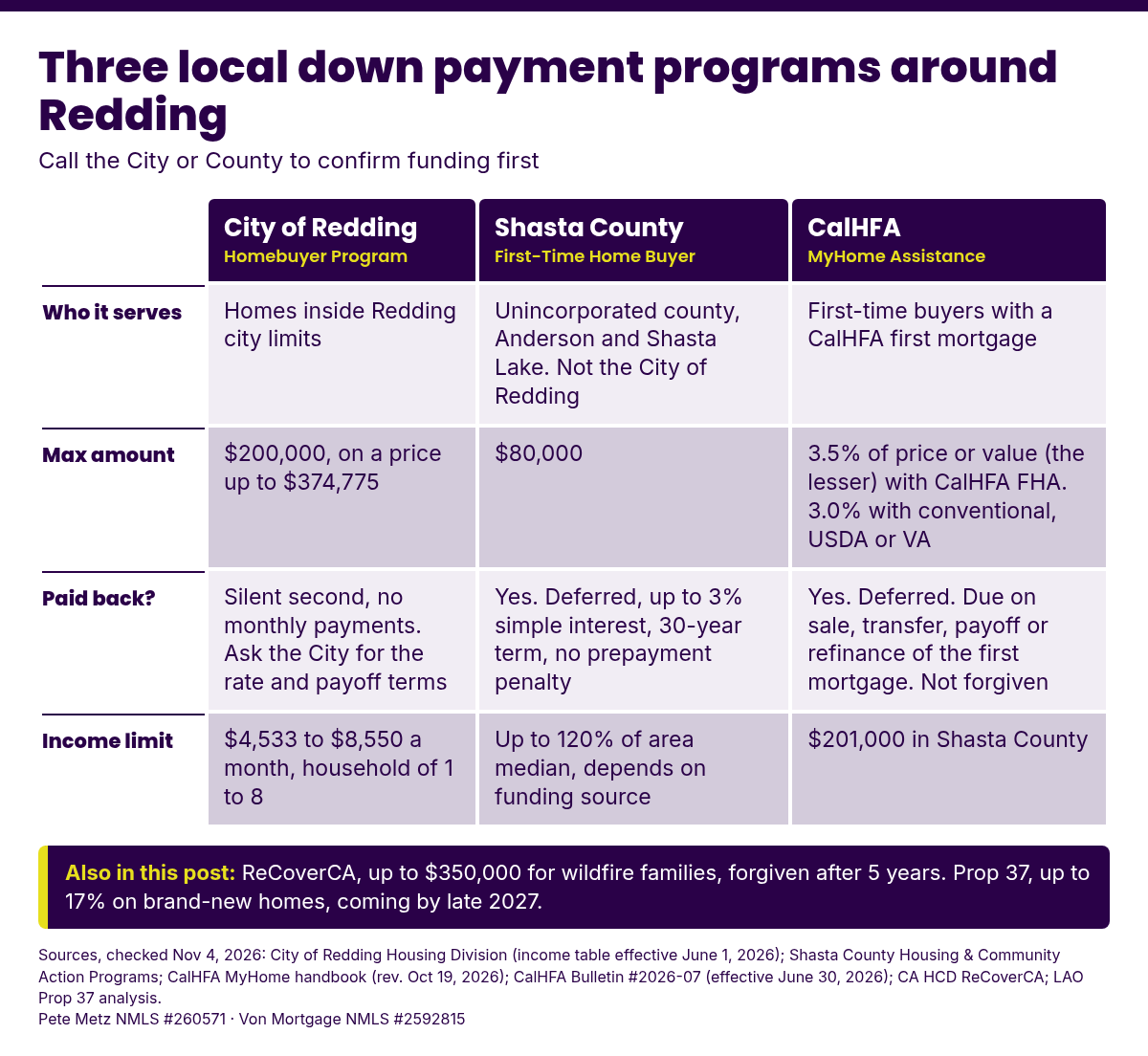
The City's silent second goes up to $200,000 on a price up to $374,775. You bring 3% of the price plus your closing costs, at least half from your own assets. Call the Housing Division at (530) 225-4162 to confirm its rate, repayment terms and current funds. For the County's funding and price limit, call (530) 225-5160.
CalHFA MyHome must be paired with a CalHFA first mortgage. CalHFA's Zero Interest Program covers closing costs only, with CalPLUS FHA, at a first mortgage rate CalHFA calls "slightly higher" than its regular FHA rate (handbook revised May 2025). California Dream For All's 2026 window closed March 16, and CalHFA's site showed no new round as of November 4, 2026.
For other programs, my national down payment assistance search lets you enter an address and price and see each program's funding status.
Can you use down payment assistance with FHA or conventional loans?
Yes, down payment assistance works with FHA and conventional loans, and with VA and USDA loans too. CalHFA MyHome pairs with CalHFA FHA, conventional, USDA and VA first mortgages. HUD Mortgagee Letter 2019-06 (April 18, 2019) lets a government entity provide an FHA borrower's minimum investment as a gift or as secondary financing, with documentation.
Not every lender offers every program. I'm a broker, so I shop your loan across many wholesale lenders.
What's the catch with down payment assistance?
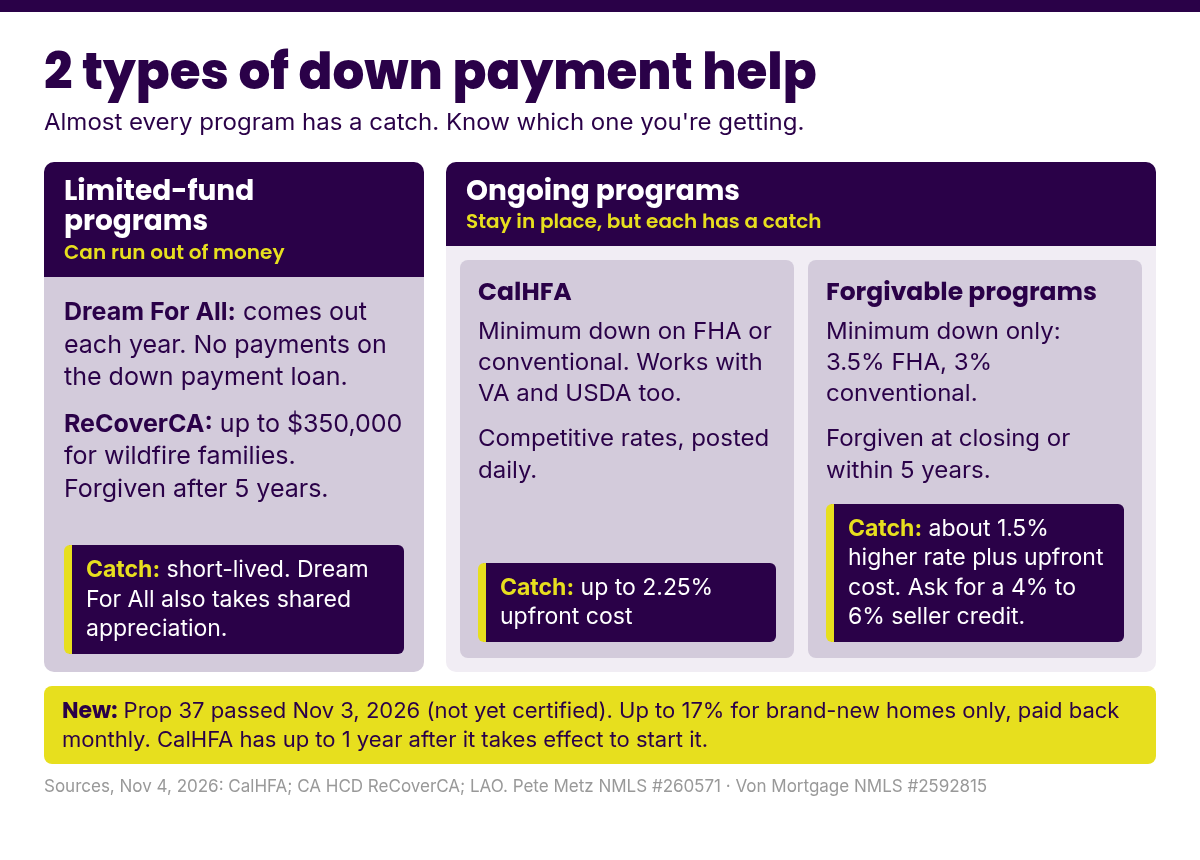
Almost every down payment assistance program has a catch, like shared appreciation, a higher rate or a higher upfront cost. There are 2 types of programs. Some have a set amount of money and can run out. Others stay in place year after year. The trick is knowing which catch you're getting.
Do down payment assistance programs run out of money?
Yes, some programs have a fixed amount of money, and once it's spent, the program is gone. Every so often, a big program comes along that is amazing, with very few catches. But these don't last long.
California Dream For All is one. It comes out each year, and it's a great program. You make no payments on the down payment loan. The small catch is shared appreciation. That means when you sell or refinance, you pay back what you borrowed plus a share of how much your home's value went up.
The ReCoverCA Homebuyer Assistance Program is the best program I have ever seen. It gives up to $350,000 toward buying a home to families hurt by certain California wildfires, like families who lost a home in a fire. It can cover the down payment and closing costs, and income limits apply. After 5 years, the loan is forgiven, so you never pay it back. Its money for the 2018 fires, which covers Shasta County, showed as open on the program's page (updated January 22, 2026). Its money for the 2017 fires ran out in July 2026.
Do down payment assistance programs have higher interest rates?
Many do. Programs that stay in place year after year, like CalHFA and forgivable programs, come with a higher rate or a higher upfront cost. Most work one of two ways:
- The rate is higher, sometimes 1% to 1.5% higher.
- The rate is competitive, but the upfront cost is higher.
What's the catch with CalHFA down payment assistance?
The catch with CalHFA is the upfront cost, which can be as high as 2.25%. Still, CalHFA is the best ongoing program, with the most favorable terms. A first-time buyer can get the minimum down payment for an FHA or conventional loan. It also works with VA and USDA loans, which need no down payment at all.
CalHFA's rates are favorable, and it posts them every day. You can check CalHFA's rates for today.
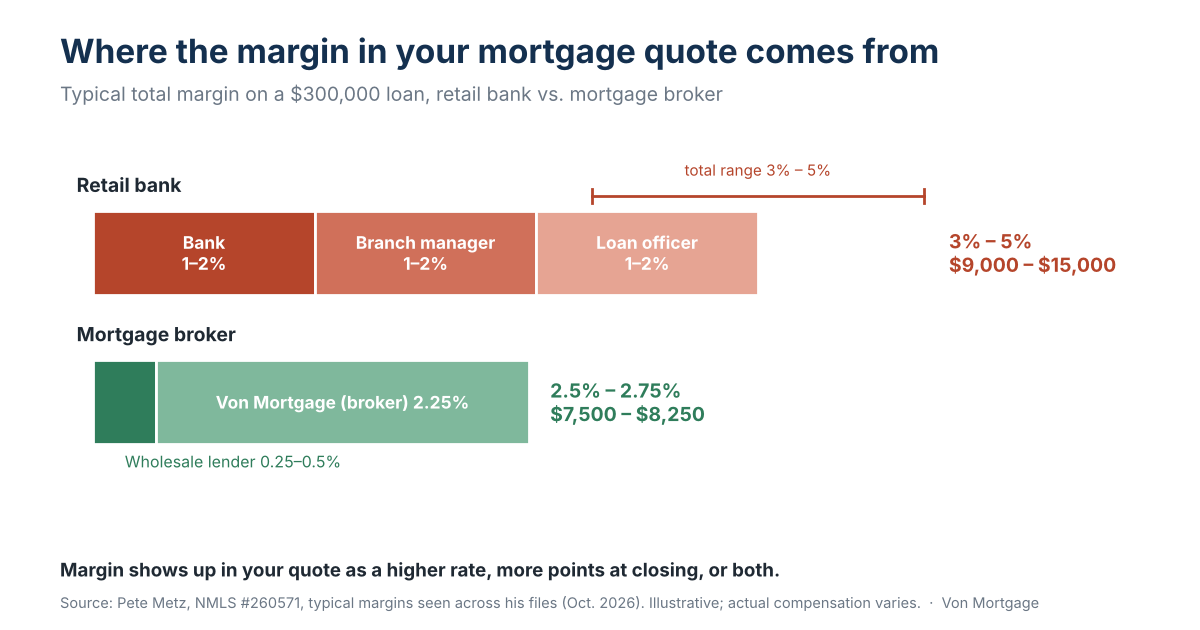
Here's why the upfront cost is higher. On most loans, the lender or broker gets paid with a rebate, also called a service release premium. That's money paid for setting up the loan, so the family doesn't have to pay it. CalHFA's program has no rebate. So the upfront fee is what pays the brokerage or lender that sets up the loan.
What's the catch with forgivable down payment assistance?
The catch with forgivable programs is a rate that's typically 1.5% higher, plus an extra upfront cost, like CalHFA. These programs forgive the down payment loan, so you never pay it back. But they only cover the minimum down payment: 3.5% for FHA and 3% for conventional. Some are forgiven the day the loan closes. Others are forgiven after up to 5 years.
Because of the higher costs, families should expect to ask for a 4% to 6% seller credit. A seller credit is money the seller agrees to put toward your closing costs. Without it, you'd pay closing costs out of your own pocket at closing. That defeats the purpose of 100% financing on FHA and conventional loans.
VA and USDA loans don't need a down payment. So with those, the down payment loan goes toward the family's closing costs.
Should I use down payment assistance if I have money saved?
Most families who have the minimum down payment saved choose to pay it themselves, after we compare the total cost both ways. Programs that stay in place really only help with the minimum down payment. So if a family already has money set aside, we show 2 side-by-side comparisons of total cost. One uses the down payment loan and its costs. The other uses the family's own minimum down payment and its costs.
There's one more reason to use your own money if you have it. When rates drop, it's a lot easier to refinance, because your loan started smaller. Refinancing with a down payment loan needs your home to go up in value first. Some of our past clients got stuck. Rates dropped, and they couldn't refinance to get a lower payment.
The City of Redding and Shasta County loans are local programs with their own rules. They can cover more than the minimum, with income limits and price caps, as the table above shows.
Is a forgivable down payment loan worth the higher rate?
Sometimes it is, and we recommend it, because it's just like coming in with your own down payment. The second loan never has to be paid back.
FHA is great for this. Even if rates stay the same, FHA lets the family streamline to a lower rate after 6 successful payments. A streamline is a quick, simple refinance with less paperwork. Since the forgivable loan's rate started 1% to 1.5% higher, there's room to drop.
Do you have to pay back down payment assistance?
You don't have to pay back forgivable programs like ReCoverCA once you meet their rules, but you do have to pay back the Shasta County and CalHFA MyHome loans. Those aren't forgiven. They defer payments, so nothing is due each month, but the balance comes due later. Interest can build while you wait. An $80,000 County loan at the 3% cap can add up to $2,400 a year in simple interest (my math on the County's terms). The City's loan is silent, with no monthly payments. Ask its Housing Division how and when it is repaid.
What happens to down payment assistance if I sell or refinance?
When you sell or refinance, you usually pay off the down payment loan, unless it's already been forgiven. With CalHFA MyHome and the Zero Interest Program, you pay the loan off when you sell, transfer, refinance or pay off the first mortgage. Dream For All repays the original amount plus a share of appreciation. Shasta County's loan has no prepayment penalty, and the home must stay your primary residence. ReCoverCA is forgiven after 5 years. If you sell or move out before then, you repay part of it.
Refinancing is harder with a down payment loan, because your home needs to go up in value first. That's why families who can pay the minimum down payment themselves have an easier time refinancing when rates drop.
Can I get down payment assistance if I've owned a home before?
Yes, if you haven't owned in the past 3 years. That is the rule for the City of Redding, Shasta County and CalHFA MyHome. The City lists exceptions for a displaced homemaker or single parent. Dream For All was stricter in 2026, requiring first-time and first-generation buyers.
How long does down payment assistance take?
Closing with down payment assistance takes about 30 days, just as fast as a regular conventional or FHA loan.
The City of Redding has its own rule. It recommends a 45-day escrow, and it won't accept a purchase contract signed before it says you're eligible. So if you're using the City's program, talk to the City before you write the offer. A home inspection, a City inspection and termite clearance also have to fit inside that time.
How much down payment assistance can I get in California?
In California, you can get anywhere from the minimum down payment, 3% to 3.5% of the price, up to $350,000 for families hurt by certain wildfires. The City of Redding goes up to $200,000 and Shasta County up to $80,000. CalHFA MyHome covers up to 3.5% of the price or appraised value, whichever is less, with CalHFA FHA and 3.0% with other loans. Dream For All offered up to 20%, capped at $150,000, in 2026. Forgivable programs cover the minimum down payment: 3.5% for FHA and 3% for conventional.
How does Prop 37 affect down payment assistance in 2027?
As of November 4, 2026, results show California voters passed Prop 37, which creates a new CalHFA loan for up to 17% of the price of a newly built home, but it isn't available yet. The Secretary of State's 8:08 a.m. update on November 4 showed 4,605,778 yes votes (61.0%) and 2,946,506 no votes (39.0%), according to the Palo Alto Ledger. The results aren't certified yet. The state has until December 11, 2026 to certify them.
Its official name is the California Middle-Class Homeownership and Family Home Construction Act of 2026. Here's how the new loan works, according to the Legislative Analyst's Office and the measure's text, both checked November 4, 2026:
- It covers up to 17% of the price. You bring at least 3% down, and that 3% can't come from a grant or borrowed money.
- It's only for newly built homes, like a house, townhome, condo or manufactured home, where you're the very first buyer. An older home doesn't count.
- Your household income can be up to double the area median income, which is the middle income for your area. You also have to be a California resident.
- It's a loan, not a grant. You make monthly payments on it, and CalHFA has to keep the interest cost as low as possible.
- The price can't be more than 125% of the county's conforming loan limit. Shasta County's 2026 limit is $832,750, per FHFA's November 25, 2025 announcement, so by my math the cap here is about $1,040,938.
So when can Redding families use it? The law takes effect 5 days after the results are certified, and then CalHFA has up to 1 year to start the program. That puts it sometime in 2027. KQED also noted on November 3, 2026 that it could take longer, because the homes have to be built first.
Prop 37 won't help with an older home. For a brand-new home, it's one more option to compare once CalHFA sets the terms. Voters also passed Prop 1, an $11.25 billion housing bond. Part of that money helps first-time buyers and veterans buy homes, according to the Los Angeles Times on November 4, 2026, which reported both measures passing with roughly 60% of counted votes.
How do Redding families get started with down payment assistance?
Start by picking the monthly payment you're comfortable with, then work out the cash. You can check what a home would cost each month, then add up your out-of-pocket costs at closing. If the payment works and cash is the only gap, assistance is worth a look.
I'd rather you see the second loan's terms before you write an offer. Send me your scenario and I'll run your numbers with and without assistance.
Updated November 4, 2026, by Pete Metz, mortgage broker at Von Mortgage in Redding, California, NMLS #260571. Program terms checked on each program's own site that day.
Disclaimer: This information is educational and is not a commitment to lend, a loan approval, or an offer of credit. Any rates, payments, down payments or other figures shown are illustrative examples only — not quoted terms and not an offer to extend credit. Actual rates and terms depend on credit, income, property, occupancy and market conditions, and change daily. For current pricing see vonmortgage.com/rates.
Pete Metz, Mortgage Broker · NMLS #260571
Dream Big Ownership LLC dba Von Mortgage · NMLS #2592815
2777 Bechelli Lane, Redding, CA 96002 · Pete@VonMortgage.com
Equal Housing Opportunity.
 Equal Housing Opportunity
Join the conversation
Comments are reviewed before they appear. Have a question about your own situation? Ask Pete directly — that stays private.
No comments yet