




Recent Posts
Categories
Tags
Years
What is a gift of equity?
A gift of equity is when a family member sells you their home for less than it's worth and the difference is credited toward your down payment and closing costs. Fannie Mae allows it on a primary or second home, and FHA allows it only between family members. Either way, you'll need a signed gift letter.
Fannie Mae's definition is short: "a gift provided by the seller of a property to the buyer" (Selling Guide B3-4.3-05, dated 10/07/2020). The seller already owns the equity. They hand part of it to the buyer inside the sale.
By Pete Metz, mortgage broker at Von Mortgage in Redding, California, NMLS #260571. Updated November 2026.
How does a gift of equity work when buying a house from family?
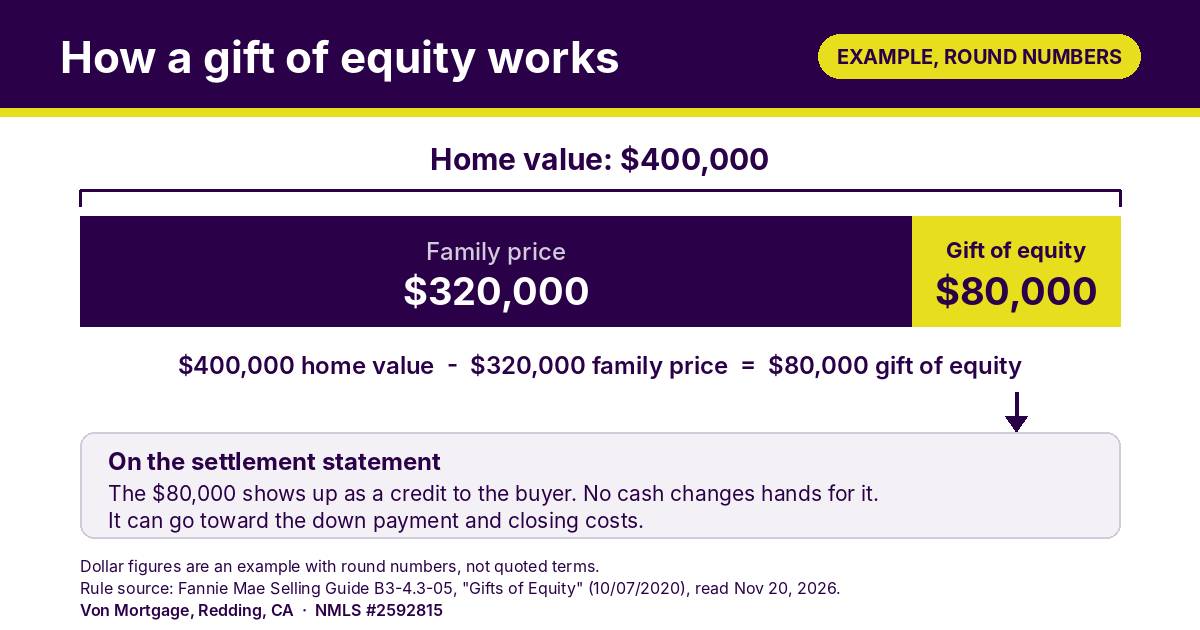
The gift shows up as a credit to the buyer on the settlement statement, which is the final list of who pays what at closing. That credit lowers the cash you need to bring.
Here is an example with round numbers, not a quote. A home is worth $400,000. Your parents want you to have it for $320,000. If the purchase contract is written at the $400,000 value, the $80,000 difference is the gift of equity.
Fannie Mae wants two things kept in the loan file: a signed gift letter and the settlement statement listing the gift of equity (B3-4.3-05, dated 10/07/2020).
Talk with me before anyone signs the purchase contract.
Who can give a gift of equity?
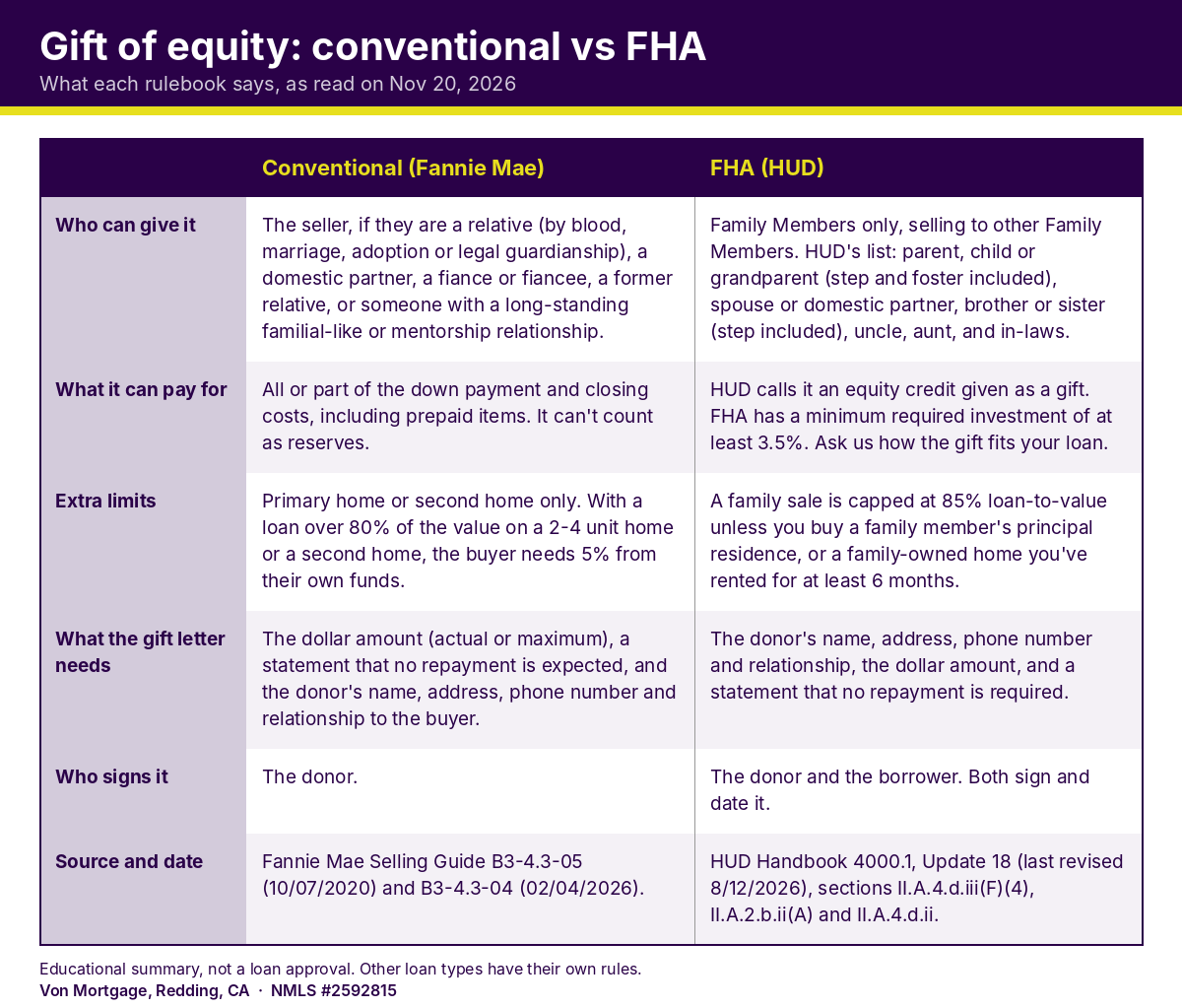
The seller gives it, and the seller has to be someone the loan rules accept as a gift donor. The list is wider on a conventional loan than on an FHA loan.
On a conventional loan, Fannie Mae (Selling Guide B3-4.3-04, dated 02/04/2026) accepts:
- A relative: a spouse, a child or other dependent, or anyone related by blood, marriage, adoption or legal guardianship
- A domestic partner, or a fiance or fiancee
- A former relative
- Someone with a long-standing familial-like or mentorship relationship with you
The donor can't be the builder, the developer, the real estate agent or anyone else with a stake in the sale.
On an FHA loan, only Family Members can give a gift of equity, and only to other Family Members (HUD Handbook 4000.1, Update 18, section II.A.4.d.iii(F)(4)(a), last revised 8/12/2026). HUD's list is children, parents and grandparents (step and foster included), a spouse or domestic partner, legally adopted and foster children, brothers and sisters (step included), uncles, aunts, and a son-, daughter-, father-, mother-, brother- or sister-in-law.
Cousins aren't on HUD's list. If your seller is a cousin or a close family friend, reach out so we can look at your situation.
What goes in a gift of equity letter?
A gift of equity letter gives the dollar amount, says no repayment is expected, and lists the donor's name, address, phone number and relationship to you. Those are Fannie Mae's requirements (B3-4.3-04, dated 02/04/2026). The amount can be the actual figure or a maximum, and the donor signs the letter.
FHA asks for the same items and one more signature. HUD wants the letter signed and dated by both the donor and you, the buyer (HUD Handbook 4000.1, Update 18, section II.A.4.d.iii(F)(4)(b), last revised 8/12/2026).
Can a gift of equity cover the down payment and closing costs?
Yes. On a conventional loan, Fannie Mae lets a gift of equity fund all or part of the down payment and closing costs, including prepaid items (B3-4.3-05, dated 10/07/2020). Prepaid items are costs you pay up front at closing, like the first year of homeowners insurance.
It can't count as reserves. Reserves are the savings a lender may want to see left over after closing.
Whether you need any of your own money depends on the home (Fannie Mae B3-4.3-04, dated 02/04/2026):
- One-unit primary home: no minimum from your own funds.
- Two- to four-unit primary home, or a second home, with a loan over 80% of the home's value: 5% has to come from your own funds.
- Loan at 80% of the home's value or less: no minimum. All of it can be a gift.
You can compare our conventional loan options.
Does an FHA loan allow a gift of equity?
Yes, but only between Family Members. That rule is in HUD Handbook 4000.1, Update 18 (last revised 8/12/2026).
FHA has a second limit to know about. HUD treats a sale between Family Members as an identity-of-interest transaction and caps it at 85% loan-to-value on a principal residence. Loan-to-value is the loan amount compared with the home's value. Section II.A.2.b.ii(A) of the same Handbook lists two exceptions when you're buying the home to live in:
- The home is another Family Member's principal residence.
- You've rented the home from a Family Member for at least six months before the contract, with a lease or other written proof.
FHA also requires a minimum investment of at least 3.5% of the Adjusted Value (section II.A.4.d.ii, last revised 8/12/2026). How a gift of equity fits with that minimum depends on your file, so ask us before the contract is written. Program basics are on our FHA loan page.
Do you pay taxes on a gift of equity?
The IRS says the donor is generally the one responsible for paying any gift tax, and in a gift of equity the donor is the seller (IRS, "Frequently asked questions on gift taxes," last reviewed July 23, 2026). This section is educational only. Talk with your tax pro before the family sets a price.
For 2026, the annual exclusion is $19,000 per person receiving the gift (IRS Rev. Proc. 2025-32, Sec. 4.42; IRS, "What's new: Estate and gift tax," last reviewed Nov 3, 2026). The IRS gift tax FAQ puts it at $38,000 per person when two spouses give together. If the gift of equity is more than the annual exclusion, the seller generally needs to file a gift tax return, Form 709. Filing doesn't always mean tax is owed.
For 2026, the lifetime gift and estate tax exclusion, which the IRS calls the basic exclusion amount, is $15,000,000 (IRS Rev. Proc. 2025-32, Sec. 2.14; IRS, "What's new: Estate and gift tax," last reviewed Nov 3, 2026). Gifts above the annual exclusion generally count against that lifetime amount. Gift tax is generally owed only after lifetime gifts go over that amount.
In California, Prop 19 may let a child keep a parent's property tax base in some parent-to-child transfers of the family home (California State Board of Equalization, Prop 19 page, read Nov 20, 2026). Check with the Shasta County Assessor or your tax pro.
How should you structure a gift of equity purchase?
Write the purchase contract at the home's value, and treat the discount as a gift of equity. Don't write the contract at the discounted price the seller wants.
Families don't really get this wrong. They just don't know how to structure the loan. Most families are buying the home at a discount, and the buyer usually wants to purchase it at that discounted price. Where families get it wrong is that they buy it for what the seller wants, not for what the home is worth.
Structuring the purchase at the home's value has more benefits for the buyer. For the seller, it works out to be about the same, except the seller has to sign a gift letter for the gift of equity. In the example above, that means writing the contract at the $400,000 value, with the $80,000 difference as a gift of equity.
The gift of equity letter is where most sellers get a little worried. They think they will have to pay taxes on the gift amount if that's how they disclose it. Most families are well under the IRS lifetime gift and estate tax exclusion, which the IRS calls the basic exclusion amount. For 2026, that amount is $15,000,000 (IRS Rev. Proc. 2025-32, Sec. 2.14; IRS, "What's new: Estate and gift tax," last reviewed Nov 3, 2026).
Gifts above the $19,000 annual exclusion generally count against that lifetime amount and generally require filing Form 709. Gift tax is generally owed only after lifetime gifts go over that $15,000,000 amount. We let families know they generally won't owe gift tax unless their lifetime gifts go over that amount, but they normally do have to disclose the gift. That's all. Talk with your tax pro about your own situation.
Once families understand this, they're thankful. The buyer may get a lower rate because of the lower loan-to-value, which is the loan amount compared with the home's value. The buyer may also avoid mortgage insurance, depending on the size of the gift. And the buyer may not need to bring their own money for the down payment. That still depends on the loan, including FHA's 3.5% minimum investment and the 85% identity-of-interest cap explained above.
What else do families ask about a gift of equity?
They ask who can give it, how it differs from a seller credit, and whether it works on a second home or rental.
Does a gift of equity have to be from a family member?
Not on every loan. On a conventional loan, Fannie Mae also accepts a domestic partner, a fiance or fiancee, a former relative, or someone with a long-standing familial-like or mentorship relationship (Selling Guide B3-4.3-04, dated 02/04/2026). On an FHA loan, yes. HUD allows a gift of equity only between Family Members (HUD Handbook 4000.1, Update 18, last revised 8/12/2026).
Is a gift of equity the same as a seller credit?
No. A seller credit is money the seller puts toward your closing costs. A gift of equity is part of the seller's equity given to you as a gift. When the seller is an acceptable donor, Fannie Mae doesn't treat them as an interested party, so the gift of equity isn't subject to its interested party contribution requirements (B3-4.3-05, dated 10/07/2020).
More on credits is in my post on seller credits.
Can you use a gift of equity on a second home or rental?
On a second home, yes, with a conventional loan. Fannie Mae permits a gift of equity on a principal residence or second home purchase (B3-4.3-05, dated 10/07/2020), and it doesn't allow gifts on an investment property (B3-4.3-04, dated 02/04/2026). If the home will be a rental, reach out so we can look at your situation.
What should you do before you buy a home from family?
Talk with me before the purchase contract is signed. Bring the price the family has in mind, a rough idea of what the home is worth, how you're related to the seller, and whether you'll live in the home.
VA and USDA loans have their own rules, so ask us about those. If this is your first home, my first-time homebuyer guide walks through the rest of the process. Send the details through our quick quote form and I'll look at your situation with you.
Sources
- Fannie Mae Selling Guide B3-4.3-05, "Gifts of Equity," dated 10/07/2020. Read Nov 20, 2026. selling-guide.fanniemae.com/sel/b3-4.3-05/gifts-equity
- Fannie Mae Selling Guide B3-4.3-04, "Personal Gifts," dated 02/04/2026. Read Nov 20, 2026. selling-guide.fanniemae.com/sel/b3-4.3-04/personal-gifts
- HUD Handbook 4000.1, Update 18, issued and last revised Aug 12, 2026. Sections II.A.4.d.iii(F)(4), II.A.2.b.ii(A), II.A.4.d.ii and the Family Member definition. Downloaded Nov 20, 2026. hud.gov/sites/default/files/Housing/documents/40001-hsgh-Update-18.pdf
- IRS Rev. Proc. 2025-32, Sec. 2.14 (2026 basic exclusion amount) and Sec. 4.42 (2026 annual exclusion). irs.gov/pub/irs-drop/rp-25-32.pdf
- IRS, "Frequently asked questions on gift taxes," last reviewed July 23, 2026. irs.gov/businesses/small-businesses-self-employed/frequently-asked-questions-on-gift-taxes
- IRS, "What's new: Estate and gift tax," last reviewed Nov 3, 2026 (2026 annual exclusion and $15,000,000 basic exclusion amount). irs.gov/businesses/small-businesses-self-employed/whats-new-estate-and-gift-tax
- IRS, "About Form 709," last reviewed March 31, 2026. irs.gov/forms-pubs/about-form-709
- California State Board of Equalization, Proposition 19 page. Read Nov 20, 2026. boe.ca.gov/prop19/
Disclaimer: This information is educational and is not a commitment to lend, a loan approval, or an offer of credit. Any rates, payments, down payments or other figures shown are illustrative examples only, not quoted terms and not an offer to extend credit. Actual rates and terms depend on credit, income, property, occupancy and market conditions, and change daily. For current pricing see vonmortgage.com/rates.
Pete Metz, Mortgage Broker · NMLS #260571
Dream Big Ownership LLC dba Von Mortgage Company · NMLS #2592815
Loans made or arranged pursuant to a California Financing Law license, #60DBO-195824.
2777 Bechelli Lane, Redding, CA 96002 · (530) 221-7700 · Pete@VonMortgage.com
Equal Housing Opportunity.



 Equal Housing Opportunity
Join the conversation
Comments are reviewed before they appear. Have a question about your own situation? Ask Pete directly — that stays private.
No comments yet