




Recent Posts
Categories
Tags
Years
PMI comes off a conventional loan in one of two ways. You can ask your servicer to cancel it once your balance reaches 80% of the home's original value, or it ends automatically when your balance is scheduled to hit 78%, if you're current (Homeowners Protection Act). FHA mortgage insurance runs 11 years with at least 10% down, or the life of the loan with less (HUD Mortgagee Letter 2013-04).
PMI is private mortgage insurance. It's a monthly charge on a conventional loan when you put less than 20% down, and it protects the lender if you stop paying. You can often get it off sooner than the automatic date by asking.
I paid mortgage insurance on my own home for about a year after I no longer needed it. One phone call and one appraisal fixed it.
By Pete Metz, mortgage broker at Von Mortgage in Redding, California, NMLS #260571. Updated November 2026.
When does PMI come off a conventional loan?
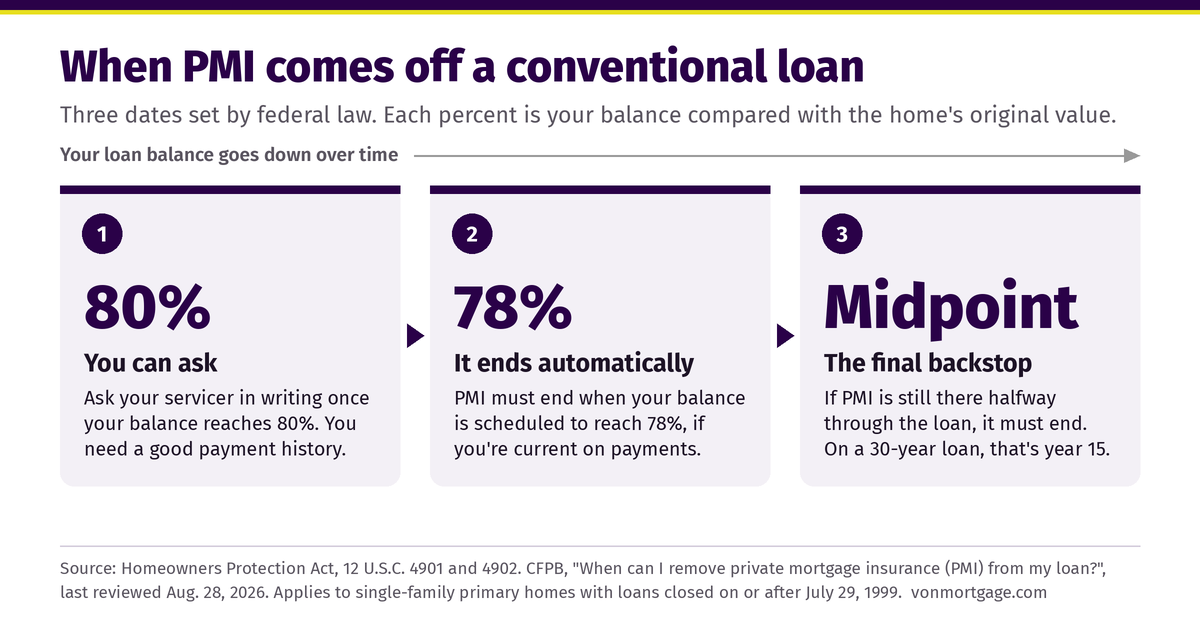
On a conventional loan, you can ask your servicer to cancel PMI once your balance reaches 80% of the home's original value, and it must end automatically when the balance is scheduled to hit 78%, if you're current. FHA mortgage insurance follows different rules: 11 years or the life of the loan.
The conventional rules come from the Homeowners Protection Act (12 U.S.C. 4901 and 4902). The Consumer Financial Protection Bureau (CFPB), on a page last reviewed August 28, 2026, says the law covers single-family primary homes with loans closed on or after July 29, 1999.
Your servicer is the company you send your payment to. Original value is the lower of your purchase price or the appraisal from when you bought. If you refinanced, it's the appraisal from the refinance.
There's also a backstop. If PMI is still on the loan at the halfway point, it has to end the next month if you're current (12 U.S.C. 4902(c)). On a 30-year loan, the CFPB puts that at 15 years.
Does PMI come off automatically?
Yes. On a conventional loan, PMI must end automatically on the date your balance is scheduled to reach 78% of the original value, if you're current on your payments (Homeowners Protection Act, 12 U.S.C. 4902(b)).
The word that matters is "scheduled." The automatic date comes from the payment schedule you got at closing. Extra payments and rising home values don't move it. If you want credit for those, you have to ask.
If you're behind on that date, PMI ends on the first day of the first month after you catch up.
How do you remove PMI without refinancing?
Ask your servicer. There are two ways to qualify, and neither one needs a new loan.
The first is to pay the balance down to 80% of the original value. Extra principal gets you there sooner. Ask in writing. The law also requires a good payment history: no payment 30 or more days late in the past 12 months, and none 60 or more days late in the 12 months before that (12 U.S.C. 4901).
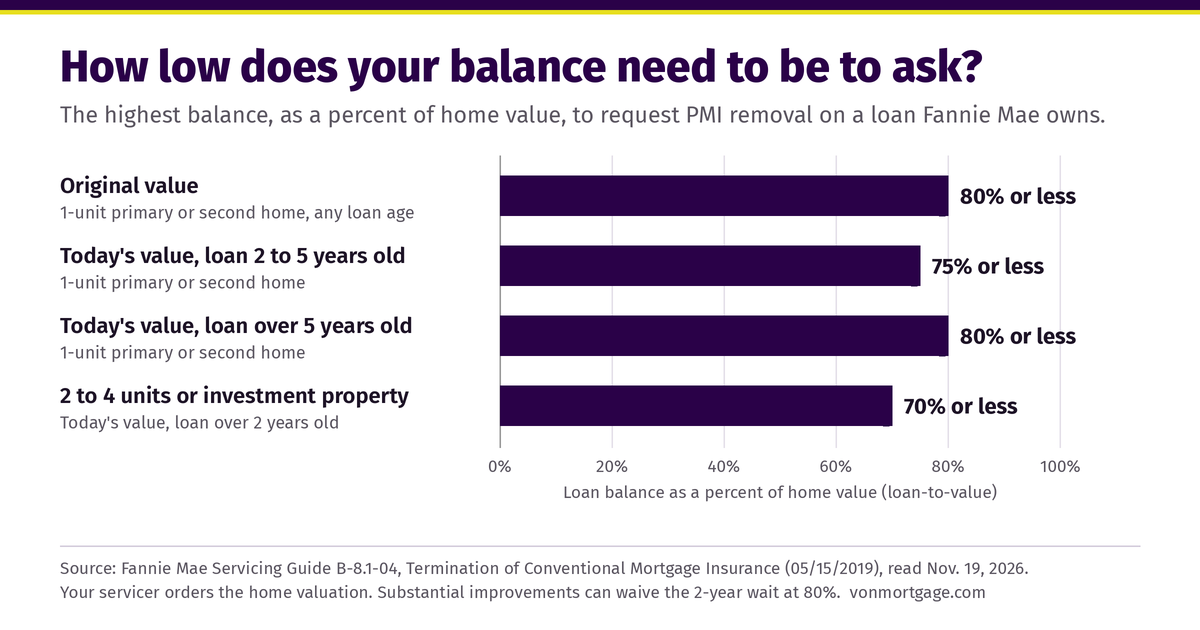
The second is to use what your home is worth today. If Fannie Mae owns your loan and it's a one-unit primary or second home, the Servicing Guide (B-8.1-04, dated 05/15/2019) sets these marks:
- Loan 2 to 5 years old: your balance has to be 75% or less of today's value.
- Loan more than 5 years old: 80% or less of today's value.
- Big improvements, like a remodeled kitchen or added square footage, can waive the two-year wait. The mark is then 80%.
Your servicer can tell you who owns your loan. If you bought in Shasta County a few years ago, what Redding home values have done will tell you whether this route is worth a call.
One thing changed this fall. On September 16, 2026, Fannie Mae Lender Letter LL-2026-07 allowed servicers to contact families whose loans look close to those marks. Before that, the guide told them not to. You may get a letter. I wouldn't wait for one.
Do you need an appraisal to remove PMI?
Sometimes. If you paid down to 80% of the original value, a new appraisal usually isn't needed, though the servicer can ask for proof the value hasn't dropped. If you're using today's value, yes. On Fannie Mae loans that means a valuation with an inside and outside inspection (Servicing Guide B-8.1-04).
I did this on my own home. I called the servicer, paid $500 for a new appraisal and sent it in. They removed $183 a month. The appraisal paid for itself in under three months.
On a loan Fannie Mae owns, the servicer gets that valuation through Fannie Mae's own system (Servicing Guide B-8.1-04). So call your servicer first and ask how they want it done before you order anything.
What can stop PMI from coming off?
A late payment, a second loan on the house, or a drop in value can each stop a request. Under the Homeowners Protection Act you have to be current and certify there's no second lien on the home, such as a second mortgage. The servicer can also say no if the home is worth less than its original value.
Property type matters too. On Fannie Mae loans, a two-to-four-unit home or an investment property needs the balance at 70% or less (Servicing Guide B-8.1-04).
The most common reason I see a PMI removal request turned down is a simple assumption: that once a family reaches 20% equity, they can just call and have it removed. A family with an FHA loan calls and gets turned down, because FHA mortgage insurance doesn't come off at 20% equity. A family with a conventional loan calls and gets told they need to wait, because the 80% mark is based on the home's original value unless they qualify under the current-value rules above. If you're within the rules, the request shouldn't get turned down: 80% of the original value with a good payment history and no second loan, or on a Fannie Mae loan, 75% of today's value after two years or 80% after five. The other time I see a no is after an appraisal, when the home doesn't come in high enough to show the equity needed. So before you pay for an appraisal, know exactly what equity your loan requires instead of assuming.
When does FHA mortgage insurance come off?
After 11 years if you put at least 10% down. If you put down less, it stays for the life of the loan. That's the rule for FHA loans with case numbers assigned on or after June 3, 2013, under HUD Mortgagee Letter 2013-04 (January 31, 2013).
FHA calls its insurance MIP, short for mortgage insurance premium. A family that buys with the minimum down payment on an FHA loan is in the life-of-loan group. FHA loans from before June 3, 2013 follow older rules, so ask your servicer.
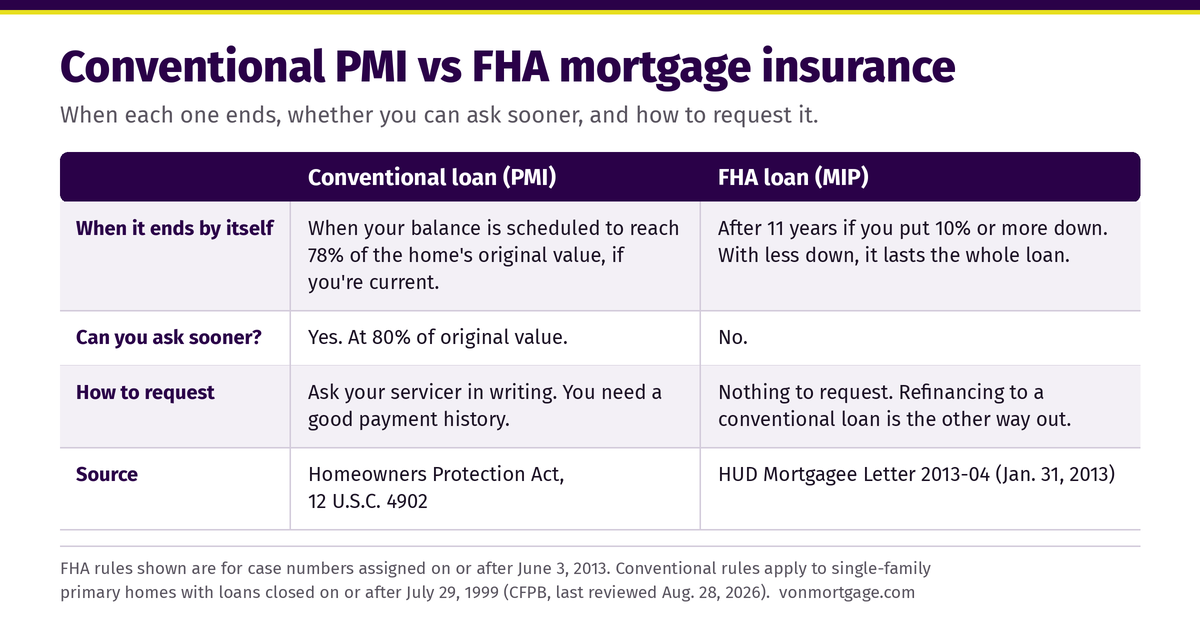
| Conventional loan (PMI) | FHA loan (MIP) | |
|---|---|---|
| When it ends by itself | When your balance is scheduled to reach 78% of the home's original value, if you're current. Backstop: the midpoint of the loan. | After 11 years if you put 10% or more down. With less down, it lasts the whole loan. |
| Can you ask sooner? | Yes. At 80% of original value. On Fannie Mae loans, also at 75% of today's value after 2 years or 80% after 5 years. | No, for case numbers assigned on or after June 3, 2013. |
| How to request | Ask your servicer in writing. You need a good payment history and no second loan on the home. | Nothing to request. Refinancing to a conventional loan is the other way out. |
| Source | Homeowners Protection Act, 12 U.S.C. 4902; Fannie Mae Servicing Guide B-8.1-04 | HUD Mortgagee Letter 2013-04 (Jan. 31, 2013) |
How do you get rid of FHA mortgage insurance without refinancing?
On most FHA loans made since June 3, 2013, you can't. With less than 10% down, MIP stays for the whole loan, and paying the balance down or a higher home value doesn't change that. With 10% or more down, you wait out the 11 years (HUD Mortgagee Letter 2013-04).
The other way out is refinancing from FHA to a conventional loan once you have enough equity. Dropping the insurance doesn't help if a higher rate eats the savings, so compare both payments first. Current pricing is on our rates page.
What else do families ask about PMI in 2026?
Mostly taxes, the October executive order and a bill in Congress.
Is PMI tax deductible in 2026?
Yes, if you itemize. Section 70108 of the One Big Beautiful Bill Act (Public Law 119-21) brought back the deduction for mortgage insurance premiums for tax years starting after December 31, 2025. The IRS draft of 2026 Publication 936, dated September 30, 2026, says it phases out above $100,000 of adjusted gross income and is gone above $109,000.
The draft covers PMI and FHA MIP on a first or second home. It's still a draft, and state tax rules can differ. Ask your tax pro before you count on it.
Does the executive order change when PMI comes off?
No, not on a loan you already have. The October 22, 2026 executive order (EO 14438) lets the Federal Housing Finance Agency set up a pilot that cancels PMI automatically using computer estimates of home value. It applies only to loans made after the pilot launches. As of November 19, 2026, I haven't seen the agency announce a pilot.
The order doesn't mention FHA mortgage insurance. I covered the rest of it in my post on the housing costs executive order.
Is there a bill to remove FHA mortgage insurance?
Yes, but it isn't law. H.R. 5508, the Mortgage Insurance Freedom Act, was introduced in the U.S. House on September 19, 2025 and sent to the House Financial Services Committee. Congress.gov shows no action since then, as of November 19, 2026. Until a bill passes, HUD's 2013 rules still decide when FHA mortgage insurance ends.
What should you do if you think your PMI can come off?
Pull three numbers and call your servicer: your loan balance, your home's original value, and a fair guess at what it's worth today.
- Balance at or under 80% of the original value: ask in writing now.
- Fannie Mae loan at least two years old, with the balance near 75% of today's value: ask about removal based on current value.
- FHA loan: check your down payment and the date of your loan.
I waited about a year longer than I had to. I'd rather you make the call early. If you want help with the math, send me your numbers and I'll tell you what I see, including whether one of our conventional loan options would cost you less than keeping FHA insurance. You can request a quote to start.
Sources
- Homeowners Protection Act, 12 U.S.C. 4901 (definitions) and 4902 (cancellation, automatic termination, final termination). Legal Information Institute, law.cornell.edu/uscode/text/12/4902 and /4901. Read Nov. 19, 2026.
- Consumer Financial Protection Bureau, "When can I remove private mortgage insurance (PMI) from my loan?" Last reviewed Aug. 28, 2026. consumerfinance.gov/ask-cfpb/when-can-i-remove-private-mortgage-insurance-pmi-from-my-loan-en-202/
- Fannie Mae Servicing Guide B-8.1-04, Termination of Conventional Mortgage Insurance (05/15/2019). servicing-guide.fanniemae.com/svc/b-8.1-04/termination-conventional-mortgage-insurance. Read Nov. 19, 2026.
- Fannie Mae Lender Letter LL-2026-07, Updates to Mortgage Insurance Termination Requirements, Sept. 16, 2026. singlefamily.fanniemae.com/media/48106/display
- HUD Mortgagee Letter 2013-04, Jan. 31, 2013. hud.gov/sites/documents/13-04ml.pdf
- One Big Beautiful Bill Act, Public Law 119-21, Sec. 70108. IRS Publication 936 for 2026, DRAFT dated Sept. 30, 2026. irs.gov/pub/irs-dft/p936--dft.pdf
- Executive Order 14438, "Decreasing Housing Costs for the American People," The White House, Oct. 22, 2026.
- H.R. 5508, Mortgage Insurance Freedom Act, introduced Sept. 19, 2025. Congress.gov, status read Nov. 19, 2026.
- Pete Metz, "Decreasing Housing Costs Executive Order: Refinance and PMI," Von Mortgage, Oct. 23, 2026 (Pete's own PMI removal figures).
Disclaimer: This information is educational and is not a commitment to lend, a loan approval, or an offer of credit. Any rates, payments, down payments or other figures shown are illustrative examples only, not quoted terms and not an offer to extend credit. Actual rates and terms depend on credit, income, property, occupancy and market conditions, and change daily. For current pricing see vonmortgage.com/rates.
Pete Metz, Mortgage Broker · NMLS #260571
Dream Big Ownership LLC dba Von Mortgage Company · NMLS #2592815
Loans made or arranged pursuant to a California Financing Law license, #60DBO-195824.
2777 Bechelli Lane, Redding, CA 96002 · (530) 221-7700 · Pete@VonMortgage.com
Equal Housing Opportunity.



 Equal Housing Opportunity
Join the conversation
Comments are reviewed before they appear. Have a question about your own situation? Ask Pete directly — that stays private.
No comments yet