




Recent Posts
Categories
Tags
Years
A one-time close construction loan is also called a construction-to-permanent loan or a single-close loan. It puts the build loan and your long-term mortgage into one approval and one closing, before construction starts. The lender pays your builder in draws as work is finished. You usually pay interest only on the money that has been drawn. When the home is finished, the loan converts to your regular mortgage.
That is how a construction loan works with one closing, whether your lot is in Redding, California or farther out in Shasta County. A one-time close removes the second closing. It also removes the second round of qualifying that comes with using two loans.
How does a construction loan work with one closing?
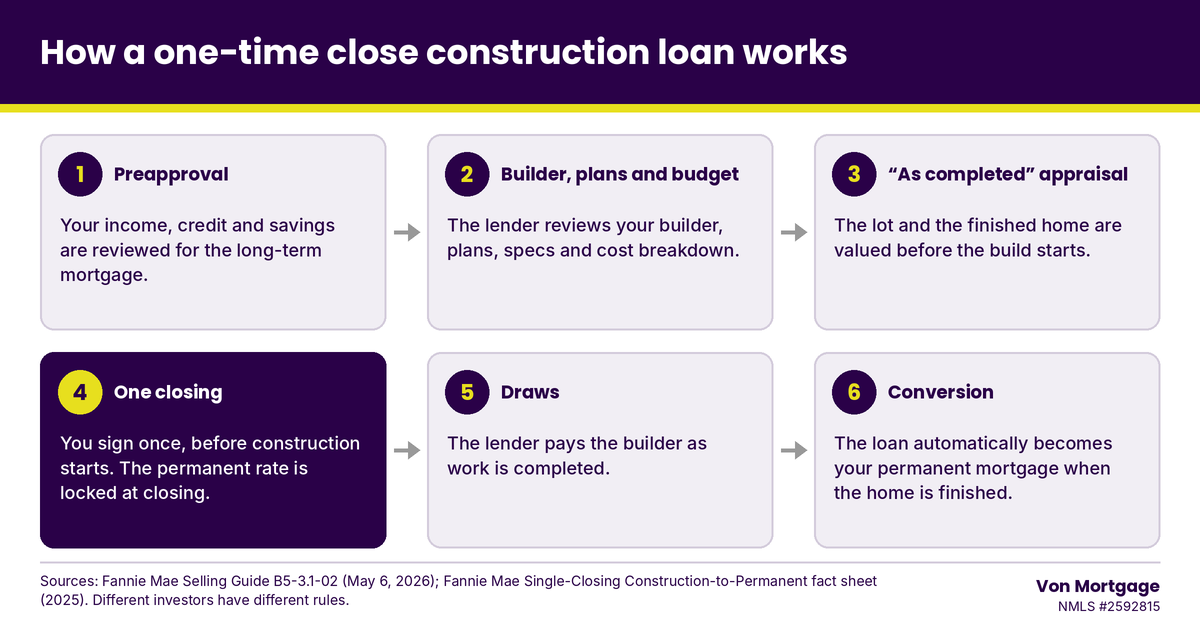
It works in six steps, and you sign loan papers once.
- Preapproval. Your income, credit and savings are reviewed for the permanent mortgage. That follows Fannie Mae's Selling Guide (section B5-3.1-02, dated May 6, 2026).
- Builder, plans and budget. The lender approves your builder and reviews the contract, plans and costs.
- "As completed" appraisal. An appraiser values the lot and the finished home before the build starts.
- One closing. You sign before construction starts. Fannie Mae's single-closing fact sheet (2025) says families can lock the permanent interest rate at that closing.
- Draws. The lender pays the builder as work gets done.
- Conversion. When the home is finished, the Selling Guide says the loan "will automatically convert" to your permanent mortgage.
One-time close vs two-time close: what's the difference?
A one-time close is one loan with one closing. A two-time close is two loans with two closings. Fannie Mae's Selling Guide (section B5-3.1-03, dated August 7, 2019) describes the two-closing version as two closings with two sets of legal documents. The first covers the build. The second is the permanent mortgage after the home is done. It can come from a different lender.
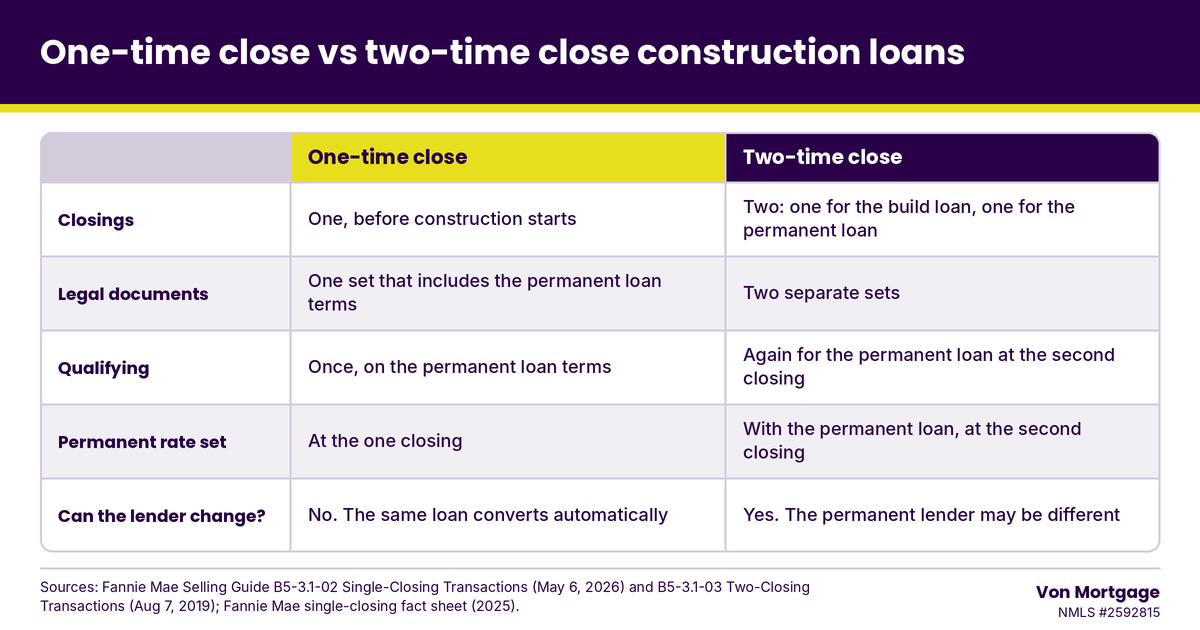
The one-time close comes with a clock. Under Selling Guide section B5-3.1-02 (May 6, 2026), no single construction period can run longer than 12 months. The total cannot pass 18 months. The guide allows no exceptions. A build that runs past that has to be handled as a two-closing loan.
The same section says that if the home's value has dropped by the time it is finished, the lender needs a new appraisal. The lender also has to qualify the loan again.
How does a construction loan work when you own the land?
When you already own the lot, the loan is set up as a refinance instead of a purchase. Your land equity can count. Fannie Mae's Selling Guide (section B5-3.1-02, May 6, 2026) calls it a limited cash-out refinance when you held legal title to the lot before the first draw. Taking extra cash out is not eligible.
The math changes too. On a purchase, the loan is measured against the lower of total cost (construction plus lot price) or the "as completed" appraised value. When you own the lot, it is measured against the "as completed" value of the lot and home together.
FHA goes by how long you have owned the land. HUD Handbook 4000.1 (Update 18, issued August 12, 2026) uses the appraised value of land owned more than six months. Otherwise, it uses the lower of cost or appraised value. On the files I work on, families who own their land outright typically see that equity count toward the down payment.
What do you need to qualify for a one-time close construction loan?
You need four things: your own loan approval, a builder the lender approves, a full set of plans with a budget, and permits. Builders need to be licensed, insured and approved by the lender. Getting a new builder approved is usually straightforward. Before final approval, the lender needs a signed builder contract, plans, specs and a cost breakdown. Down payment and credit terms depend on the loan program. Those terms are on the program pages linked below.
How do draws and payments work while the house is built?
The lender pays the builder in stages as work is finished. You pay only on the money that has gone out. On the one-time close loans I arrange, families pay interest only on what has been drawn during the build. Many VA one-time close programs include an interest reserve that covers the interest during the build. That means you may not make payments until the home is finished.
FHA and USDA rules require your written sign-off on every draw. That comes from HUD Handbook 4000.1 (Update 18, August 12, 2026) and 7 CFR 3555.105 (last amended November 29, 2022).
Which loan programs offer a one-time close?
Conventional, VA, FHA and USDA rules all allow one. Which ones you can get depends on the lender. Different investors have different rules.
- Conventional: see our page on a conventional one-time close with 5% down.
- VA: see our VA one-time close construction loan page.
- FHA: HUD Handbook 4000.1 (Update 18, August 12, 2026) allows a construction-to-permanent loan with "a single mortgage closing prior to the start of construction."
- USDA: 7 CFR 3555.105 allows a combined construction and permanent loan that closes before construction starts.
Not every lender offers the FHA and USDA versions, so ask.
What's different about building in Shasta County?
Water, septic and permits often take more planning here, especially on rural lots that need a well and septic. I've helped families build everywhere from Bella Vista and Palo Cedro to Cottonwood, Anderson and out toward Trinity. I work from our mortgage office in Redding, California. I know the local builders, the appraisers who handle new construction, and the quirks of building on land with well and septic. We also work with families building in Anderson and building in Shasta Lake.
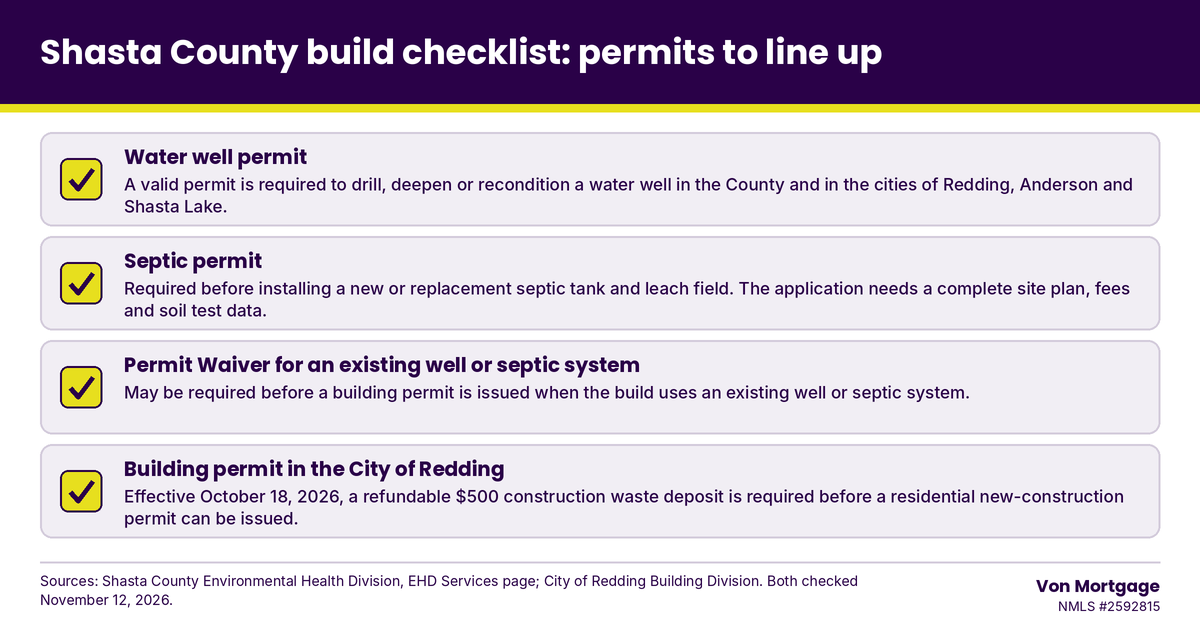
Shasta County's Environmental Health Division requires a permit to drill a water well in the county and in the cities of Redding, Anderson and Shasta Lake. That comes from its EHD Services page, checked November 12, 2026. A septic permit comes before a new or replacement tank and leach field. The application needs a site plan, fees and soil test data. If your build will use an existing well or septic system, a Permit Waiver may be required before the building permit.
The City of Redding Building Division (checked November 12, 2026) says a refundable $500 construction waste deposit is required before a building permit can be issued for a new residential project. That rule is effective October 18, 2026.
On the files I work on, the borrower side moves quickly. Credit, the application and your approval amount usually come together fast. What takes time is the contractor side. Most families don't realize they need a contractor and a signed contract. The builder has to be approved by the bank before it will fund the construction loan. The builder also has to provide all the bids and spell out exactly what the contract says between you and your contractor.
Reach out to me directly. I can send you a worksheet that goes over each cost of the build, so you can see what the true cost of your home might be.
What else do families ask about one-time close construction loans?
Four questions come up most.
Is a construction-to-permanent loan the same as a one-time close loan?
Yes, when it has a single closing. All three names (one-time close, single-close and construction-to-permanent) describe one loan. That loan pays for the build and then converts to your long-term mortgage. Fannie Mae's Selling Guide also describes a two-closing version, so ask which one you are being offered.
Can I be my own builder with a one-time close loan?
It depends on the program. FHA rules in HUD Handbook 4000.1 (Update 18, August 12, 2026) allow it only if you are a licensed general contractor. USDA's rule, 7 CFR 3555.105, makes builders constructing their own residence ineligible. Other rules vary by investor. Reach out and ask.
Does the rate lock at closing or when the house is finished?
At closing, on Fannie Mae's single-closing loan. Fannie Mae's fact sheet (2025) says you can lock your permanent rate when you close. You may be able to get a lower rate at conversion if rates drop during construction. More in our post on what a rate lock is.
How long can construction take on a one-time close loan?
Up to 12 months for any single construction period, and 18 months in total, under Fannie Mae's Selling Guide (section B5-3.1-02, May 6, 2026). The guide allows no exceptions. That build window is separate from how long it takes to close a mortgage.
What should you do before you pick a lot or a builder?
Get the loan side looked at first. The lot, the builder and the budget are all reviewed as part of the loan. Send me all three and I'll show you which one-time close program fits. If your build doesn't fit what's on this page, reach out anyway. Get a quote for your build.
Disclaimer: This information is educational and is not a commitment to lend, a loan approval, or an offer of credit. Any rates, payments, down payments or other figures shown are illustrative examples only, not quoted terms and not an offer to extend credit. Actual rates and terms depend on credit, income, property, occupancy and market conditions, and change daily. For current pricing see vonmortgage.com/rates.
Pete Metz NMLS #260571
Dream Big Ownership LLC dba Von Mortgage Company NMLS #2592815
CA CFL license 60DBO-195824
(530) 221-7700 · 2777 Bechelli Lane, Redding, CA 96002
Equal Housing Opportunity.

 Equal Housing Opportunity
Join the conversation
Comments are reviewed before they appear. Have a question about your own situation? Ask Pete directly — that stays private.
No comments yet