




Recent Posts
Categories
Tags
Years
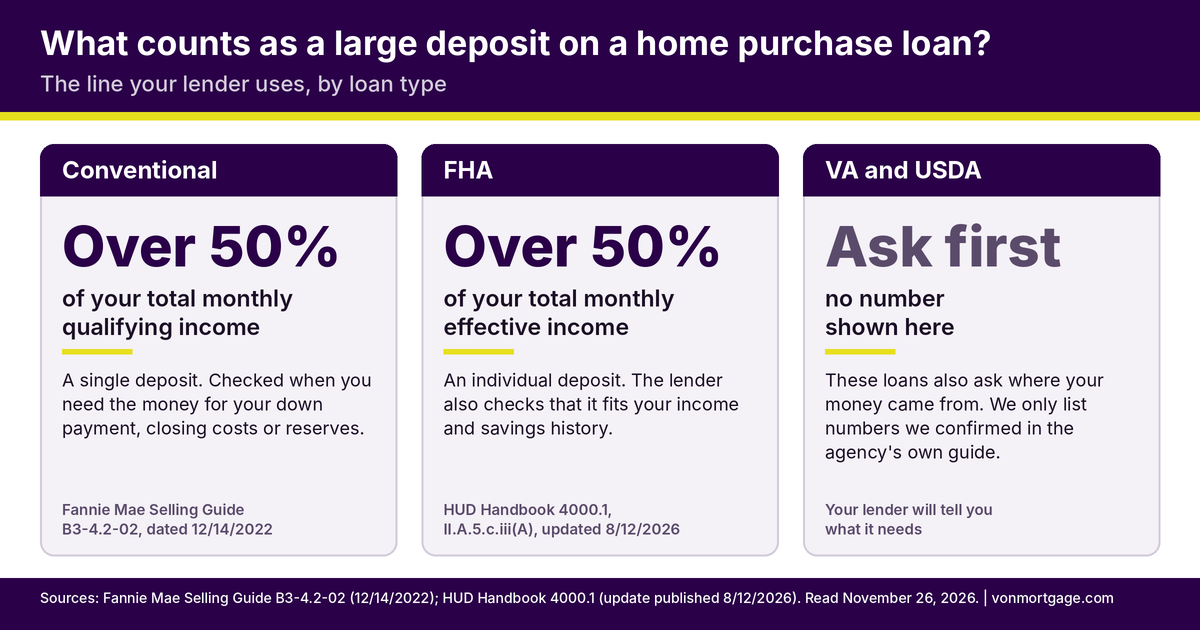
For a conventional purchase loan, a large deposit is any single deposit over 50% of your total monthly qualifying income (Fannie Mae Selling Guide B3-4.2-02, dated 12/14/2022). FHA uses 50% of your total monthly effective income (HUD Handbook 4000.1, updated 8/12/2026). If you need that money to close, your lender documents where it came from, usually with a short signed letter and statements.
By Pete Metz, mortgage broker at Von Mortgage in Redding, California, NMLS #260571. Updated November 2026.
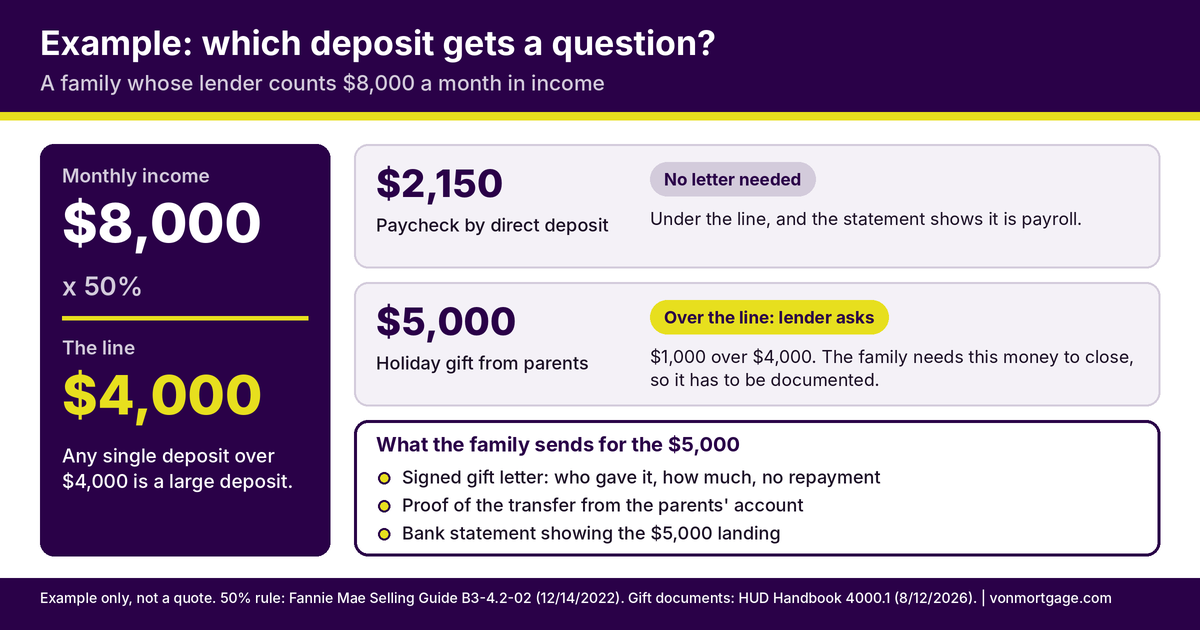
How much is a large deposit if your family earns $8,000 a month?
Anything over $4,000 in a single deposit. That is 50% of $8,000. This is an example, not a quote.
Qualifying income is the monthly income your lender counts to approve the loan, before taxes. Ask your lender which number it is using.
So in this example, a $5,000 gift from your parents is a large deposit. A $2,150 paycheck is not.
What is considered a large deposit for an FHA loan?
On an FHA loan, it is any individual deposit over 50% of your total monthly effective income. Effective income is FHA's name for the income your lender counts.
The lender has to get documentation for a deposit that size. It also checks that your deposits fit your income and savings history (HUD Handbook 4000.1, section II.A.5.c.iii(A), update published 8/12/2026).
This replaced an older FHA rule. Some pages online still show the old one.
| Loan type | What counts as large | What the lender does | Source and date |
|---|---|---|---|
| Conventional | Over 50% of total monthly qualifying income | Documents it when you need the money to close | Fannie Mae Selling Guide B3-4.2-02, dated 12/14/2022 |
| FHA | Over 50% of total monthly effective income | Documents it and checks your savings history | HUD Handbook 4000.1, section II.A.5.c.iii(A), update published 8/12/2026 |
| VA and USDA | No number listed here | Asks where deposits came from | Ask your lender |
VA and USDA loans follow similar sourcing rules, and your lender will ask about deposits. Different investors can also set tighter rules than the agency guides.
Does a large deposit matter if you don't need the money to close?
On a conventional purchase, it matters much less. Fannie Mae has the lender document a large deposit when the money is needed for your down payment, closing costs or reserves (B3-4.2-02, dated 12/14/2022). Reserves are savings you still have after closing.
If a large deposit is not documented, the lender subtracts the unexplained amount from your verified funds. Say you have $30,000 in the bank and $6,000 of it is unexplained. The lender counts $24,000. If you need $20,000 to close, you still have enough.
On an FHA loan, plan to document it either way.
How do you explain a large deposit to the underwriter?
You explain it with a short signed letter and the paper that backs it up. The underwriter is the person who reviews your file and signs off on the loan.
The letter is a few plain sentences. It says:
- The date and amount of the deposit
- Which account it went into
- Where the money came from
- Whether you have to pay it back
Sign it and date it. Then attach proof that matches. If you sold a car, send the bill of sale and a copy of the check.
The best time to do this is at pre-approval, before you write an offer. A deposit found late can add to how long it takes to close.
What if family gives you cash over the holidays while you're in escrow?
Ask them to send it by check or bank transfer, and tell your lender before it lands. Escrow is the stretch between your accepted offer and closing day.
Money from family is a gift, and a gift needs a gift letter. On an FHA loan, the giver and you both sign it. It lists the giver's name, address and phone number, how you are related, the amount, and that you don't have to pay it back. The lender also needs proof of the transfer (HUD Handbook 4000.1, update published 8/12/2026).
Actual cash is the hard one. FHA does not accept a giver's cash on hand, meaning money kept outside a bank, as the source of a gift.
A gift of equity, where a relative sells you their home for less than it is worth, is a different kind of family gift.
Which deposits don't need a letter?
Deposits that explain themselves on the bank statement don't need a letter. Fannie Mae's examples are a payroll direct deposit, Social Security, an IRS or state tax refund, and a transfer between your own verified accounts (B3-4.2-02, dated 12/14/2022).
Bank statement loans work differently, because your deposits are counted as income. See what underwriting asks for on a bank statement loan.
What else do families ask about large deposits?
Three more questions come up: cash, moving money and loan size.
Is a cash deposit harder to source than a transfer?
Yes. A transfer leaves a record at both banks, and cash does not. On an FHA loan, cash you kept at home has to be deposited, and you explain how you saved it and how long it took (HUD Handbook 4000.1, update published 8/12/2026).
Should I move money between accounts before I apply?
You don't have to, and it is simpler to leave it where it is. If you do move money, keep the statements for both accounts. A transfer between your own verified accounts that shows on the statement does not need a letter (Fannie Mae Selling Guide B3-4.2-02, dated 12/14/2022).
Does a large deposit raise how much I can borrow?
No. Your loan size comes from your income, your debts and your credit. A documented deposit counts toward your down payment, closing costs or reserves. A bigger down payment means a smaller loan on the same home.
Have a deposit you're not sure about? Request a quote and we'll look at it with you, or start your application when you're ready. Buying your first home? Start with our first-time homebuyer page. If your situation doesn't fit what's here, reach out to Pete Metz, mortgage broker at Von Mortgage, NMLS #260571.
Sources
- Fannie Mae Selling Guide, B3-4.2-02, Depository Accounts, dated 12/14/2022. Large deposit definition (a single deposit over 50% of total monthly qualifying income), purchase rules, the unsourced amount subtracted from verified funds, and deposits identified on the statement. Read November 26, 2026. selling-guide.fanniemae.com/sel/b3-4.2-02/depository-accounts
- HUD Handbook 4000.1, FHA Single Family Housing Policy Handbook, update published August 12, 2026 (FHA INFO 2026-18). Checking and Savings Accounts, sections II.A.4.d.iii(A) (TOTAL) and II.A.5.c.iii(A) (Manual): documentation for individual deposits over 50% of total monthly Effective Income, and the income and savings history check. Same Sources of Funds section group: Cash on Hand and Gifts (gift letter contents, transfer documents; cash on hand is not an acceptable source of donor gift funds). Read November 26, 2026. hud.gov/hud-partners/single-family-handbook-4000-1
- Worked examples ($8,000 income and a $4,000 line; $30,000 in the bank with $6,000 unexplained): Von Mortgage arithmetic from the rules above. Examples only.
Disclaimer: This information is educational and is not a commitment to lend, a loan approval, or an offer of credit. Any rates, payments, down payments or other figures shown are illustrative examples only, not quoted terms and not an offer to extend credit. Actual rates and terms depend on credit, income, property, occupancy and market conditions, and change daily. For current pricing see vonmortgage.com/rates.
Pete Metz, Mortgage Broker · NMLS #260571
Dream Big Ownership LLC dba Von Mortgage Company · NMLS #2592815
Loans made or arranged pursuant to a California Financing Law license, #60DBO-195824.
2777 Bechelli Lane, Redding, CA 96002 · (530) 221-7700 · Pete@VonMortgage.com
Equal Housing Opportunity.
 Equal Housing Opportunity
Join the conversation
Comments are reviewed before they appear. Have a question about your own situation? Ask Pete directly — that stays private.
No comments yet